Get your free personalized podcast brief
We scan new podcasts and send you the top 5 insights daily.
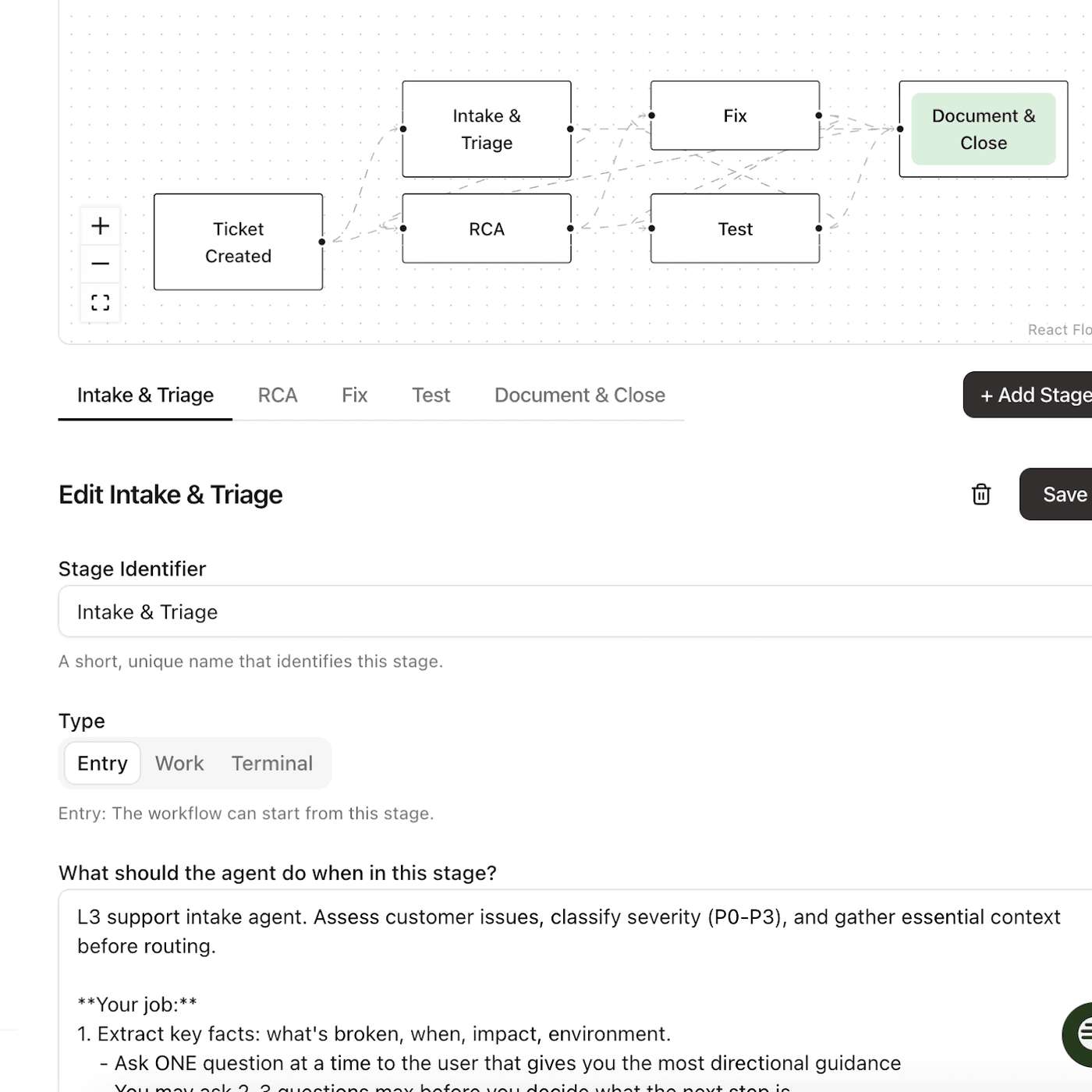
Treating AI as a personal assistant solves individual tasks but not team coordination. The solution is to deploy "AI Teammates"—integrated agents with specific roles, permissions, and the ability to work with multiple stakeholders within a shared workflow, autonomously moving projects forward.
Related Insights
Don't think of AI as replacing roles. Instead, envision a new organizational structure where every human employee manages a team of their own specialized AI agents. This model enhances individual capabilities without eliminating the human team, making everyone more effective.

To build a useful multi-agent AI system, model the agents after your existing human team. Create specialized agents for distinct roles like 'approvals,' 'document drafting,' or 'administration' to replicate and automate a proven workflow, rather than designing a monolithic, abstract AI.
Early AI adoption by PMs is often a 'single-player' activity. The next step is a 'multiplayer' experience where the entire team operates from a shared AI knowledge base, which breaks down silos by automatically signaling dependencies and overlapping work.

The next evolution of work will involve humans acting as orchestrators for "swarms" of specialized AI agents. A manager will direct a team of agents—each trained for a specific function like email marketing or media buying—to collaboratively execute complex projects with high levels of autonomy.

The next evolution for autonomous agents is the ability to form "agentic teams." This involves creating specialized agents for different tasks (e.g., research, content creation) that can hand off work to one another, moving beyond a single user-to-agent relationship towards a system of collaborating AIs.

The next frontier for AI isn't just personal assistants but "teammates" that understand an entire team's dynamics, projects, and shared data. This shifts the focus from single-user interactions to collaborative intelligence by building a knowledge graph connecting people and their work.

Instead of a monolithic AI, create a team of agents with specific roles (e.g., 'Debbie the assistant,' 'Soren the engineer'). This human-like model makes it easier to manage capabilities, control access, and conceptualize the system's functions because it maps to our innate understanding of human teams.

Instead of creating one monolithic "Ultron" agent, build a team of specialized agents (e.g., Chief of Staff, Content). This parallels existing business mental models, making the system easier for humans to understand, manage, and scale.

To maximize an AI agent's effectiveness, treat it like a team member, not just a tool. Integrate it directly into your company's communication and project management systems (like Slack). This ensures the agent has the full context necessary to perform its tasks.

The AI agent is designed to act like a human team member within existing systems. It performs bi-directional updates in tools like Jira or Linear—adding comments, changing statuses, and assigning tickets. This seamless integration ensures human teams maintain visibility and that established processes aren't disrupted.