Get your free personalized podcast brief
We scan new podcasts and send you the top 5 insights daily.
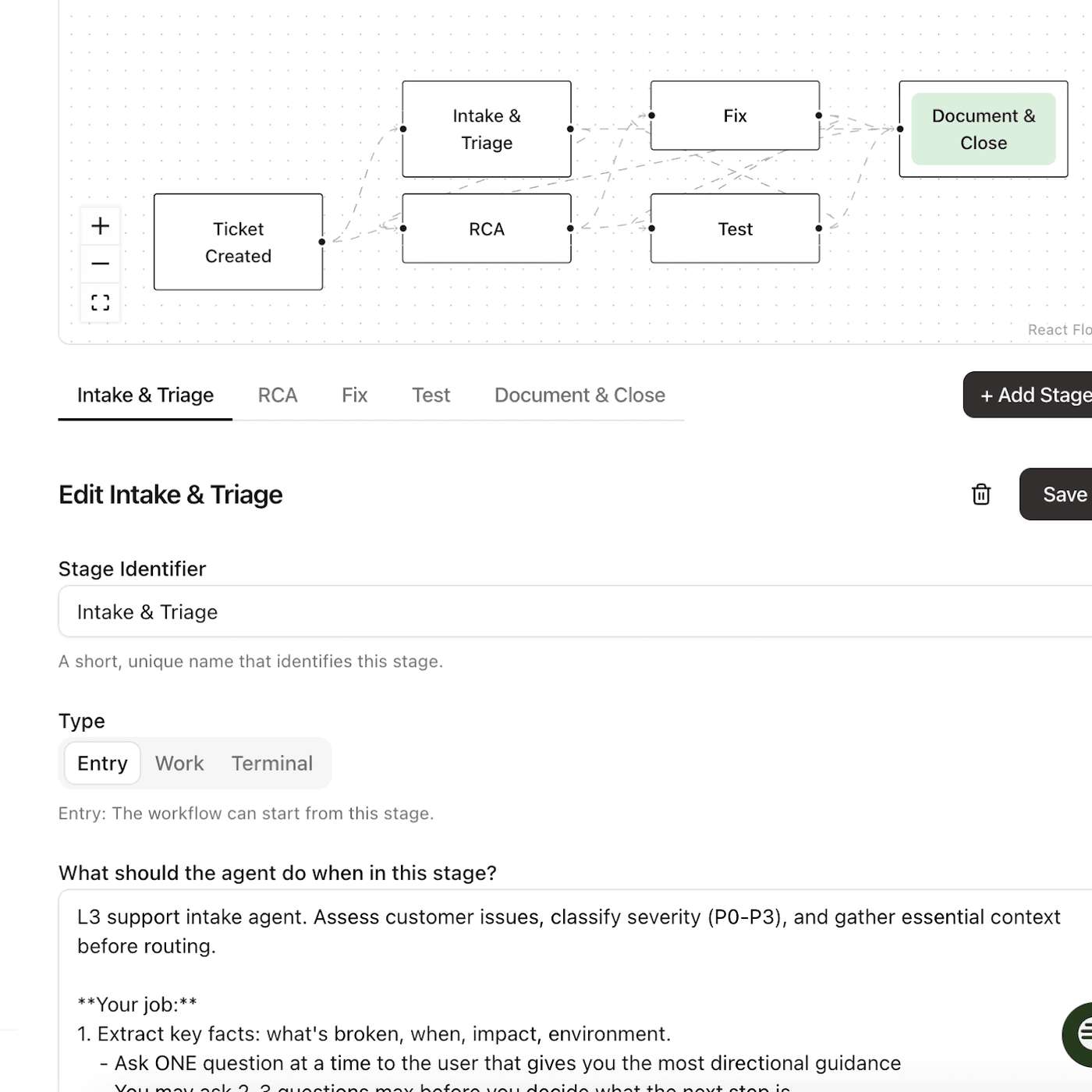
The AI agent is designed to act like a human team member within existing systems. It performs bi-directional updates in tools like Jira or Linear—adding comments, changing statuses, and assigning tickets. This seamless integration ensures human teams maintain visibility and that established processes aren't disrupted.
Related Insights
Because LLMs are non-deterministic like humans, it's more effective to integrate them using existing human-centric processes. Give an agent an email, permissions, and "onboarding" so it can navigate the organization like an employee, rather than building complex new software interfaces.

Integrate AI agents directly into core workflows like Slack and institutionalize them as the "first line of response." By tagging the agent on every new bug, crash, or request, it provides an initial analysis or pull request that humans can then review, edit, or build upon.
Instead of forcing teams to adopt entirely new processes, Atlassian is integrating agentic capabilities into familiar tools like Jira. Allowing users to assign a standard work item to an AI agent minimizes disruption and friction, accelerating adoption by enhancing, rather than replacing, established workflows.

Project management tools like Jira are not obsolete; they are positioned to become the coordination layer for AI agents. As autonomous agents work together on complex tasks, they will require standardized, headless systems for project management and knowledge sharing, creating a new market for agent coordination.
Building a bespoke communication layer for multiple AI agents is a complex "scaffolding" problem. A simpler, more direct solution is to treat agents as digital coworkers, assigning them accounts on existing platforms like Slack or Google Docs, enabling them to interact using established human workflows.

User workflows rarely exist in a single application; they span tools like Slack, calendars, and documents. A truly helpful AI must operate across these tools, creating a unified "desired path" that reflects how people actually work, rather than being confined by app boundaries.

Prioritize using AI to support human agents internally. A co-pilot model equips agents with instant, accurate information, enabling them to resolve complex issues faster and provide a more natural, less-scripted customer experience.

To maximize an AI agent's effectiveness, treat it like a team member, not just a tool. Integrate it directly into your company's communication and project management systems (like Slack). This ensures the agent has the full context necessary to perform its tasks.
The paradigm shift with AI agents is from "tools to click buttons in" (like CRMs) to autonomous systems that work for you in the background. This is a new form of productivity, akin to delegating tasks to a team member rather than just using a better tool yourself.

To drive adoption of AI agents, don't force users into a new application. Instead, integrate the agent directly into their existing collaboration tools like Slack. This approach reduces friction and makes the agent feel like a natural part of the team, leading to higher engagement and user satisfaction.
