Get your free personalized podcast brief
We scan new podcasts and send you the top 5 insights daily.
Art is a mechanism for changing perception. It often makes audiences uncomfortable at first by introducing a novel idea or form. Over time, great art guides people from that initial discomfort to a new state of understanding, fundamentally altering how they see the world.

Related Insights
The most effective ideas are not the most outlandish. Human psychology craves both novelty and familiarity simultaneously. Truly successful creative work, from marketing to scientific research, finds the perfect balance between being innovative and being grounded in something the audience already understands.

The pursuit of pure originality is often a status game that leads to incomprehensible ideas. A more effective approach is to see originality as a new way to show people an old, constant truth. This re-frames innovation as a novel form of derivation, making it more accessible and relatable.
![Wolfgang Hammer - The Power of Story - [Invest Like the Best, EP.447] thumbnail](https://megaphone.imgix.net/podcasts/adaa55e4-bead-11f0-a5d6-a799713dc0a0/image/a76713c3a8fb2abf443f9164703734c5.jpg?ixlib=rails-4.3.1&max-w=3000&max-h=3000&fit=crop&auto=format,compress)
The value of an artwork isn't measured by the hours it took to create, but by the artist's entire life's work and perspective. A seemingly simple piece gains meaning from the decades of thought the artist brings to it, shifting the focus from labor to accumulated wisdom.
Great artists and thinkers don't necessarily have unique ideas. Instead, they possess the courage and self-esteem to grant significance to the common, relatable thoughts that most people dismiss. In their work, we find our own neglected ideas finally given legitimacy.

Citing Kurt Vonnegut, the host and artist agree that the best creative work uses entertainment as a vehicle for delivering deeper insights. Rather than just being fun, its purpose is to inform and share experiences, making complex ideas accessible and memorable for the audience.
Awe is not just appreciating beauty; it's a cognitive process defined by encountering vast mysteries that require a "need for accommodation." This means you must rearrange your existing knowledge structures and mental models to make sense of the new, incomprehensible experience.

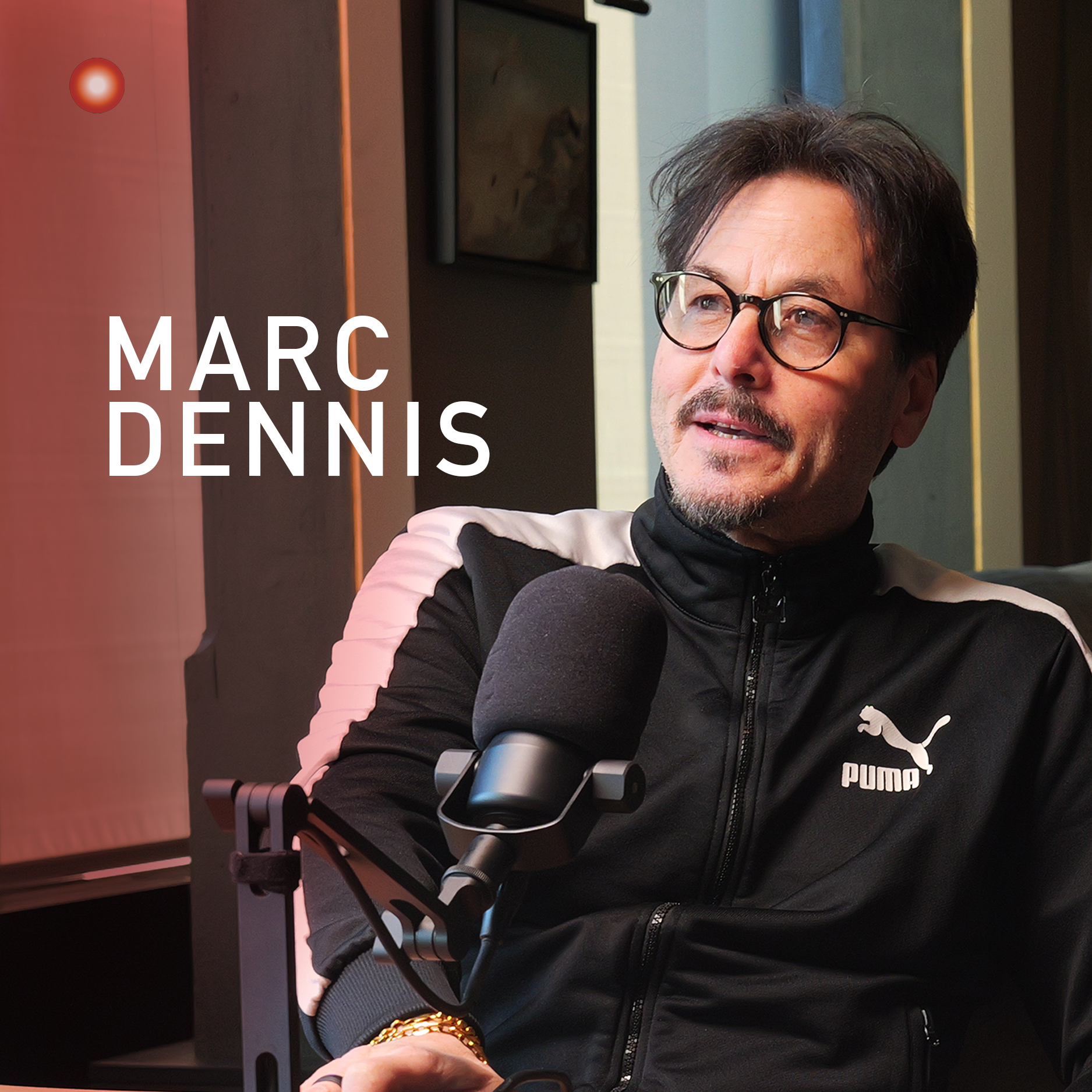
Marc Dennis states his purpose is not self-expression or personal catharsis. Instead, he aims to create work that entertains others, providing a mirror for them to reflect upon and discover parts of themselves within his art. His success is measured by the audience's self-discovery.
A story's core mechanic for engagement is not just emotion, but the constant betrayal of the audience's expectations. People are drawn to narratives, jokes, and songs precisely because they want their predictions about what happens next to be wrong. This element of surprise is what makes a story satisfying and compels an audience to continue.
Dennis creates "paintings within paintings" to challenge perception. Inspired by Wile E. Coyote and a real-life museum experience, his work makes the viewer's interaction part of the art itself, creating a nested, self-aware narrative that questions the relationship between art and its audience.
Improving imagination is less like a painter adding to a blank canvas and more like a sculptor removing material. The primary task is to forget expected answers and consensus reality. This subtractive process uncovers the truly novel ideas that are otherwise obscured by convention.
![Kevin Kelly - Be Generous and Unique - [Invest Like the Best, CLASSICS] thumbnail](https://megaphone.imgix.net/podcasts/9e957b1c-b60e-11f0-8fae-c3720ebd149d/image/fe443cb4b0d58f10dbccb1cf43a6abe2.jpg?ixlib=rails-4.3.1&max-w=3000&max-h=3000&fit=crop&auto=format,compress)