Get your free personalized podcast brief
We scan new podcasts and send you the top 5 insights daily.
The next frontier for AI in product is automating time-consuming but cognitively simple tasks. An AI agent can connect CRM data, customer feedback, and product specs to instantly generate a qualified list of beta testers, compressing a multi-week process into days.

Related Insights
The evolution of 'agentic AI' extends beyond content generation to automating the connective tissue of business operations. Its future value is in initiating workflows that span departments, such as kickstarting creative briefs for marketing, creating product backlogs from feedback, and generating service tickets, streamlining operational handoffs.

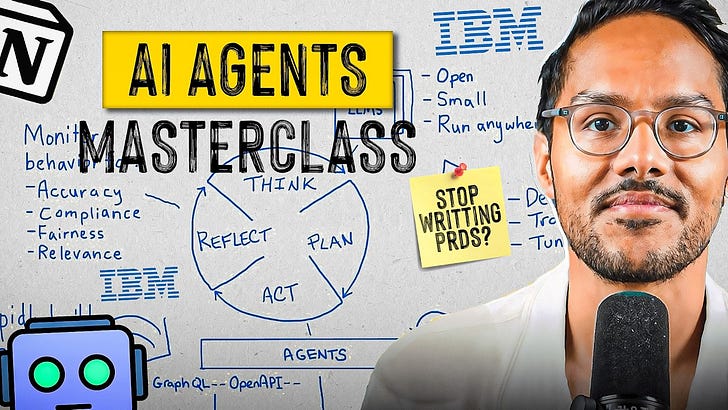
AI agents will automate PM tasks like competitive analysis, user feedback synthesis, and PRD writing. This efficiency gain could shift the standard PM-to-developer ratio from 1:6-10 to 1:20-30, allowing PMs to cover a much broader product surface area and focus on higher-level strategy.
To successfully automate complex workflows with AI, product teams must go beyond traditional discovery. A "forward-deployed PM" works on-site with customers, directly observing workflows and tweaking AI parameters like context windows and embeddings in real-time to achieve flawless automation.

The most significant productivity gains come from applying AI to every stage of development, including research, planning, product marketing, and status updates. Limiting AI to just code generation misses the larger opportunity to automate the entire engineering process.

AI automates tactical tasks, shifting the PM's role from process management to de-risking delivery by developing deep customer insights. This allows PMs to spend more time confirming their instincts about customer needs, which engineering teams now demand.

Go beyond just generating documents. PM Dennis Yang uses an AI agent in Cursor to read comments on a Confluence PRD, categorize them by priority, draft responses, and post them on his behalf. This automates the tedious but critical process of acknowledging and incorporating feedback.

Instead of focusing on foundational models, software engineers should target the creation of AI "agents." These are automated workflows designed to handle specific, repetitive business chores within departments like customer support, sales, or HR. This is where companies see immediate value and are willing to invest.

Instead of a multi-week process involving PMs and engineers, a feature request in Slack can be assigned directly to an AI agent. The AI can understand the context from the thread, implement the change, and open a pull request, turning a simple request into a production feature with minimal human effort.

The paradigm shift with AI agents is from "tools to click buttons in" (like CRMs) to autonomous systems that work for you in the background. This is a new form of productivity, akin to delegating tasks to a team member rather than just using a better tool yourself.

Contrary to the belief that PMs are the earliest tech adopters, go-to-market functions (sales, marketing, support) are leading agent adoption. Their work involves frequently recurring, pattern-based tasks that are a perfect fit for automation, putting them ahead of the curve.