Get your free personalized podcast brief
We scan new podcasts and send you the top 5 insights daily.
AI automates tactical tasks, shifting the PM's role from process management to de-risking delivery by developing deep customer insights. This allows PMs to spend more time confirming their instincts about customer needs, which engineering teams now demand.

Related Insights
The ultimate vision for AI in product isn't just generating specs. It's creating a dynamic knowledge base where shipping a product feeds new data back into the system, continuously updating the company's strategic context and improving all future decisions.

AI agents will automate PM tasks like competitive analysis, user feedback synthesis, and PRD writing. This efficiency gain could shift the standard PM-to-developer ratio from 1:6-10 to 1:20-30, allowing PMs to cover a much broader product surface area and focus on higher-level strategy.
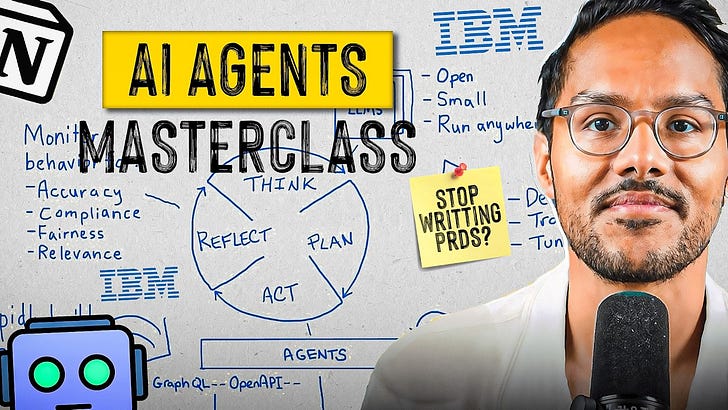
Generative AI's most immediate impact for product managers isn't just writing user stories. It's consolidating disparate information sources into a single interface, freeing up the cognitive load wasted on context switching and allowing for deeper strategic thinking.
By creating a central repository infused with company strategy and market data, AI tools can help junior PMs produce assets with the same contextual depth as a 20-year veteran, democratizing product intuition and standardizing quality across the team.
The next frontier for AI in product is automating time-consuming but cognitively simple tasks. An AI agent can connect CRM data, customer feedback, and product specs to instantly generate a qualified list of beta testers, compressing a multi-week process into days.
Historically, resource-intensive prototyping (requiring designers and tools like Figma) was reserved for major features. AI tools reduce prototype creation time to minutes, allowing PMs to de-risk even minor features with user testing and solution discovery, improving the entire product's success rate.

Instead of holding context for multiple projects in their heads, PMs create separate, fully-loaded AI agents (in Claude or ChatGPT) for each initiative. These "brains" are fed with all relevant files and instructions, allowing the PM to instantly get up to speed and work more efficiently.
Product managers often hit cognitive fatigue from constantly re-formatting the same core information for different audiences (e.g., customer notes to PRD, PRD to Jira tickets, tickets to executive summaries). Automating this "translation" work with AI frees up mental energy for higher-value strategic tasks and prevents lazy, context-poor handoffs.

The traditional tasks of a product manager—writing specs, building plans, prototyping—are being automated by AI. The role will likely evolve into a hybrid "Experience Engineer" who combines product, design, and engineering skills to build experiences, or a highly commercial "GM" role with direct P&L responsibility.

As AI automates synthesis and creation, the product manager's core value shifts from managing the development process to deeply contextualizing all available information (market, customer, strategy) to define the *right* product direction.