Get your free personalized podcast brief
We scan new podcasts and send you the top 5 insights daily.
For field trials, Rainbird creates 'production intent' parts using 'soft tooling'—cheaper, lower-volume molds made from softer steel. Unlike 3D prints, these parts have the same manufacturing limitations as the final product, providing far more realistic feedback on form, fit, and durability before investing in expensive production molds.

Related Insights
At NASA, the design process involves building multiple quick prototypes and deliberately failing them to learn their limits. This deep understanding, gained through intentional destruction, is considered essential before attempting to build the final, mission-critical version of a component like those on the Mars Rover.

At Rainbird, engineers build the first 'production intent' units for field trials themselves, on the actual assembly line. This serves two critical functions: it produces the necessary test units and simultaneously allows the engineering team to validate and debug the manufacturing process before scaling up.
Atomic Industries is scaling its manufacturing operations by creating a bifurcated factory system. Its first facility is dedicated solely to designing and creating molds. These molds are then shipped to a second, larger facility focused exclusively on high-volume part production, optimizing the workflow for both complex tooling and mass manufacturing.

Instead of starting with a blank slate, Nike's team prototypes new ideas by physically cutting and modifying existing products. This "cobbling" method enables rapid, low-cost testing of core concepts before investing in new designs and expensive molds, allowing them to fail fast and forward.

Boom Supersonic accelerates development by manufacturing its own parts. This shrinks the iteration cycle for a component like a turbine blade from 6-9 months (via an external supplier) to just 24 hours. This rapid feedback loop liberates engineers from "analysis paralysis" and allows them to move faster.

Unconventional AI operates as a "practical research lab" by explicitly deferring manufacturing constraints during initial innovation. The focus is purely on establishing "existence proofs" for new ideas, preventing premature optimization from killing potentially transformative but difficult-to-build concepts.

In design thinking, early prototypes aren't for validating a near-finished product. They are rough, low-cost "artifacts" (like bedsheets for walls) designed to help stakeholders vividly pre-experience a new reality. This generates more accurate feedback and invites interaction before significant investment.
Rainbird live-streamed customer focus groups back to its engineering team. This allowed engineers to hear feedback directly, eliminating skepticism and creating immediate alignment on necessary design changes without requiring them to travel.
Anduril's R&D building houses machine shops, labs, and a 'dev test area' designed specifically to break products. By putting engineers across the parking lot from facilities that can rapidly prototype and test for failures (e.g., saltwater corrosion, vibration), they create an extremely tight feedback loop, speeding up iteration.
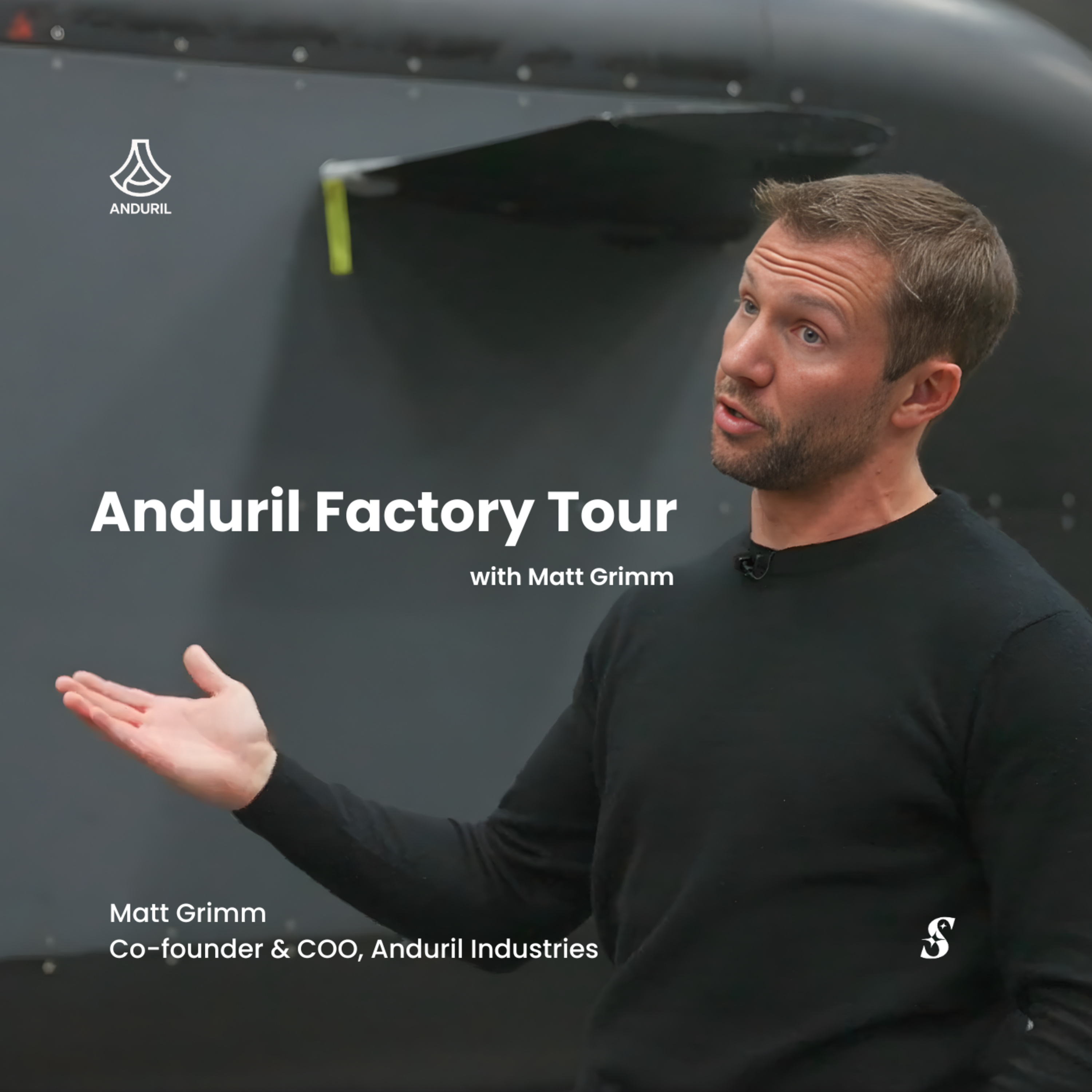
Anduril prototypes drone frames by milling them from solid metal blocks. While extremely wasteful and expensive for mass production, this method bypasses the slow and costly process of creating molds for casting, drastically reducing latency during the critical iterative design phase and getting products to market faster.