Get your free personalized podcast brief
We scan new podcasts and send you the top 5 insights daily.
Atomic Industries is scaling its manufacturing operations by creating a bifurcated factory system. Its first facility is dedicated solely to designing and creating molds. These molds are then shipped to a second, larger facility focused exclusively on high-volume part production, optimizing the workflow for both complex tooling and mass manufacturing.

Related Insights
Hardware development is often stalled by supplier lead times. To combat this, proactively map out multiple, redundant manufacturing options for every component. By maintaining a constantly updated "lookup table" of suppliers, processes, and their current lead times, teams can parallelize workflows and minimize downtime.

Tesla's most profound competitive advantage is not its products but its mastery of manufacturing processes. By designing and building its own production line machinery, the company achieves efficiencies and innovation cycles that competitors relying on third-party equipment cannot match. This philosophy creates a deeply defensible moat.

The push to build defense systems in America reveals that critical sub-components, like rocket motors or high-powered amplifiers, are no longer manufactured domestically at scale. This forces new defense companies to vertically integrate and build their own factories, essentially rebuilding parts of the industrial base themselves.

To build a new American semiconductor foundry by 2028, Substrate is rejecting the modern specialized model. Instead, it's vertically integrating by designing and building its own lithography tools. This return to the industry's roots is aimed at reducing complexity and cost, enabling them to move faster.

A business's core function is to become a system for repetition. This starts by finding one customer with strong demand, delivering a supply that fits perfectly, and documenting that success. The entire business then becomes a 'factory' optimized to find and replicate that initial case study.

Boom Supersonic accelerates development by manufacturing its own parts. This shrinks the iteration cycle for a component like a turbine blade from 6-9 months (via an external supplier) to just 24 hours. This rapid feedback loop liberates engineers from "analysis paralysis" and allows them to move faster.

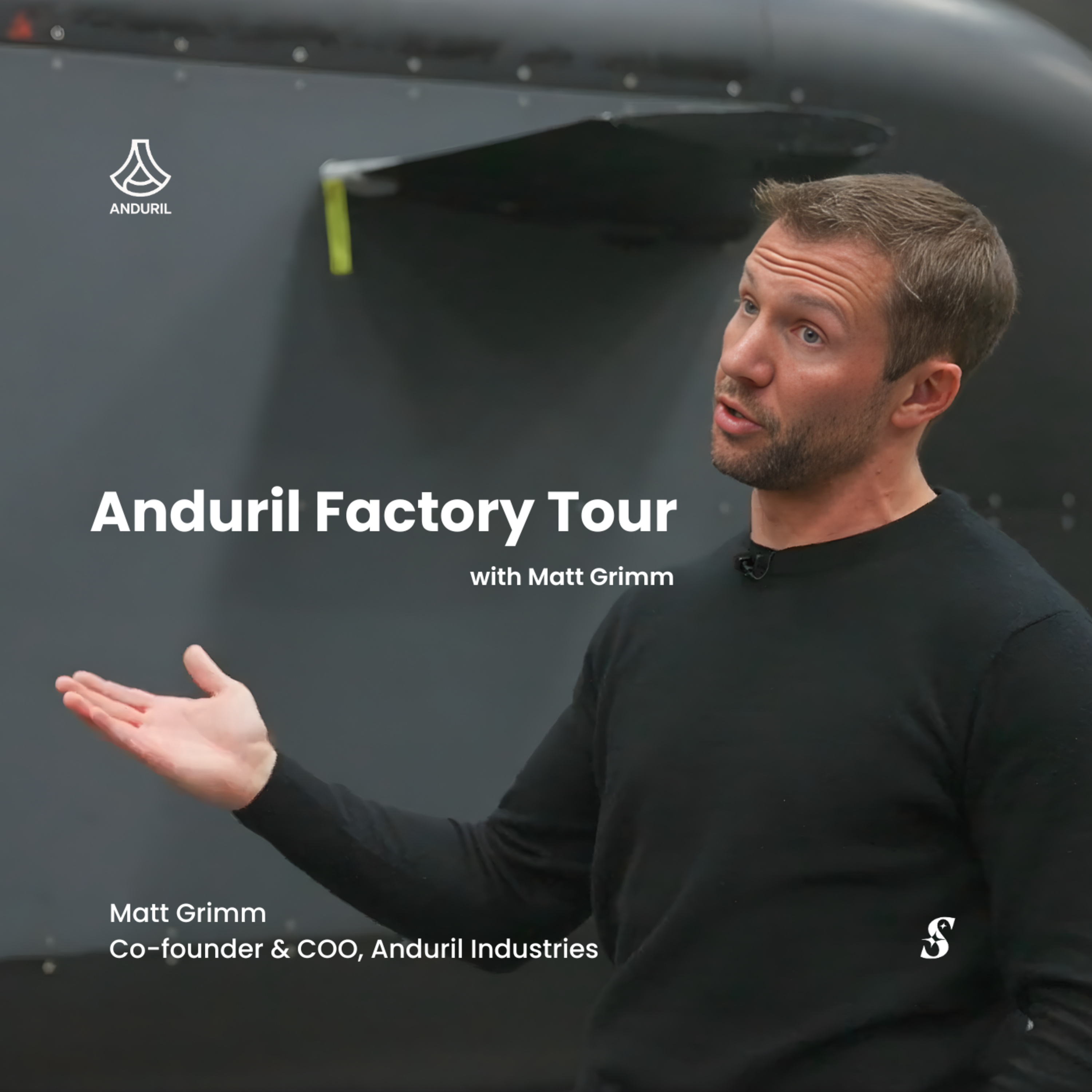
Anduril's R&D building houses machine shops, labs, and a 'dev test area' designed specifically to break products. By putting engineers across the parking lot from facilities that can rapidly prototype and test for failures (e.g., saltwater corrosion, vibration), they create an extremely tight feedback loop, speeding up iteration.
A startup's core function is to find one successful, repeatable customer 'case study' and then build a factory (pipeline, sales, delivery) to replicate it at scale. This manufacturing-based mental model prevents random acts of improvement and helps founders apply concepts like bottleneck theory to know exactly where to focus their efforts for maximum impact.
When Shelter Skin's first shipment melted in transit, their vertically integrated model was a lifesaver. They could immediately change product seals and packaging. Had they outsourced to a lab, they would have been stuck with 10,000 faulty units and a potential $150,000 loss.

Anduril prototypes drone frames by milling them from solid metal blocks. While extremely wasteful and expensive for mass production, this method bypasses the slow and costly process of creating molds for casting, drastically reducing latency during the critical iterative design phase and getting products to market faster.