Get your free personalized podcast brief
We scan new podcasts and send you the top 5 insights daily.
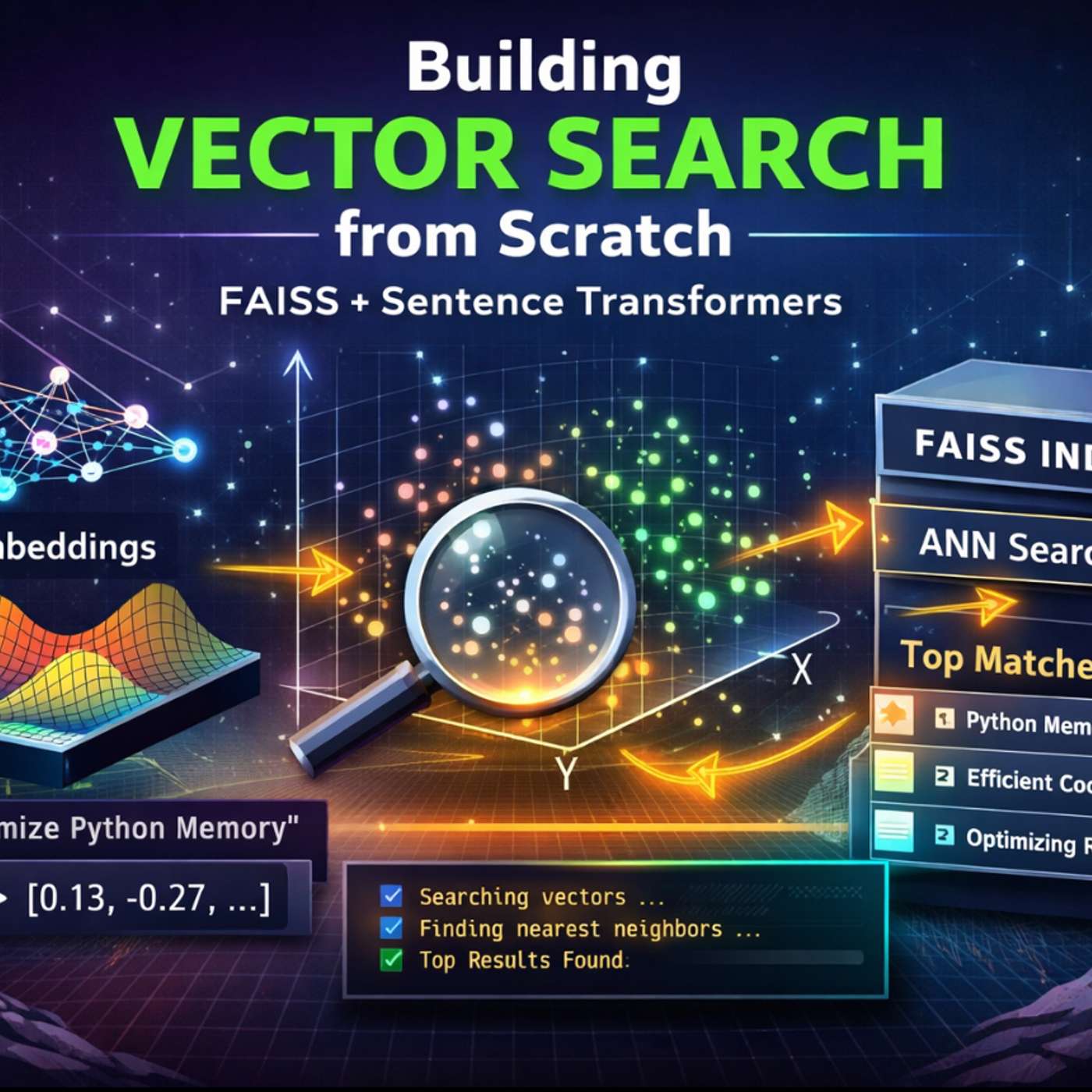
Retrieval Augmented Generation (RAG) uses vector search to find relevant documents based on a user's query. This factual context is then fed to a Large Language Model (LLM), forcing it to generate responses based on provided data, which significantly reduces the risk of "hallucinations."
Related Insights
To avoid AI hallucinations, Square's AI tools translate merchant queries into deterministic actions. For example, a query about sales on rainy days prompts the AI to write and execute real SQL code against a data warehouse, ensuring grounded, accurate results.

Benchmarking revealed no strong correlation between a model's general intelligence and its tendency to hallucinate. This suggests that a model's "honesty" is a distinct characteristic shaped by its post-training recipe, not just a byproduct of having more knowledge.

Instead of building a single, monolithic AI agent that uses a vast, unstructured dataset, a more effective approach is to create multiple small, precise agents. Each agent is trained on a smaller, more controllable dataset specific to its task, which significantly reduces the risk of unpredictable interpretations and hallucinations.

According to IBM's AI Platform VP, Retrieval-Augmented Generation (RAG) was the killer app for enterprises in the first year after ChatGPT's release. RAG allows companies to connect LLMs to their proprietary structured and unstructured data, unlocking immense value from existing knowledge bases and proving to be the most powerful initial methodology.
While vector search is a common approach for RAG, Anthropic found it difficult to maintain and a security risk for enterprise codebases. They switched to "agentic search," where the AI model actively uses tools like grep or find to locate code, achieving similar accuracy with a cleaner deployment.

Teams often agonize over which vector database to use for their Retrieval-Augmented Generation (RAG) system. However, the most significant performance gains come from superior data preparation, such as optimizing chunking strategies, adding contextual metadata, and rewriting documents into a Q&A format.

AEO is not about getting into an LLM's training data, which is slow and difficult. Instead, it focuses on Retrieval-Augmented Generation (RAG)—the process where the LLM performs a live search for current information. This makes AEO a real-time, controllable marketing channel.

Traditional benchmarks incentivize guessing by only rewarding correct answers. The Omniscience Index directly combats hallucination by subtracting points for incorrect factual answers. This creates a powerful incentive for model developers to train their systems to admit when they lack knowledge, improving reliability.
Classic RAG involves a single data retrieval step. Its evolution, "agentic retrieval," allows an AI to perform a series of conditional fetches from different sources (APIs, databases). This enables the handling of complex queries where each step informs the next, mimicking a research process.

Unlike general-purpose LLMs, Google's NotebookLM exclusively uses your uploaded source materials (docs, transcripts, videos) to answer queries. This prevents hallucinations and allows marketing teams to create a reliable, searchable knowledge base for onboarding, product launches, and content strategy.
