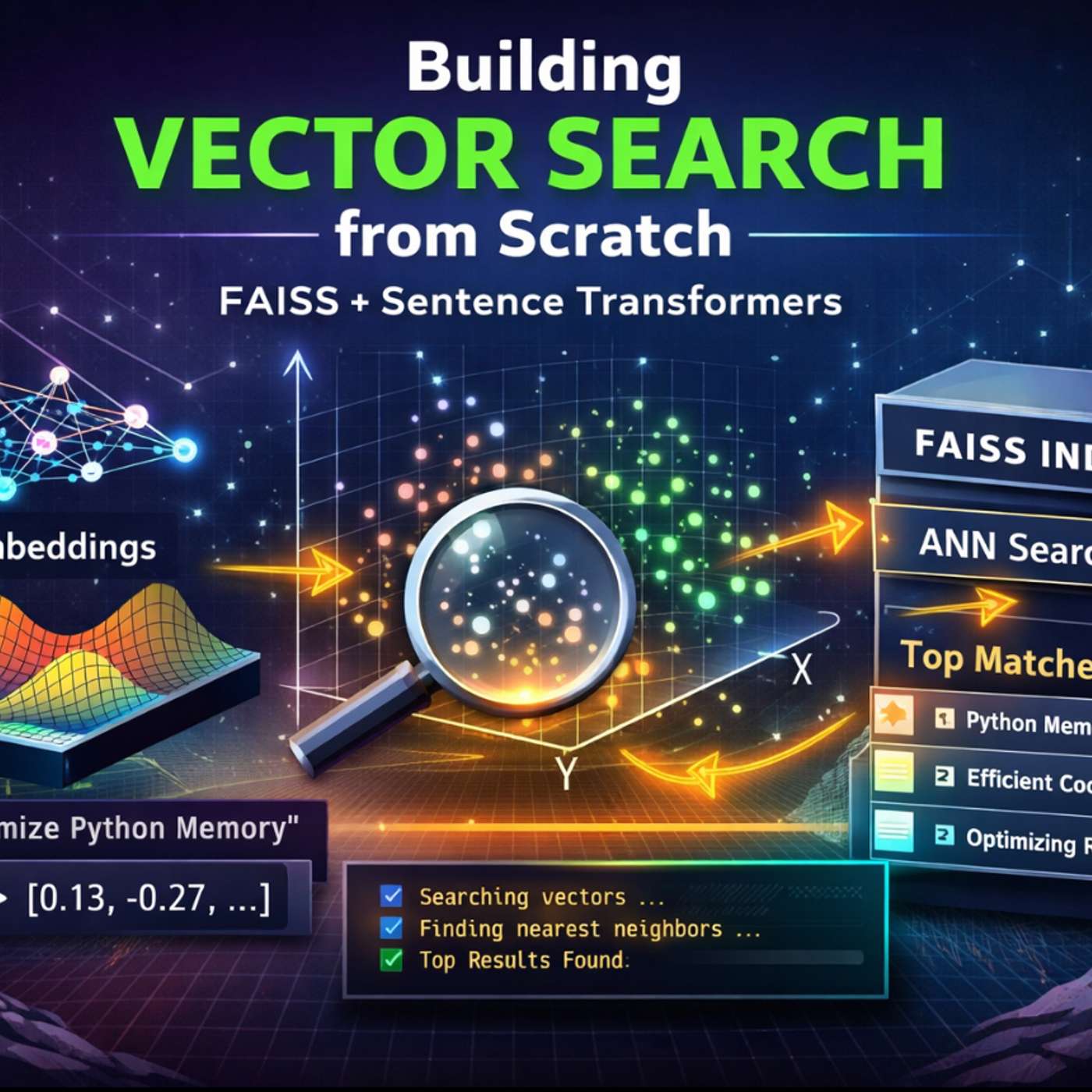
Retrieval Augmented Generation (RAG) uses vector search to find relevant documents based on a user's query. This factual context is then fed to a Large Language Model (LLM), forcing it to generate responses based on provided data, which significantly reduces the risk of "hallucinations."
Systems like FAISS are optimized for vector similarity search and do not store the original data. Engineers must build and maintain a separate system to map the returned vector IDs back to the actual documents or metadata, a crucial step for production applications.
For millions of vectors, exact search (like a FAISS flat index) is too slow. Production systems use Approximate Nearest Neighbor (ANN) algorithms which trade a small amount of accuracy for orders-of-magnitude faster search performance, making large-scale applications feasible.
Managed vector databases are convenient, but building a search engine from scratch using a library like FAISS provides a deeper understanding of index types, latency tuning, and memory trade-offs, which is crucial for optimizing AI systems.