Get your free personalized podcast brief
We scan new podcasts and send you the top 5 insights daily.
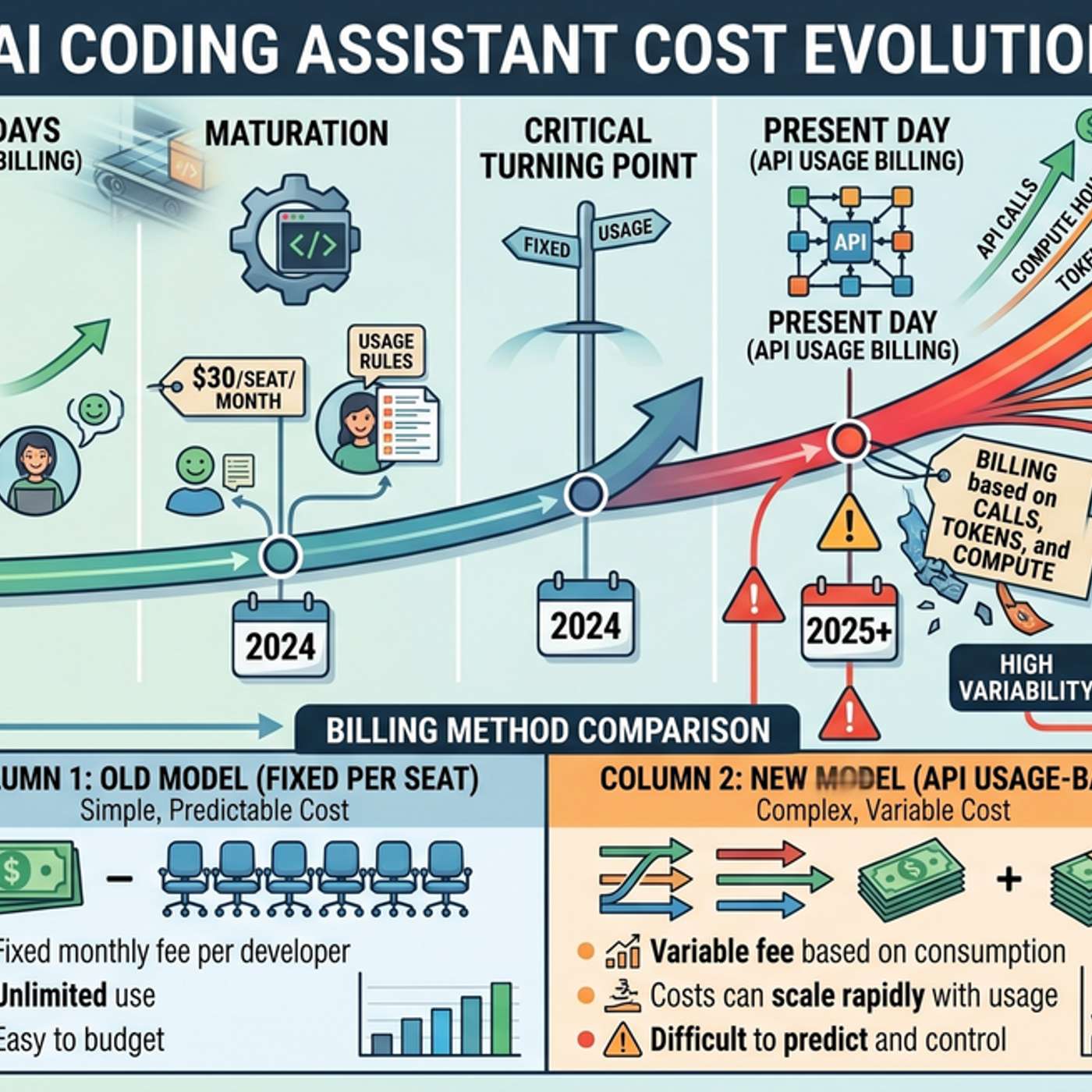
AI model providers are shifting from subsidized subscriptions to metered, usage-based pricing for their most powerful models. This forces go-to-market teams to stop experimenting freely and start rigorously calculating the ROI for each AI-powered workflow, as costs are now directly tied to usage.

Related Insights
For years, flat-rate AI subscriptions heavily subsidized power users, masking the true cost of token consumption. As providers shift to usage-based billing, this subsidy is ending. Enterprises now face "sticker shock" and must justify AI spend with clear ROI, moving from rampant experimentation to cost-conscious implementation.
![The AI Token Shortage Begins [AI Monthly Recap] thumbnail](https://d3t3ozftmdmh3i.cloudfront.net/staging/podcast_uploaded_nologo/41472609/41472609-1752234663609-8665756a468e5.jpg)
Flat-rate AI plans are becoming economically unviable due to token-hungry agents. Companies like Google and Microsoft are pushing usage-based billing, forcing enterprises to confront the surprisingly high real cost of running models at scale, which was previously hidden by subsidized pricing experiments.
Intense demand for AI tokens is outstripping compute supply, making flat-rate SaaS pricing unsustainable. Companies like GitHub are now shifting to usage-based billing to cover escalating inference costs, marking a fundamental change in how AI products are sold and signaling a broader industry trend.
The AI industry has shifted from a subsidized model to a "token shortage" era. This forces all companies, from AI providers to enterprise users like Uber, to prioritize cost-effective usage. Business models are now usage-based, making architectural and financial efficiency paramount.
The era of 'token maxing,' where enterprises used AI models without cost constraints, is ending. Companies like Microsoft are now scrutinizing the ROI of their AI spend, leading to budget cuts and a potential deceleration in the hyper-growth seen by model providers.

The dominant per-user-per-month SaaS business model is becoming obsolete for AI-native companies. The new standard is consumption or outcome-based pricing. Customers will pay for the specific task an AI completes or the value it generates, not for a seat license, fundamentally changing how software is sold.

The era of simple, flat-rate subscriptions for powerful AI tools is ending. Google's introduction of "compute-based usage limits" for its premium Ultra plan, even while lowering the base price, signals an industry-wide shift to hybrid models that combine a base subscription with usage-based charges for complex AI tasks.
Companies initially gamified AI use, leading to a "token maxing" culture. Now, facing enormous, unexpected bills, they are experiencing "sticker shock." This is forcing a strategic shift from encouraging maximum usage to demanding ROI calculations and finding the most cost-effective AI model for a given task.

The next major business model shift in software is from seat-based pricing to outcome-based pricing (e.g., paying per task completed). This favors AI-native newcomers, as incumbents will struggle to adapt their GTM and financial models.

Just as uncontrolled cloud spending in the 2010s spawned the FinOps field, the shift to consumption-based AI pricing will necessitate a similar discipline. This involves attributing costs to specific workloads, setting granular budgets, and providing real-time visibility to prevent budget overruns and measure ROI accurately.