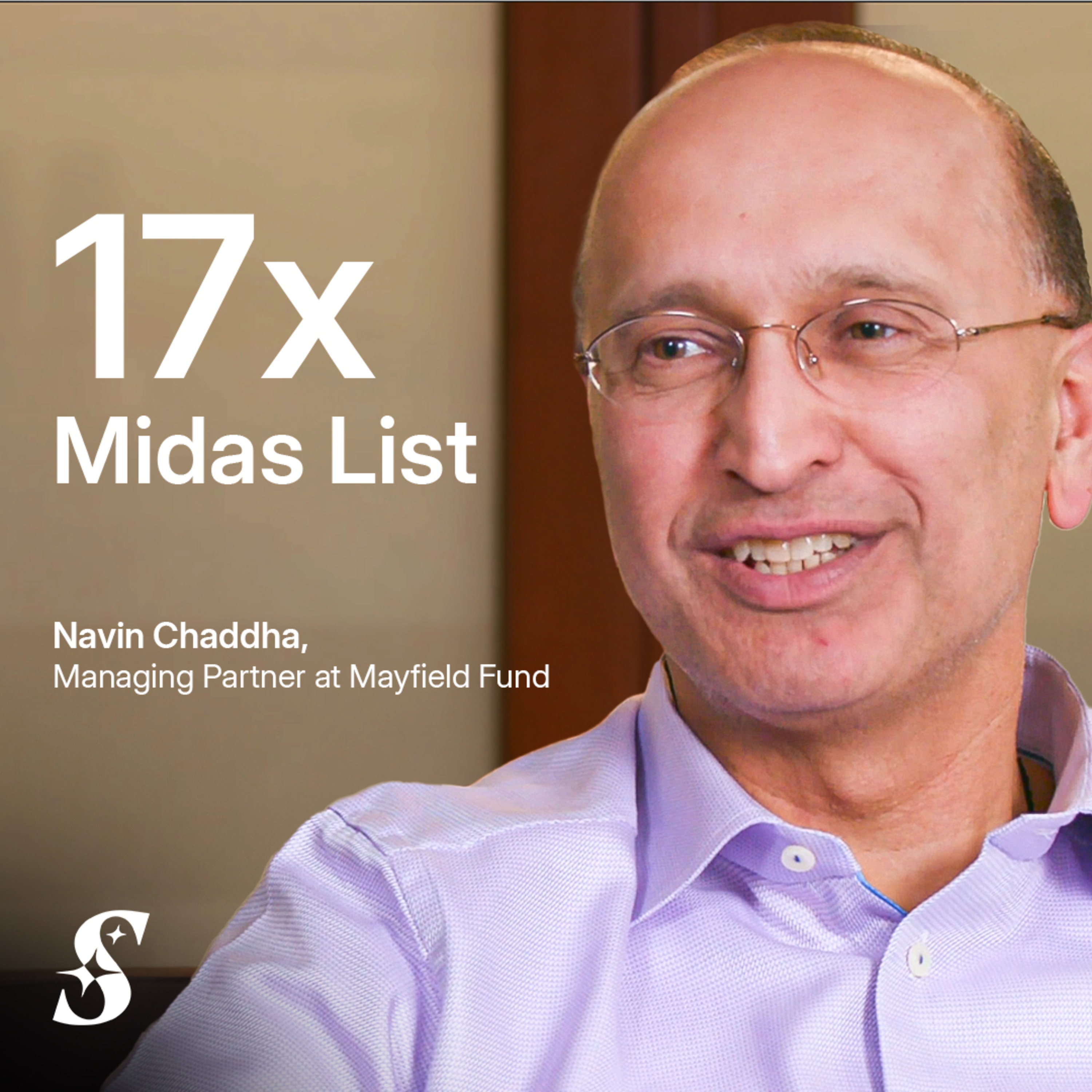
Veteran VC Navin Chaddha argues that AI's impact is an order of magnitude greater than previous tech waves. This is because AI's conversational interfaces democratize creation for billions, while its ability to reason and act provides a second 10x force multiplier, resulting in a 100x total opportunity.
To combat valuation hype, Mayfield defines its investment thesis as a specific 'product.' Just as In-N-Out doesn't sell chicken burgers, Mayfield doesn't do billion-dollar seed rounds. This 'product focus' allows them to stay disciplined and partner only with founders who align with their sustainable model.
The new AI technology landscape is a layered 'Collaborative Intelligence Stack.' It starts with hardware and models but culminates in 'AI teammates'—agentic AIs that augment human workers. The largest future value lies in this top layer, which could capture 10-20% of the $30 trillion global knowledge worker spend.
The dominant per-user-per-month SaaS business model is becoming obsolete for AI-native companies. The new standard is consumption or outcome-based pricing. Customers will pay for the specific task an AI completes or the value it generates, not for a seat license, fundamentally changing how software is sold.
While AI models and coding agents scale to $100M+ revenues quickly, the truly exponential growth is in the hardware ecosystem. Companies in optical interconnects, cooling, and power are scaling from zero to billions in revenue in under two years, driven by massive demand from hyperscalers building AI infrastructure.
The traditional SaaS growth metric for top companies—reaching $1M, $3M, then $10M in annual recurring revenue—is outdated. For today's top-decile AI-native startups, the new expectation is an accelerated path of $1M, $10M, then $50M, reflecting the dramatically faster adoption cycles and larger market opportunities.
Many AI coding agents are unprofitable because their business model is broken. They charge a fixed subscription fee but pay variable, per-token costs for model inference. This means their most engaged power users, who should be their best customers, are actually their biggest cost centers, leading to negative gross margins.