Get your free personalized podcast brief
We scan new podcasts and send you the top 5 insights daily.
Just as uncontrolled cloud spending in the 2010s spawned the FinOps field, the shift to consumption-based AI pricing will necessitate a similar discipline. This involves attributing costs to specific workloads, setting granular budgets, and providing real-time visibility to prevent budget overruns and measure ROI accurately.
Related Insights
Organizations with structured SDLCs can adapt to consumption-based AI pricing because they can attribute costs to specific work items and make deliberate trade-offs, like routing simple tasks to cheaper models. Teams with ad-hoc workflows will struggle, as unattributable costs spiral and quality becomes inconsistent.
The optimal strategy for managing AI costs is neither total restriction nor a free-for-all. It's providing engineers with dedicated "learning budgets" and experimentation pools, coupled with clear visibility into costs. This fosters innovation responsibly without incurring surprise invoices and turns cost into a first-class constraint.
Contrary to the belief that enterprises have unlimited budgets, they are focused on the ROI of their AI spend. As agentic workflows cause token bills to skyrocket, orchestration tools that intelligently route queries to the most cost-effective model for a given task are becoming essential infrastructure.

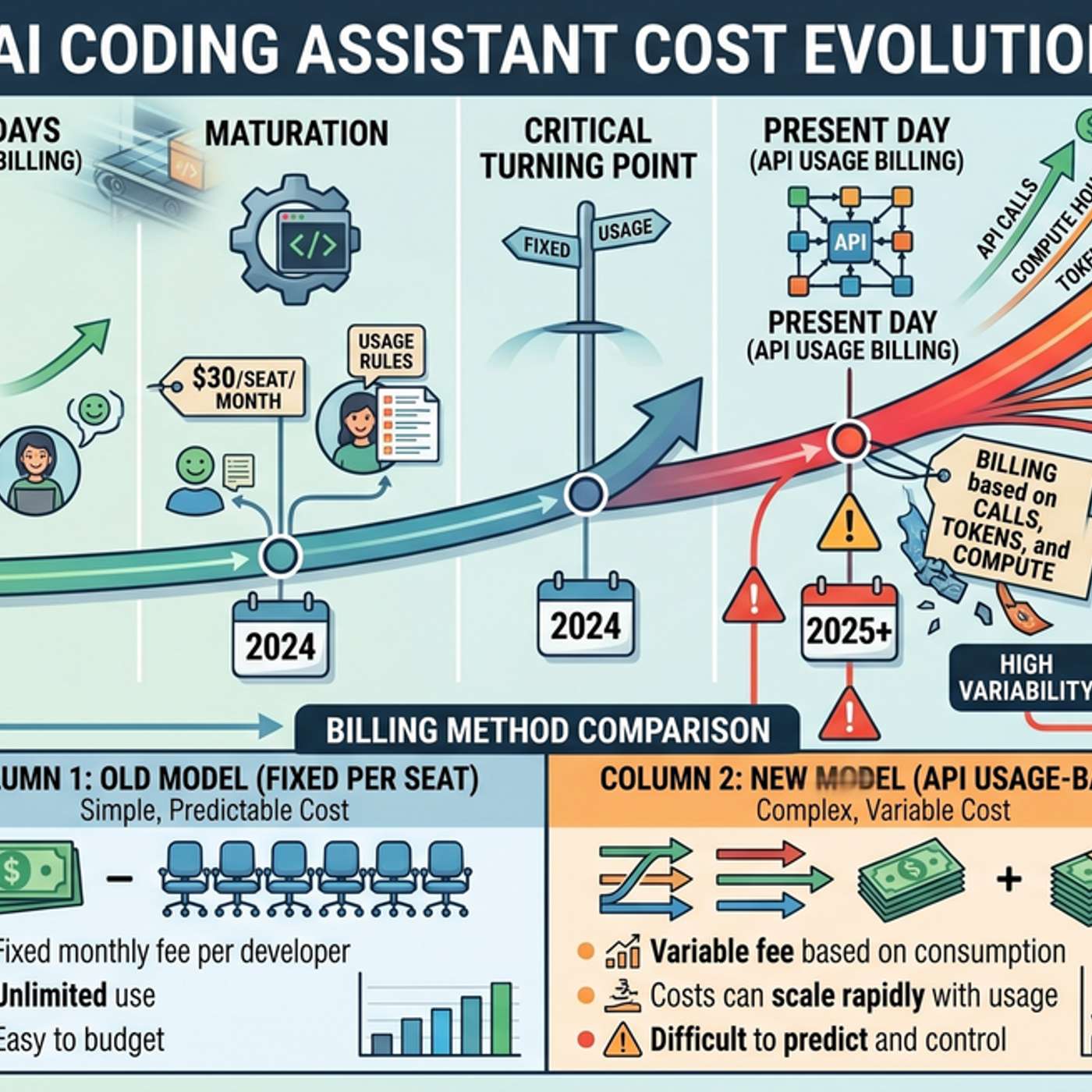
The AI market is moving beyond simple $20/month subscriptions toward high-cost API consumption. As AI's value becomes clearer, companies are increasingly willing to approve massive budgets, with figures like $250,000 per engineer per year for AI inference becoming a justifiable business expense.

The end of subsidized AI pricing is forcing companies to confront its true operational expense. As AI bills begin to rival payroll, a fundamental transition is occurring where capital expenditure on silicon (CapEx) is displacing operational expenditure on human neurons (OpEx), reshaping corporate budgets.

The $15-$25 per-review price for Anthropic's tool moves AI expenses from a predictable monthly software subscription to a variable cost that scales like human labor. This forces CTOs to justify AI budgets with direct headcount savings, creating immense pressure on ROI.
The move away from seat-based licenses to consumption models for AI tools creates a new operational burden. Companies must now build governance models and teams to track usage at an individual employee level—like 'Bob in accounting'—to control unpredictable costs.

Beyond upfront pricing, sophisticated enterprise customers now demand cost certainty for consumption-based AI. They require vendors to provide transparent cost structures and protections for when usage inevitably scales, asking, 'What does the world look like when the flywheel actually spins?'
Paralleling the cloud adoption curve, the current surge in AI spending will inevitably be followed by an 'optimization point.' Enterprises will shift from experimentation to efficiency, scrutinizing token usage and seeking to reduce costs, forcing AI providers to help them optimize.

AI's usage-based pricing doesn't fit traditional seat-based software budgets. Frame it like a marketing program (e.g., paid ads). If increased spending on AI tools generates high ROI, it justifies a larger, flexible budget, shifting the conversation with finance from fixed cost to performance investment.
