Get your free personalized podcast brief
We scan new podcasts and send you the top 5 insights daily.
To encourage widespread AI adoption, Snowflake's leadership provides a central, effectively unlimited budget for AI tools. This prevents departmental budget constraints from becoming a bottleneck, ensuring teams can experiment and build without being held back by cost concerns.

Related Insights
The optimal strategy for managing AI costs is neither total restriction nor a free-for-all. It's providing engineers with dedicated "learning budgets" and experimentation pools, coupled with clear visibility into costs. This fosters innovation responsibly without incurring surprise invoices and turns cost into a first-class constraint.
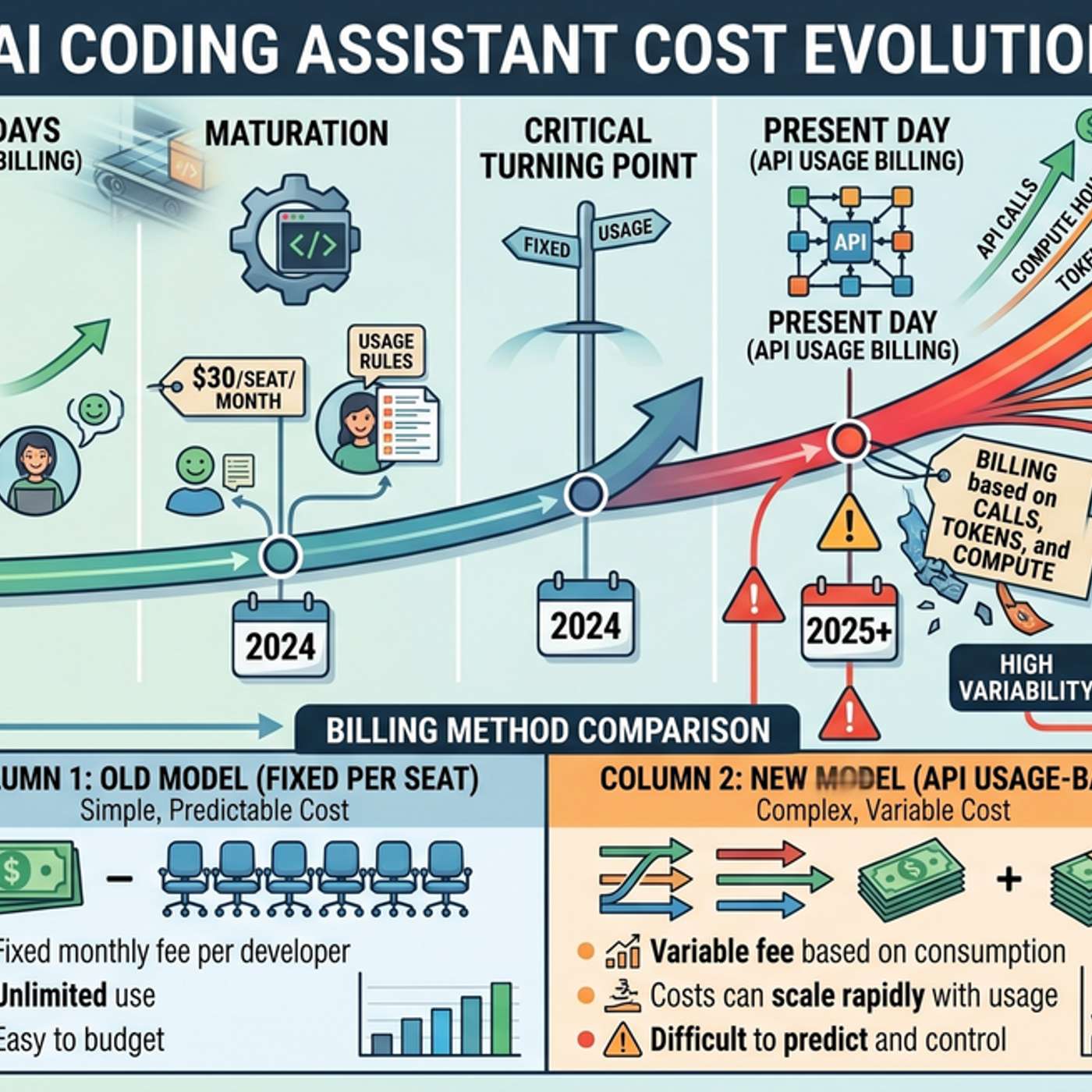
Strict budget controls on AI usage, such as per-employee spending caps, have a hidden cost. They create a "known ROI bias," pushing employees toward safe, incremental productivity tasks instead of the large-scale, uncertain experiments required to unlock AI's true economic value. This focus on efficiency inadvertently kills breakthrough innovation.

While empowering employees to experiment with AI is crucial, Snowflake found it's ineffective without an executive mandate. If the CEO doesn't frame AI as a top strategic initiative, employees will treat it as optional, hindering real adoption. Success requires combining top-down leadership with bottom-up innovation.
AI agent platforms are typically priced by usage, not seats, making initial costs low. Instead of a top-down mandate for one tool, leaders should encourage teams to expense and experiment with several options. The best solution for the team will emerge organically through use.

Snowflake established a cross-functional AI council with volunteers who dedicate 10-20% of their time to experimentation. This avoids chaotic, duplicated efforts from a company-wide mandate. The council then shares learnings and rolls out proven use cases to the broader team quarterly, ensuring structured adoption.
To foster breakthrough ideas, companies should initially provide engineers with unrestricted access to the most powerful AI models, ignoring costs. Optimization should only happen after an idea proves its value at scale, as early cost-cutting stifles creativity.

Snowflake drove internal AI transformation through a dual approach. The CEO issued a top-down mandate making AI non-negotiable, while the company simultaneously provided bottom-up empowerment by giving all employees access to a coding agent to build their own tools and solutions.

To combat budget chaos from AI usage, enterprises are moving the cost of technology from the central CIO's budget to the P&L of the specific business unit using it. This decentralizes accountability, forcing department managers to make ROI-driven decisions about their team's AI consumption.

Pay-per-use AI models create a psychological blocker, making teams hesitant to experiment for fear of racking up high costs. A fixed-price, unlimited-use model allows for unrestricted creativity and experimentation, similar to how a chef with inexpensive ingredients can innovate freely.

AI's usage-based pricing doesn't fit traditional seat-based software budgets. Frame it like a marketing program (e.g., paid ads). If increased spending on AI tools generates high ROI, it justifies a larger, flexible budget, shifting the conversation with finance from fixed cost to performance investment.
