Get your free personalized podcast brief
We scan new podcasts and send you the top 5 insights daily.
To combat budget chaos from AI usage, enterprises are moving the cost of technology from the central CIO's budget to the P&L of the specific business unit using it. This decentralizes accountability, forcing department managers to make ROI-driven decisions about their team's AI consumption.

Related Insights
AI agent spending won't be confined to limited IT budgets. Instead, it will draw from massive line-of-business operating budgets (OpEx), pitched as augmenting core workflows. This shift could realistically double enterprise technology spend.

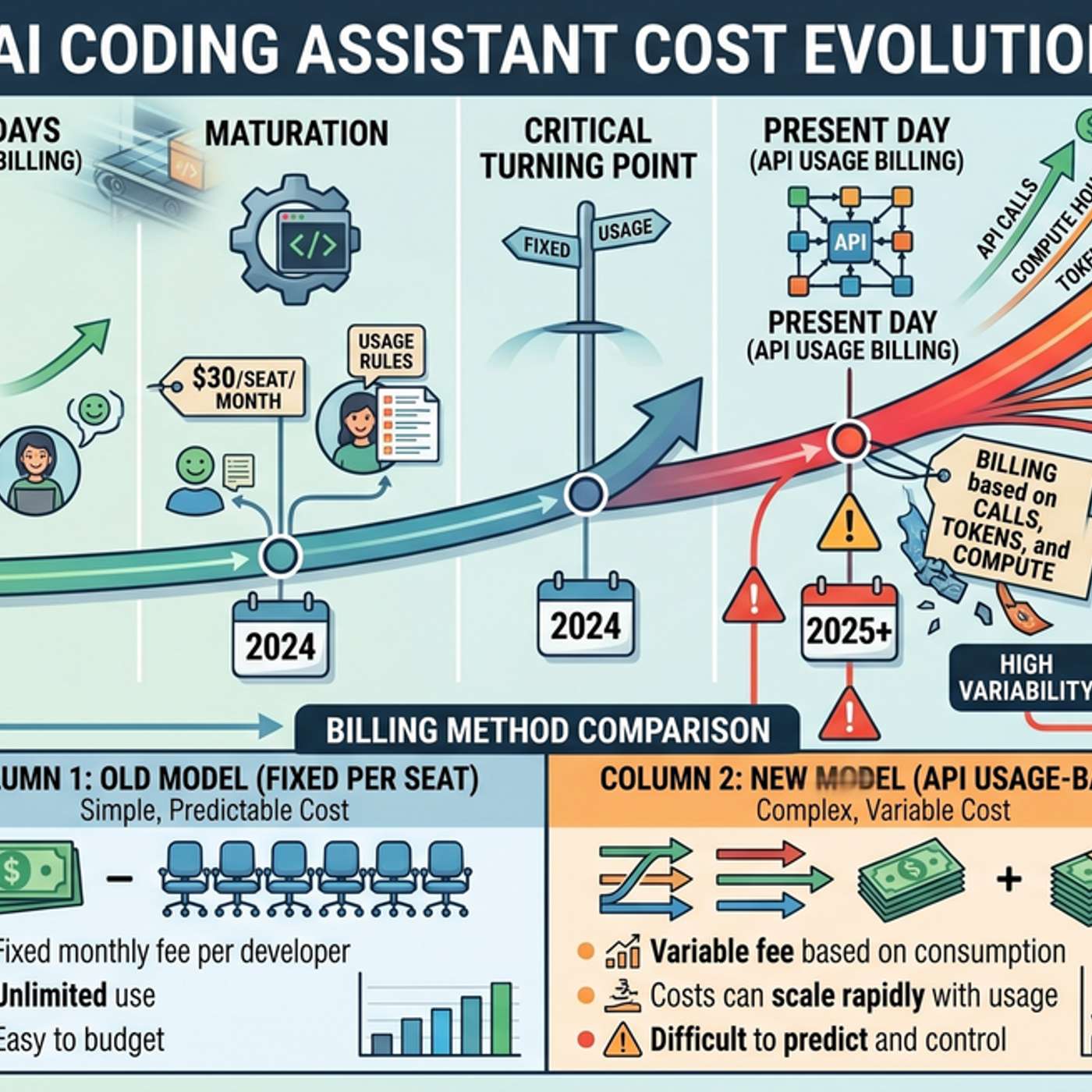
Traditional software budgeting fails for generative AI, where costs are variable and tied to tokens and usage. A CFO noted a team's daily per-person cost jumped 50% in one week. Companies must accept this volatility, run pilots to establish baseline costs, and then determine ROI, rather than trying to set a fixed budget upfront.

The end of subsidized AI pricing is forcing companies to confront its true operational expense. As AI bills begin to rival payroll, a fundamental transition is occurring where capital expenditure on silicon (CapEx) is displacing operational expenditure on human neurons (OpEx), reshaping corporate budgets.

Historically, labor costs dwarfed software spending. As AI automates tasks, software budgets will balloon, turning into a primary corporate expense. This forces CFOs to scrutinize software ROI with the same rigor they once applied only to their workforce.

Insatiable demand for AI tools is causing corporate AI spending to explode much faster than anticipated. Some companies have exhausted their entire annual AI budget in just three months, forcing leaders to scramble to ration usage, manage costs, and justify the return on investment.

The move away from seat-based licenses to consumption models for AI tools creates a new operational burden. Companies must now build governance models and teams to track usage at an individual employee level—like 'Bob in accounting'—to control unpredictable costs.
Companies initially gamified AI use, leading to a "token maxing" culture. Now, facing enormous, unexpected bills, they are experiencing "sticker shock." This is forcing a strategic shift from encouraging maximum usage to demanding ROI calculations and finding the most cost-effective AI model for a given task.

After encouraging rampant AI usage in Q1, CFOs are now discovering the massive, unbudgeted costs. This has triggered a sudden, widespread 'penny drop' moment across corporations, leading to the rapid implementation of spending caps and formal budgets, which will likely slow the pace of AI adoption in the short term.

Just as uncontrolled cloud spending in the 2010s spawned the FinOps field, the shift to consumption-based AI pricing will necessitate a similar discipline. This involves attributing costs to specific workloads, setting granular budgets, and providing real-time visibility to prevent budget overruns and measure ROI accurately.
Box CEO Aaron Levy notes a critical shift in corporate budgeting. AI spending is moving beyond the confines of the IT budget (typically 3-7% of revenue) to become a core operational expense (OPEX) for every department, from marketing to legal. This change will fundamentally alter how all business units allocate resources.