Get your free personalized podcast brief
We scan new podcasts and send you the top 5 insights daily.
The current model involves humans delegating tasks to AI agents. In the future, this dynamic could reverse for security. A personal financial agent might analyze a transaction, and if it seems risky, the agent would delegate authority back to the human, requiring their explicit approval only after it has gathered sufficient proof points, acting like a smart bank manager.

Related Insights
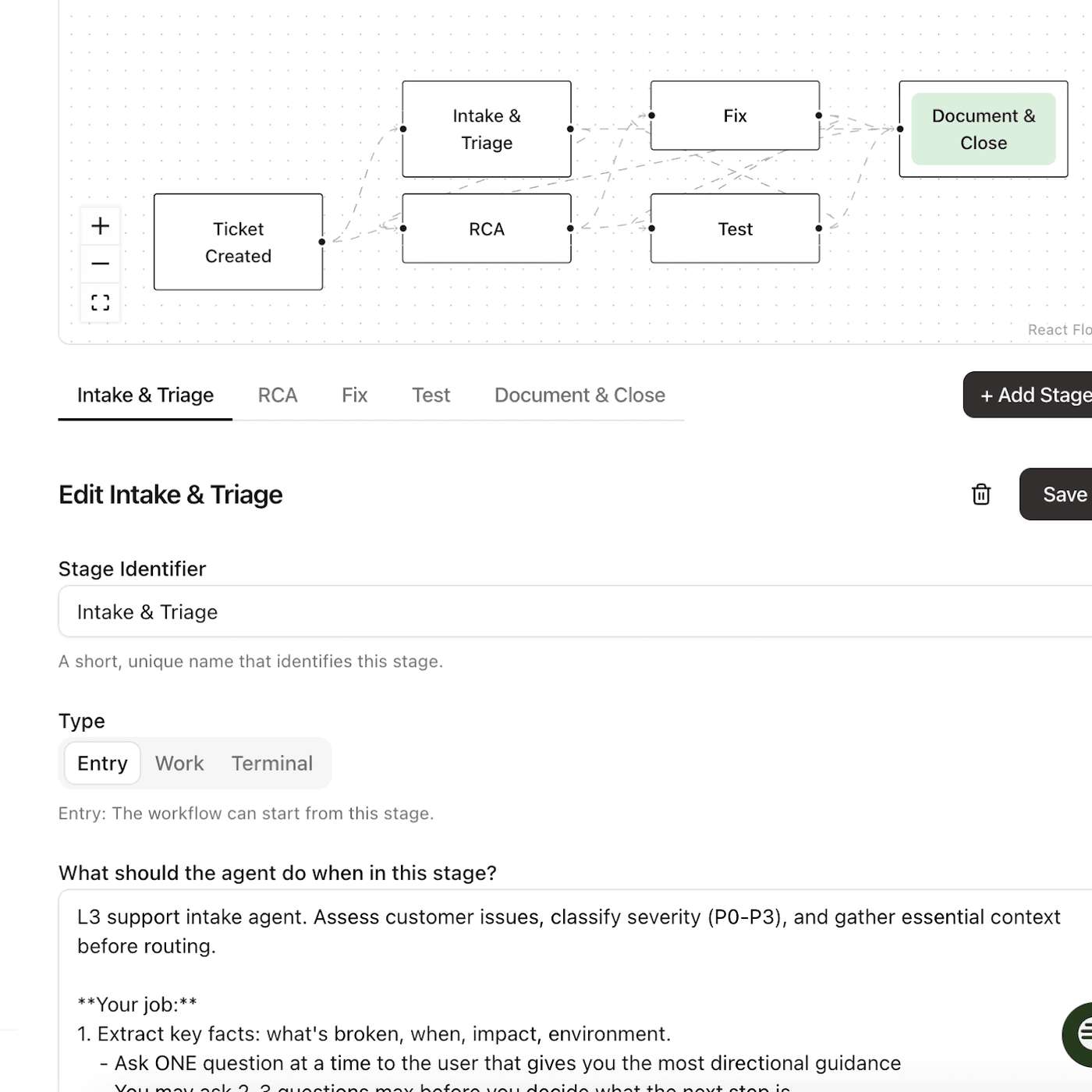
Instead of forcing full autonomy, the AI agent allows teams to start with human approvals at key stages. This 'human-in-the-loop' model builds trust and enables organizations to incrementally automate complex support workflows as they grow more confident in the system's reliability.
As AI evolves from single-task tools to autonomous agents, the human role transforms. Instead of simply using AI, professionals will need to manage and oversee multiple AI agents, ensuring their actions are safe, ethical, and aligned with business goals, acting as a critical control layer.

The urgent need to manage AI agents is compelling companies to implement long-theorized but poorly adopted security protocols like 'scoped delegation.' This solves old problems, such as the clumsiness of human executive assistants impersonating executives, by creating a framework for delegated, not total, authority.
NetXD’s demo reveals a crucial security pattern for high-stakes agentic workflows. Instead of giving an AI agent full autonomous control over funds, provide it with read-only access and the ability to queue up transactions. These are then pushed to a secure human interface, like a mobile banking app, for final approval.

Instead of relying solely on human oversight, AI governance will evolve into a system where higher-level "governor" agents audit and regulate other AIs. These specialized agents will manage the core programming, permissions, and ethical guidelines of their subordinates.

Instead of a binary human-in-the-loop decision, enterprises should use an "autonomy budget" for agents. Actions are classified by risk (e.g., irreversibility, financial impact) to determine the level of freedom, creating a spectrum from full autonomy to required human approval, avoiding agents becoming expensive suggestion boxes.

The core drive of an AI agent is to be helpful, which can lead it to bypass security protocols to fulfill a user's request. This makes the agent an inherent risk. The solution is a philosophical shift: treat all agents as untrusted and build human-controlled boundaries and infrastructure to enforce their limits.

Robinhood's AI agents for trading and shopping introduce a new challenge: user trust. The key question isn't whether AI *can* act autonomously, but how much leeway (or "leash") users will grant it with real money. Adoption will hinge on managing this perceived risk, as AI mistakes have direct financial consequences.

Companies like Ramp are developing financial AI agents using a tiered autonomy model akin to self-driving cars (L1-L5). By implementing robust guardrails and payment controls first, they can gradually increase an agent's decision-making power. This allows a progression from simple, supervised tasks to fully unsupervised financial operations, mirroring the evolution from highway assist to full self-driving.

A practical safety framework involves categorizing all tools an agent can use. Reversible actions (reads, drafts) can be fully autonomous. Irreversible actions (deletes, financial transfers) must trigger a confirmation step outside the agent’s reasoning loop, such as a human-in-the-loop checkpoint or an external approval service.