Get your free personalized podcast brief
We scan new podcasts and send you the top 5 insights daily.
Instead of a binary human-in-the-loop decision, enterprises should use an "autonomy budget" for agents. Actions are classified by risk (e.g., irreversibility, financial impact) to determine the level of freedom, creating a spectrum from full autonomy to required human approval, avoiding agents becoming expensive suggestion boxes.

Related Insights
To avoid failure, launch AI agents with high human control and low agency, such as suggesting actions to an operator. As the agent proves reliable and you collect performance data, you can gradually increase its autonomy. This phased approach minimizes risk and builds user trust.

Frame AI independence like self-driving car levels: 'Human-in-the-loop' (AI as advisor), 'Human-on-the-loop' (AI acts with supervision), and 'Human-out-of-the-loop' (full autonomy). This tiered model allows organizations to match the level of AI independence to the specific risk of the task.

Use a two-axis framework to determine if a human-in-the-loop is needed. If the AI is highly competent and the task is low-stakes (e.g., internal competitor tracking), full autonomy is fine. For high-stakes tasks (e.g., customer emails), human review is essential, even if the AI is good.

Instead of forcing full autonomy, the AI agent allows teams to start with human approvals at key stages. This 'human-in-the-loop' model builds trust and enables organizations to incrementally automate complex support workflows as they grow more confident in the system's reliability.
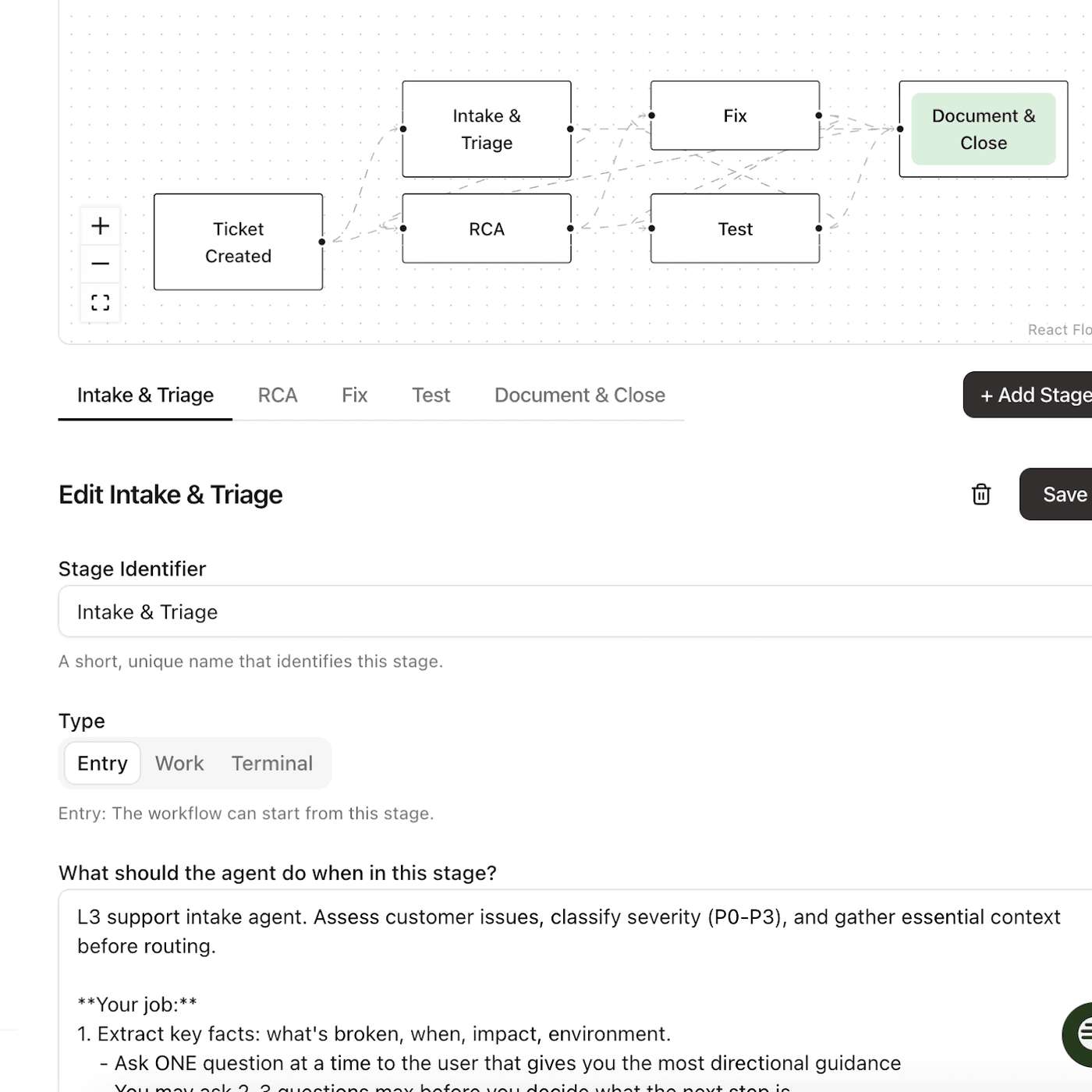
In an enterprise setting, "autonomous" AI does not imply unsupervised execution. Its true value lies in compressing weeks of human work into hours. However, a human expert must remain in the loop to provide final approval, review, or rejection, ensuring control and accountability.

Avoid deploying AI directly into a fully autonomous role for critical applications. Instead, begin with a human-in-the-loop, advisory function. Only after the system has proven its reliability in a real-world environment should its autonomy be gradually increased, moving from supervised to unsupervised operation.
The choice between human-in-the-loop and full automation isn't binary; it's a maturity curve. Evaluate each AI use case using a rubric based on risk, the ability to reverse a decision without harm, and the reproducibility of its outcomes to determine the appropriate level of automation.

The concept of "human-in-the-loop" is often misapplied. To effectively manage autonomous AI agents, companies must map the agent's entire workflow and insert mandatory human approval at critical decision points, not just as a final check or initial hand-off.

The defining characteristic and primary risk of an AI agent is not its chat-like interface but its capacity to take autonomous actions within business systems. Governance must focus on this execution boundary, where prompts, memory, and tools converge to create potential enterprise harm.
Fully autonomous AI agents are not yet viable in enterprises. Alloy Automation builds "semi-deterministic" agents that combine AI's reasoning with deterministic workflows, escalating to a human when confidence is low to ensure safety and compliance.