Get your free personalized podcast brief
We scan new podcasts and send you the top 5 insights daily.
Lenovo's CFO notes a strategic divide. One school of thought uses tight constraints to see who innovates most efficiently. The other, common at US tech firms, gives high caps to let employees "go to town," believing this is the fastest way to discover high-ROI use cases and talent.

Related Insights
The optimal strategy for managing AI costs is neither total restriction nor a free-for-all. It's providing engineers with dedicated "learning budgets" and experimentation pools, coupled with clear visibility into costs. This fosters innovation responsibly without incurring surprise invoices and turns cost into a first-class constraint.
Strict budget controls on AI usage, such as per-employee spending caps, have a hidden cost. They create a "known ROI bias," pushing employees toward safe, incremental productivity tasks instead of the large-scale, uncertain experiments required to unlock AI's true economic value. This focus on efficiency inadvertently kills breakthrough innovation.

To drive AI uptake, Lenovo's CFO intentionally cuts funding for legacy processes. This forces teams, who are naturally adaptable, to use AI tools out of necessity rather than relying on old behaviors and budgets, ensuring a more disciplined and effective transition.
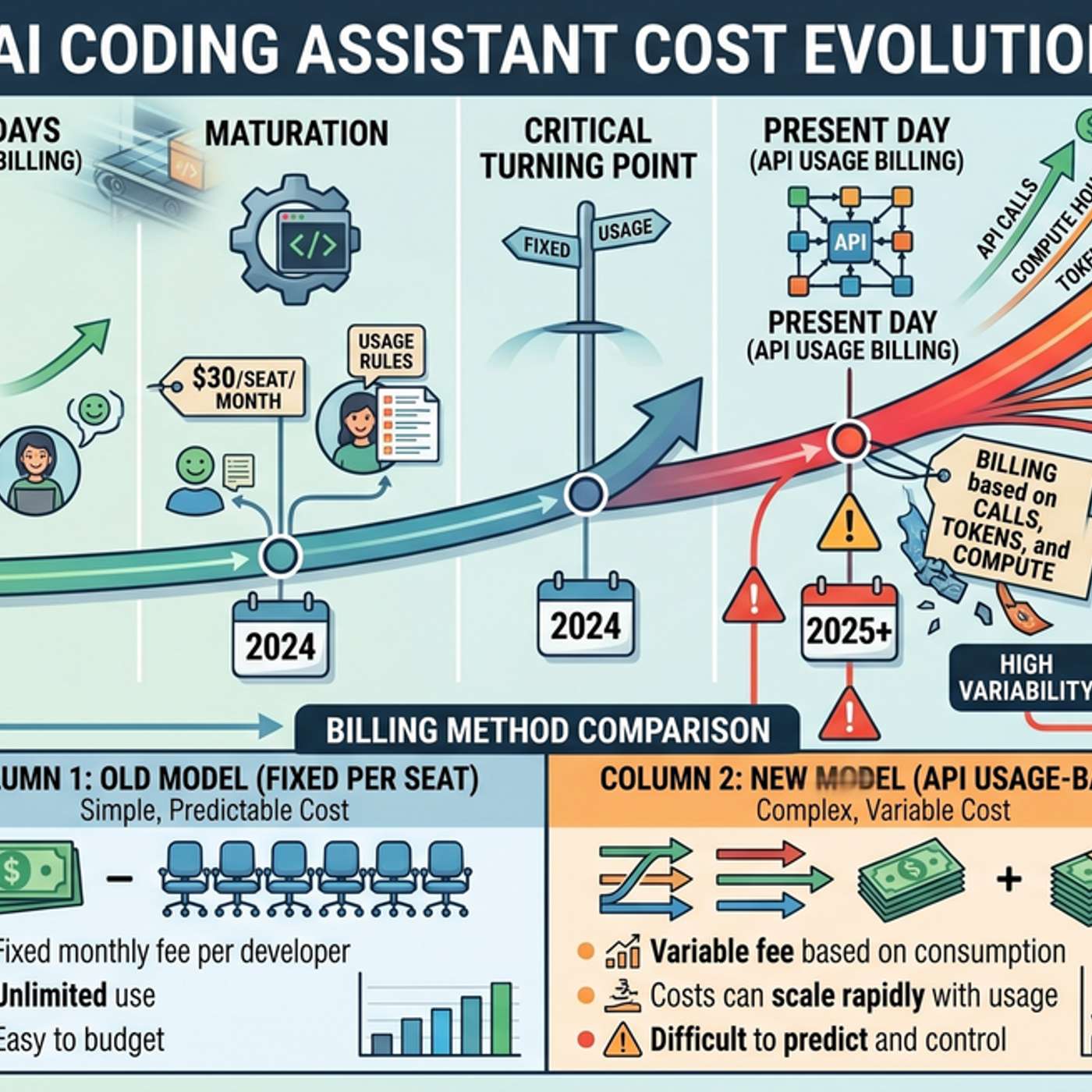
An anecdote about an engineer spending $100M in a month on AI tokens reveals a core enterprise issue. For Lenovo's CFO, the problem isn't the amount but its lack of planning and clear ROI. This signals a shift from predictable software subscriptions to volatile, usage-based AI compute costs.
To foster breakthrough ideas, companies should initially provide engineers with unrestricted access to the most powerful AI models, ignoring costs. Optimization should only happen after an idea proves its value at scale, as early cost-cutting stifles creativity.

Despite massive enterprise spending on AI that fuels hypergrowth for companies like Anthropic, non-tech companies find it difficult to realize tangible value. This creates a conflict where CFOs question the spend while CIOs warn of disruption if they pause.

After encouraging rampant AI usage in Q1, CFOs are now discovering the massive, unbudgeted costs. This has triggered a sudden, widespread 'penny drop' moment across corporations, leading to the rapid implementation of spending caps and formal budgets, which will likely slow the pace of AI adoption in the short term.

The recent trend of companies rationing AI after massive, uncontrolled spending is a healthy and predictable market correction. This initial phase of expensive experimentation, while seemingly wasteful, is a necessary step for organizations to learn how to apply AI tools with surgical precision and track ROI effectively.

To encourage widespread AI adoption, Snowflake's leadership provides a central, effectively unlimited budget for AI tools. This prevents departmental budget constraints from becoming a bottleneck, ensuring teams can experiment and build without being held back by cost concerns.

The high cost of AI is becoming a major operational challenge. Uber, after exhausting its entire 2026 AI budget in just four months, has instituted a $1,500 per month cap per tool for its engineers. This signals a broader trend of companies needing to manage AI spend carefully.
