Get your free personalized podcast brief
We scan new podcasts and send you the top 5 insights daily.
The recent trend of companies rationing AI after massive, uncontrolled spending is a healthy and predictable market correction. This initial phase of expensive experimentation, while seemingly wasteful, is a necessary step for organizations to learn how to apply AI tools with surgical precision and track ROI effectively.

Related Insights
The AI race has been a prisoner's dilemma where companies spend massively, fearing competitors will pull ahead. As the cost of next-gen systems like Blackwell and Rubin becomes astronomical, the sheer economics will force a shift. Decision-making will be dominated by ROI calculations rather than the existential dread of slowing down.
![Gavin Baker - Nvidia v. Google, Scaling Laws, and the Economics of AI - [Invest Like the Best, EP.451] thumbnail](https://megaphone.imgix.net/podcasts/d97fee14-d4d7-11f0-8951-8324b640c1c1/image/d3a8b5ecbf3957de5b91f278a191c9ff.jpg?ixlib=rails-4.3.1&max-w=3000&max-h=3000&fit=crop&auto=format,compress)
A significant disconnect is emerging between massive corporate spending on AI and tangible returns. With reports that only 1 in 20 CFOs can prove positive ROI and Uber burning its AI budget, the market is poised for a pullback as executives demand accountability.

The current massive investment in AI is driven by a belief that it is the most critical technology of the decade. Large companies are willing to spend billions with uncertain immediate returns simply to secure a long-term strategic position, making it a must-have expenditure that overrides normal financial discipline.

The era of 'token maxing,' where enterprises used AI models without cost constraints, is ending. Companies like Microsoft are now scrutinizing the ROI of their AI spend, leading to budget cuts and a potential deceleration in the hyper-growth seen by model providers.

The massive $700B capital injection into AI demands a return. The next few years will shift focus from hype to demonstrable results. Companies that can't show a quick, real, and efficient ROI will face a reckoning, even if they have grand aspirations.

Current AI spending appears bubble-like, but it's not propping up unprofitable operations. Inference is already profitable. The immense cash burn is a deliberate, forward-looking investment in developing future, more powerful models, not a sign of a failing business model. This re-frames the financial risk.

Paralleling the cloud adoption curve, the current surge in AI spending will inevitably be followed by an 'optimization point.' Enterprises will shift from experimentation to efficiency, scrutinizing token usage and seeking to reduce costs, forcing AI providers to help them optimize.

The initial explosion in AI spending was largely additive, not a replacement for existing budgets. Going forward, this will change. Companies will start substituting AI spend for traditional SaaS licenses and human capital as they rationalize operating expenses and seek higher ROI.

Just as uncontrolled cloud spending in the 2010s spawned the FinOps field, the shift to consumption-based AI pricing will necessitate a similar discipline. This involves attributing costs to specific workloads, setting granular budgets, and providing real-time visibility to prevent budget overruns and measure ROI accurately.
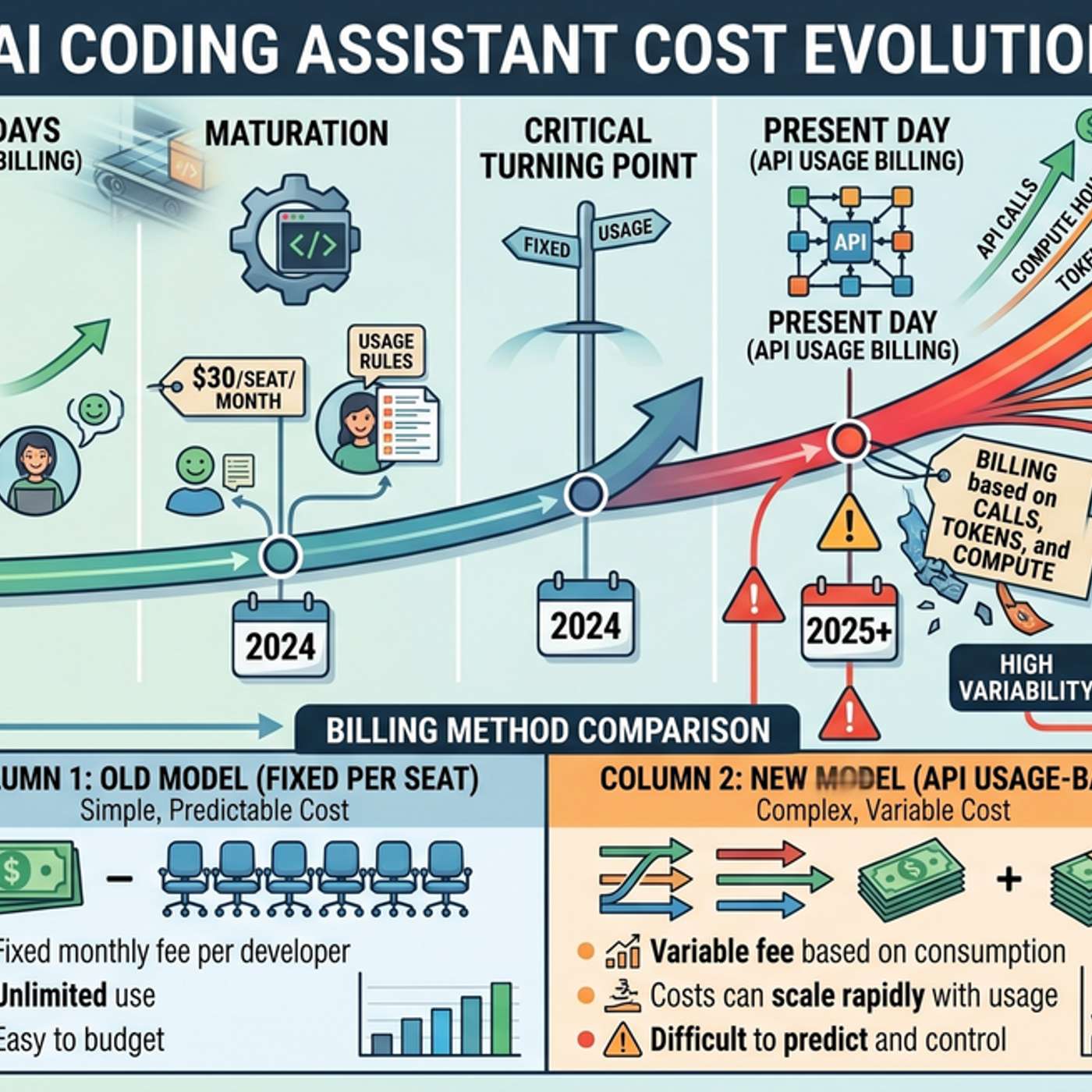
The CTO of Uber, after exhausting the company's AI budget early in the year, publicly stated he's not seeing a return on the investment. This highlights a growing trend among enterprises to scrutinize the high costs of AI against unclear productivity gains and question the ROI.
