Get your free personalized podcast brief
We scan new podcasts and send you the top 5 insights daily.
After encouraging rampant AI usage in Q1, CFOs are now discovering the massive, unbudgeted costs. This has triggered a sudden, widespread 'penny drop' moment across corporations, leading to the rapid implementation of spending caps and formal budgets, which will likely slow the pace of AI adoption in the short term.

Related Insights
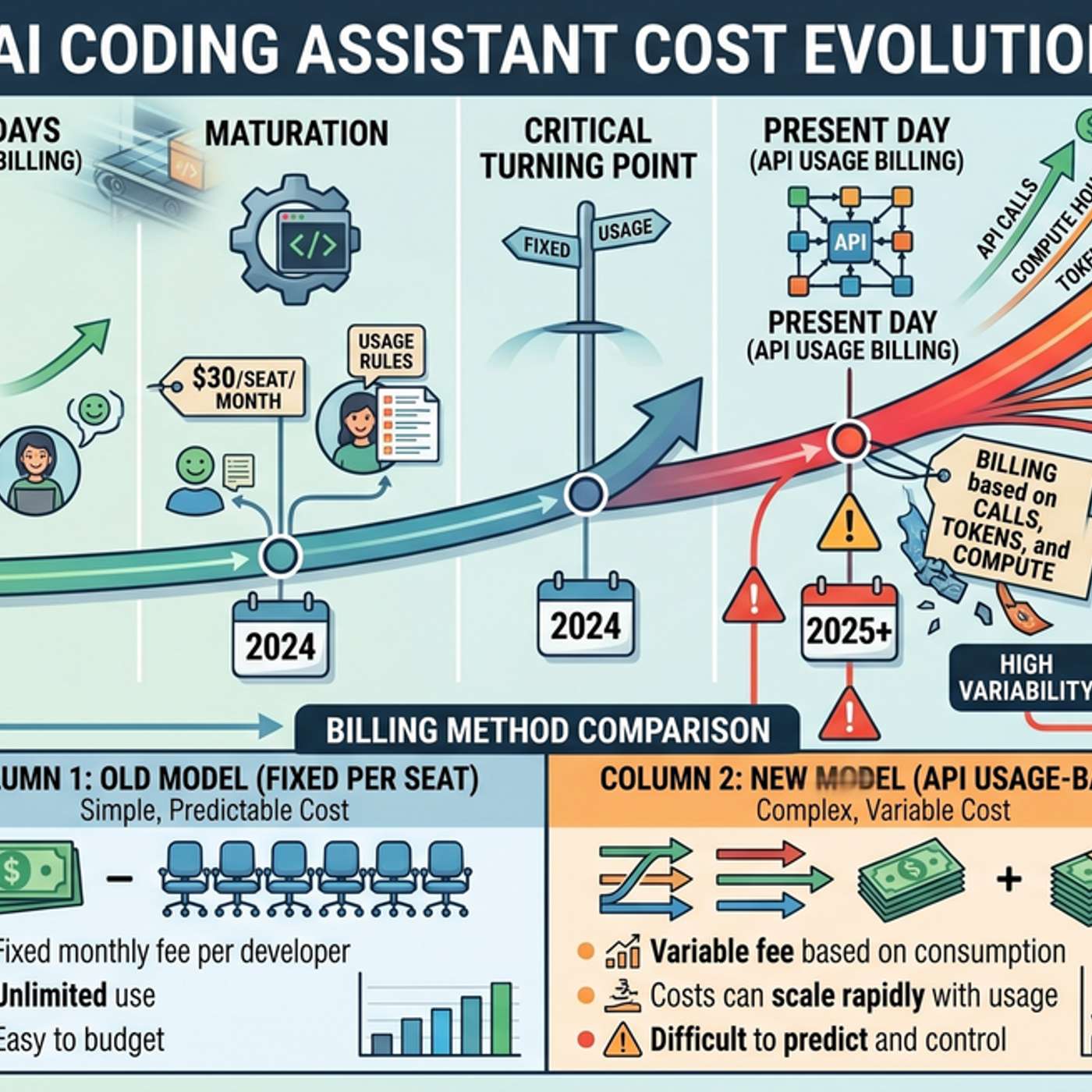
For years, flat-rate AI subscriptions heavily subsidized power users, masking the true cost of token consumption. As providers shift to usage-based billing, this subsidy is ending. Enterprises now face "sticker shock" and must justify AI spend with clear ROI, moving from rampant experimentation to cost-conscious implementation.
![The AI Token Shortage Begins [AI Monthly Recap] thumbnail](https://d3t3ozftmdmh3i.cloudfront.net/staging/podcast_uploaded_nologo/41472609/41472609-1752234663609-8665756a468e5.jpg)
The end of subsidized AI pricing is forcing companies to confront its true operational expense. As AI bills begin to rival payroll, a fundamental transition is occurring where capital expenditure on silicon (CapEx) is displacing operational expenditure on human neurons (OpEx), reshaping corporate budgets.
The most heated topic among Fortune 500 CIOs is no longer which AI model is most powerful, but how to manage unpredictable and soaring token costs. Companies are struggling to find the right strategies—from workload prioritization to user-based access tiers—to create a predictable cost model in a rapidly evolving tech landscape.
The era of 'token maxing,' where enterprises used AI models without cost constraints, is ending. Companies like Microsoft are now scrutinizing the ROI of their AI spend, leading to budget cuts and a potential deceleration in the hyper-growth seen by model providers.

The shift to AI-driven development introduces a wildly unpredictable cost: token consumption. This expense could range from a minor line item to exceeding the entire engineering payroll, creating an unprecedented budgeting challenge for CFOs and threatening companies' profitability if not managed correctly.

Insatiable demand for AI tools is causing corporate AI spending to explode much faster than anticipated. Some companies have exhausted their entire annual AI budget in just three months, forcing leaders to scramble to ration usage, manage costs, and justify the return on investment.

Companies initially gamified AI use, leading to a "token maxing" culture. Now, facing enormous, unexpected bills, they are experiencing "sticker shock." This is forcing a strategic shift from encouraging maximum usage to demanding ROI calculations and finding the most cost-effective AI model for a given task.

The "golden age" of cheap, plentiful AI experimentation is over due to token shortages and high costs. This new "trade-offs era" forces companies to justify AI expenses, which slows the pace of human replacement, buys time for adaptation, and forces the market toward more sustainable, realistic pricing models.
The recent trend of companies rationing AI after massive, uncontrolled spending is a healthy and predictable market correction. This initial phase of expensive experimentation, while seemingly wasteful, is a necessary step for organizations to learn how to apply AI tools with surgical precision and track ROI effectively.

Just as uncontrolled cloud spending in the 2010s spawned the FinOps field, the shift to consumption-based AI pricing will necessitate a similar discipline. This involves attributing costs to specific workloads, setting granular budgets, and providing real-time visibility to prevent budget overruns and measure ROI accurately.