Get your free personalized podcast brief
We scan new podcasts and send you the top 5 insights daily.
While compressing video across the temporal dimension offers higher efficiency, it inherently introduces latency. For real-time, interactive applications like "world models," a less efficient frame-by-frame compression approach is necessary to enable immediate responsiveness.

Related Insights
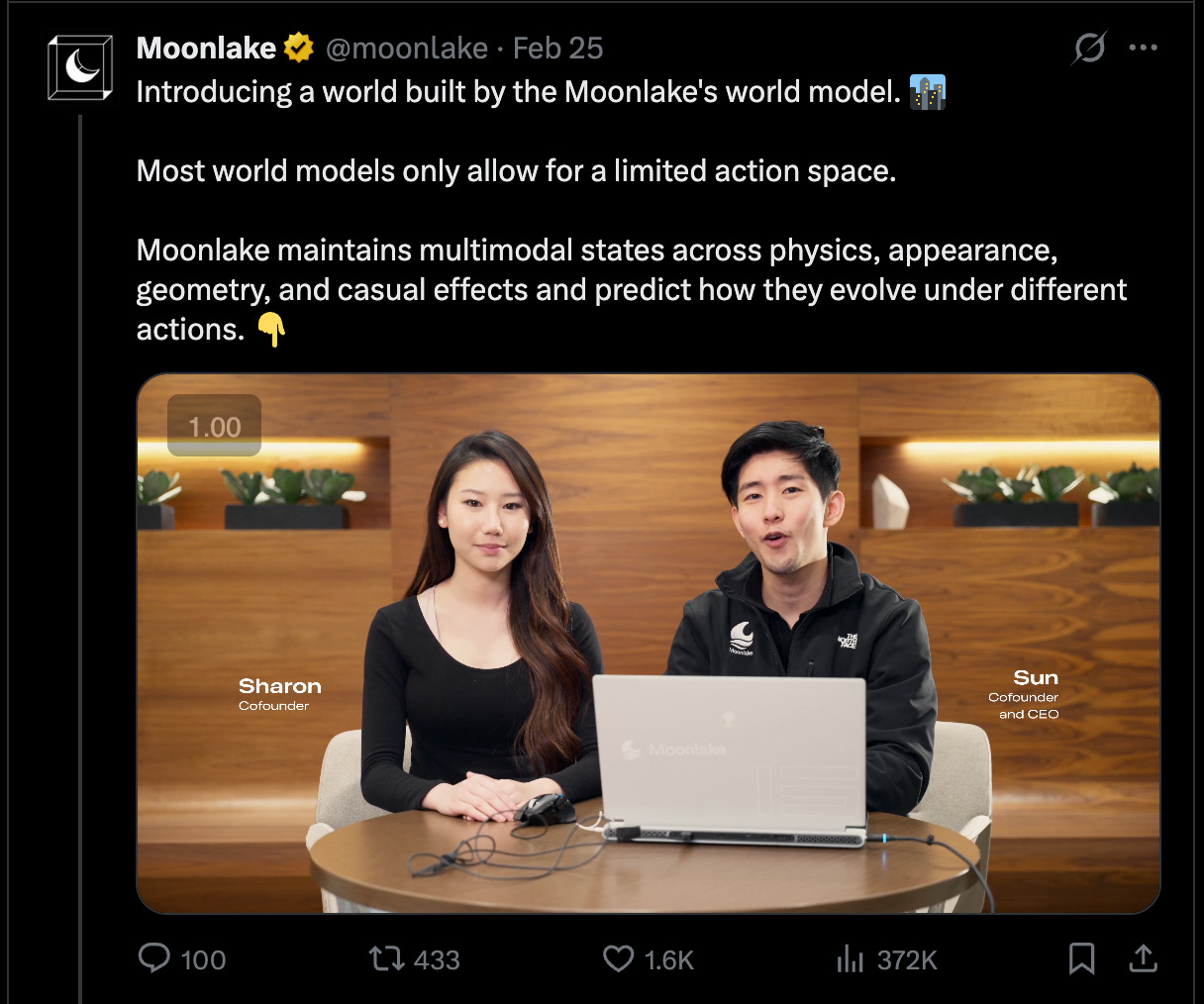
Unlike video generation models that merely predict pixels, Moonlake argues a true world model must understand and predict the consequences of actions over time. This requires an abstracted, semantic understanding of the world, not just visual fidelity.
Unlike video models that generate frame-by-frame, Marble natively outputs Gaussian splats—tiny, semi-transparent particles. This data structure enables real-time rendering, interactive editing, and precise camera control on client devices like mobile phones, a fundamental architectural advantage for interactive 3D experiences.

The future of video isn't just AI-generated clips but a new, interactive media format akin to a video game. Synthesia's CEO envisions personalized, real-time experiences like sales training simulations or conversational movies. This evolution is currently bottlenecked by the high cost and bandwidth of inference, which next-gen infrastructure aims to solve.

Roblox is solving its blocky-graphics problem with a hybrid architecture. Its traditional engine provides the "ground truth" for physics and multiplayer sync, while generative video world models act as a real-time visual layer, adding photorealistic detail on top. This maintains game logic while achieving AAA visuals.

To truly evaluate a video AI's capabilities, developers should test its performance on complex temporal tasks. This includes analyzing rapid scene changes for context-switching ability and tracking the precise order of events for temporal accuracy.
Sora doesn't process pixels or frames individually. Instead, it uses "space-time tokens" — small cuboids of video data combining spatial and temporal information. This voxel-like representation is the fundamental unit, enabling the model to understand properties like object permanence through global attention.

Traditional video models process an entire clip at once, causing delays. Descartes' Mirage model is autoregressive, predicting only the next frame based on the input stream and previously generated frames. This LLM-like approach is what enables its real-time, low-latency performance.

A "world model" transcends simple video generation. It is defined by three key capabilities: real-time responsiveness to user input (e.g., mouse clicks), long-horizon consistency over minutes or hours, and interactivity via multiple modalities like keyboard and voice.
The primary challenge in creating stable, real-time autoregressive video is error accumulation. Like early LLMs getting stuck in loops, video models degrade frame-by-frame until the output is useless. Overcoming this compounding error, not just processing speed, is the core research breakthrough required for long-form generation.
The primary performance bottleneck for LLMs is memory bandwidth (moving large weights), making them memory-bound. In contrast, diffusion-based video models are compute-bound, as they saturate the GPU's processing power by simultaneously denoising tens of thousands of tokens. This represents a fundamental difference in optimization strategy.
