Get your free personalized podcast brief
We scan new podcasts and send you the top 5 insights daily.
Roblox is solving its blocky-graphics problem with a hybrid architecture. Its traditional engine provides the "ground truth" for physics and multiplayer sync, while generative video world models act as a real-time visual layer, adding photorealistic detail on top. This maintains game logic while achieving AAA visuals.

Related Insights
While AI tools reduce the cost of creating game assets, Roblox's CEO argues this won't change the competitive dynamics. He believes consumer expectations for quality and polish increase at the same pace as the technology's capability, keeping the bar for success perpetually high.

NVIDIA's DLSS 5 is more than a simple upscaling tool; it uses generative AI to re-render game scenes in real-time on consumer hardware. This shifts graphics technology from pixel interpolation to live, AI-driven style transfer and scene reconstruction.

Roblox's CEO identifies the central challenge for large-scale virtual worlds not as physics simulation, but as efficiently synchronizing the state and memory of thousands of simultaneous players. This deep infrastructure problem is where new AI and data representation breakthroughs are most needed.
The user experience of Roblox games belies the immense technical infrastructure underneath. The platform runs on its own custom cloud with over 40 data centers, hundreds of thousands of servers, and more than 400 proprietary AI models to manage its massive scale.

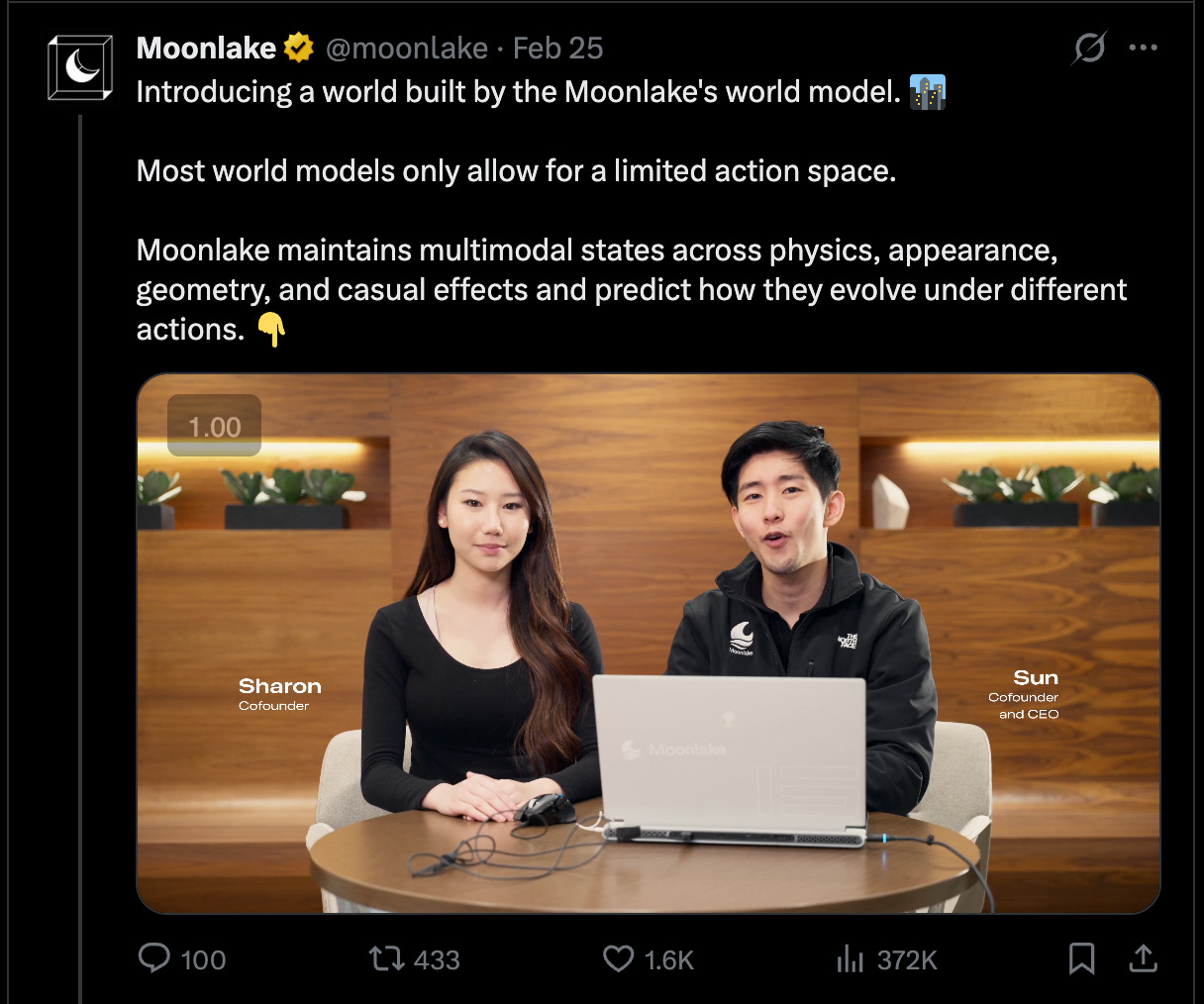
To create persistent and interactive AI-generated worlds, Moon Lake uses a hybrid approach. It encodes deterministic rules and interactivity using symbolic representations like code, while leveraging pixel-based models only for the world's visual appearance. This allows for long-horizon memory and complex game mechanics that pixel-only models struggle with.
Previous versions of NVIDIA's DLSS used AI for super sampling (upscaling resolution from 720p to 4K). DLSS 5 represents a fundamental shift, using generative AI to create and modify details like lighting and facial structures in real-time, moving beyond interpolation to on-the-fly content generation.
From its inception, Roblox prioritized making in-game objects functional, a concept they term "4D." This means objects run on a physics simulator, allowing for emergent behavior (e.g., a wheel properly falling off a car) rather than just being static 3D models.
Moonlake uses a reasoning model for causality, physics, and game logic, while a separate diffusion model ("Reverie") renders this state into photorealistic visuals. This modularity allows for consistent interaction while offering aesthetic flexibility, described as "skins for worlds."
To maintain relevance across generations, Roblox focuses on a simple but difficult technical specification: thousands of photorealistic people interacting in real-time. This resilient foundation allows the content to evolve with trends while the core engineering mission remains constant.
Dave Baszucki posits that as photorealistic 4D simulation improves, it will become the primary communication medium. Standard video conferencing will become a "legacy analog mode," a down-sampled version of a richer, more interactive 4D experience that offers superior features like spatial audio.