Get your free personalized podcast brief
We scan new podcasts and send you the top 5 insights daily.
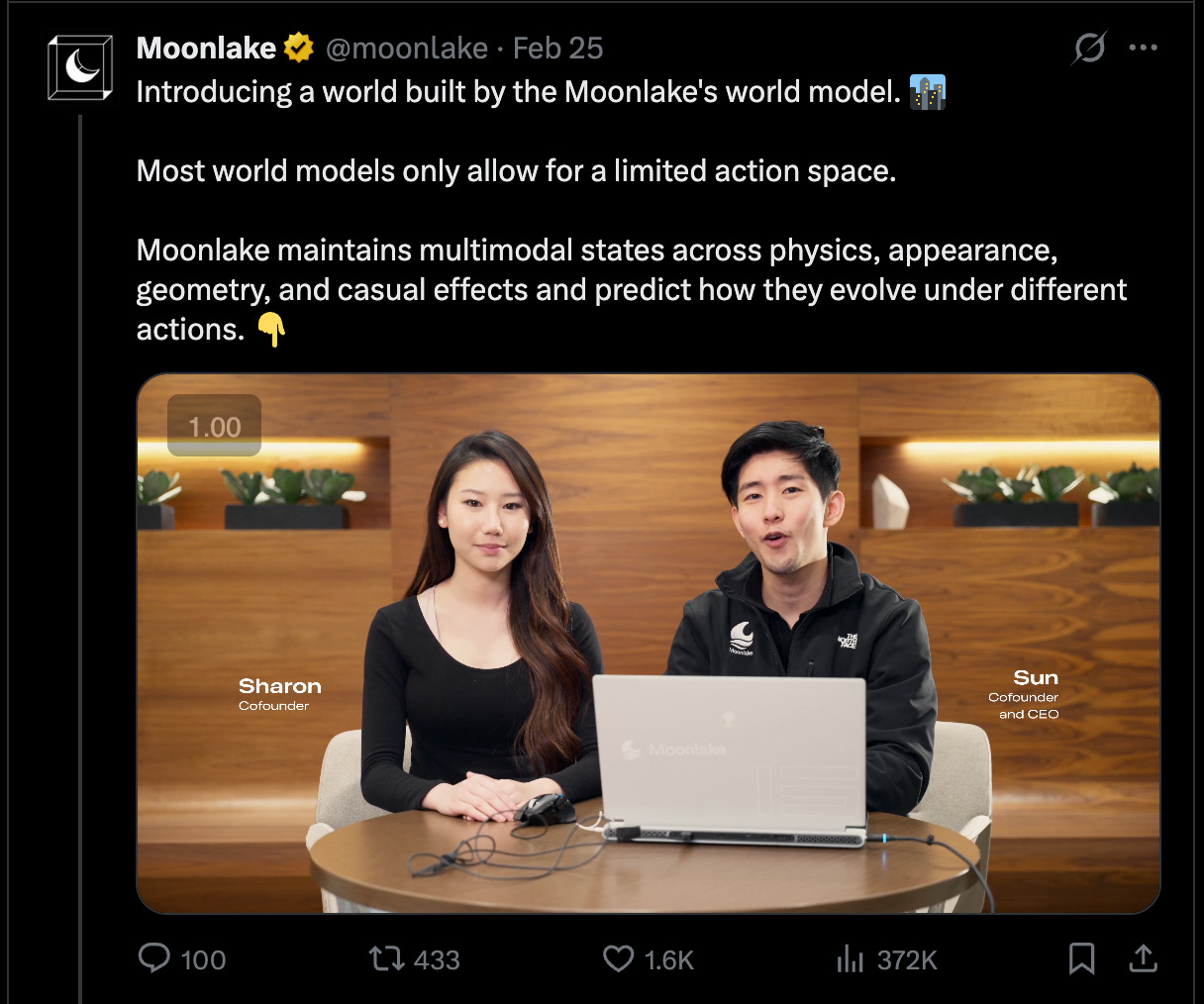
Unlike video generation models that merely predict pixels, Moonlake argues a true world model must understand and predict the consequences of actions over time. This requires an abstracted, semantic understanding of the world, not just visual fidelity.
Related Insights
Sora 2's most significant advancement is not its visual quality, but its ability to understand and simulate physics. The model accurately portrays how water splashes or vehicles kick up snow, demonstrating a grasp of cause and effect crucial for true world-building.

Language is just one 'keyhole' into intelligence. True artificial general intelligence (AGI) requires 'world modeling'—a spatial intelligence that understands geometry, physics, and actions. This capability to represent and interact with the state of the world is the next critical phase of AI development beyond current language models.

Startups and major labs are focusing on "world models," which simulate physical reality, cause, and effect. This is seen as the necessary step beyond text-based LLMs to create agents that can truly understand and interact with the physical world, a key step towards AGI.
Today's AI models are powerful but lack a true sense of causality, leading to illogical errors. Unconventional AI's Naveen Rao hypothesizes that building AI on substrates with inherent time and dynamics—mimicking the physical world—is the key to developing this missing causal understanding.

To create persistent and interactive AI-generated worlds, Moon Lake uses a hybrid approach. It encodes deterministic rules and interactivity using symbolic representations like code, while leveraging pixel-based models only for the world's visual appearance. This allows for long-horizon memory and complex game mechanics that pixel-only models struggle with.

The AI's ability to handle novel situations isn't just an emergent property of scale. Waive actively trains "world models," which are internal generative simulators. This enables the AI to reason about what might happen next, leading to sophisticated behaviors like nudging into intersections or slowing in fog.

While a world model can generate a physically plausible arch, it doesn't understand the underlying physics of force distribution. This gap between pattern matching and causal reasoning is a fundamental split between AI and human intelligence, making current models unsuitable for mission-critical applications like architecture.

Moonlake uses a reasoning model for causality, physics, and game logic, while a separate diffusion model ("Reverie") renders this state into photorealistic visuals. This modularity allows for consistent interaction while offering aesthetic flexibility, described as "skins for worlds."
Prof. Cho outlines two competing visions for world models. One camp believes in high-fidelity, step-by-step prediction (e.g., video generation). The other, which he and Yann LeCun favor, argues for abstract, high-level latent models that can plan without simulating every detail, akin to human thinking.

Demis Hassabis sees video generation as more than a content tool; it's a step toward building AI with "world models." By learning to generate realistic scenes, these models develop an intuitive understanding of physics and causality, a foundational capability for AGI to perform long-term planning in the real world.
