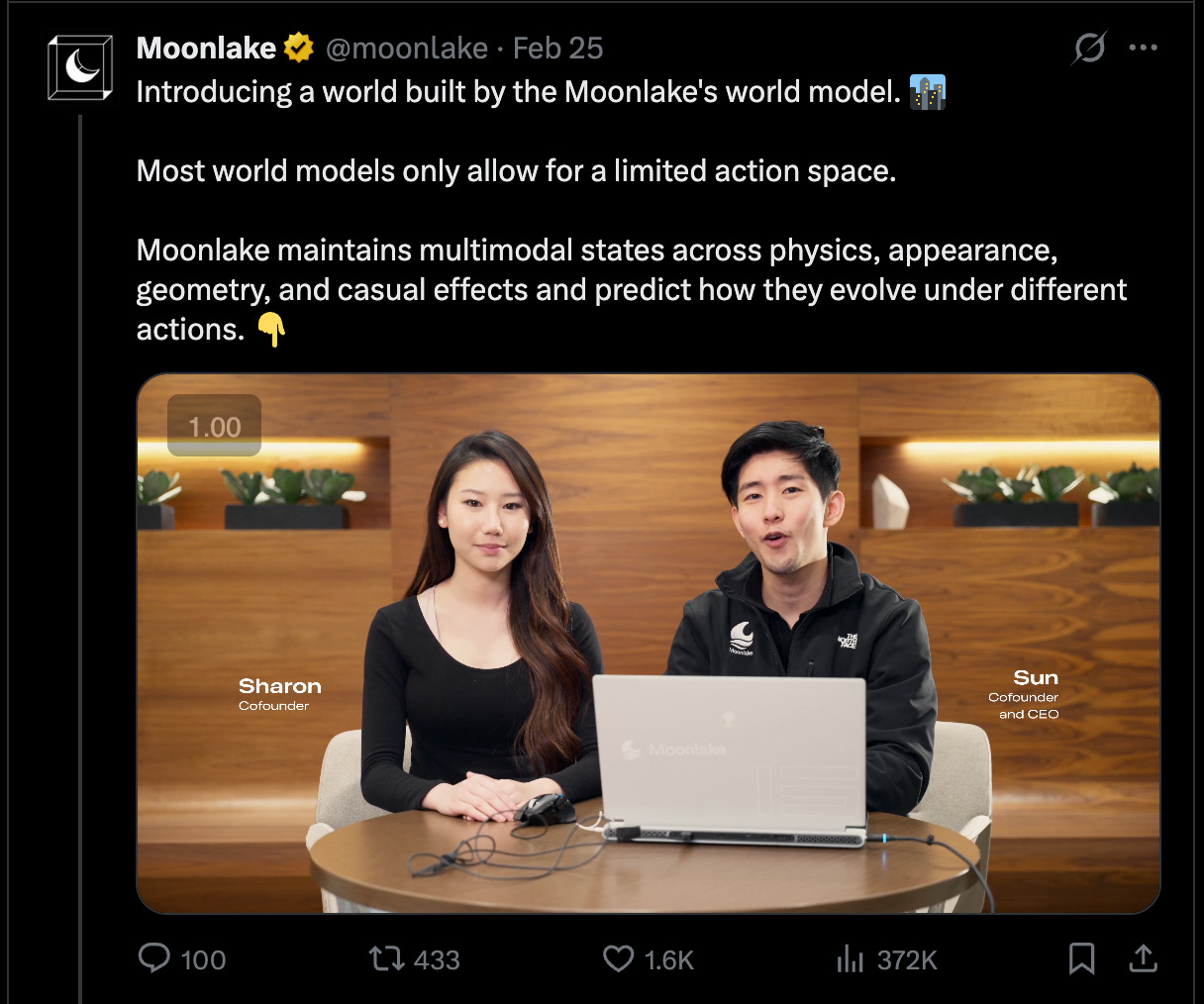
Unlike video generation models that merely predict pixels, Moonlake argues a true world model must understand and predict the consequences of actions over time. This requires an abstracted, semantic understanding of the world, not just visual fidelity.
While acknowledging the power of scale, Moonlake argues that incorporating symbolic structure allows models to learn with orders of magnitude less data. This mirrors human cognition, which uses abstracted semantic descriptions rather than processing every pixel.
Manning counters LeCun's philosophy that language is just a "low bit rate" add-on. He posits that language, as a symbolic system, was the cognitive tool that vaulted human intelligence, enabling abstract reasoning and long-term planning—capabilities essential for advanced AI.
Moonlake uses a reasoning model for causality, physics, and game logic, while a separate diffusion model ("Reverie") renders this state into photorealistic visuals. This modularity allows for consistent interaction while offering aesthetic flexibility, described as "skins for worlds."
Their Reverie model is not just a post-processing filter; it integrates into the game loop itself. Game state changes can dynamically trigger changes in rendering, creating novel interactions where visuals become part of the game mechanics, not just static aesthetics.
The speakers argue that complex generative systems like world models and even LLMs defy simple benchmarks. The ultimate measure of success is utility and user adoption—"people walking with their feet"—much like how consumers choose between GPT and Claude based on perceived value.
Great games are defined by their concept and gameplay, not just visual fidelity. Many successful games use primitive graphics, while visually stunning games often fail if mechanics are poor. This justifies focusing on a strong underlying world model that enables robust interaction.
Instead of training a separate spatial audio model, Moonlake's AI leverages a game engine as a tool. The engine's built-in understanding of 3D space allows the model to generate correct spatial audio as a natural, emergent consequence of actions within the simulated world.
Moonlake’s philosophy isn’t against the "bitter lesson" but reframes it. Instead of predicting raw bytes (the most extreme approach), the challenge is finding the most efficient abstraction for multimodal data—akin to tokens for text—to make learning tractable with current compute.