Get your free personalized podcast brief
We scan new podcasts and send you the top 5 insights daily.
A "world model" transcends simple video generation. It is defined by three key capabilities: real-time responsiveness to user input (e.g., mouse clicks), long-horizon consistency over minutes or hours, and interactivity via multiple modalities like keyboard and voice.

Related Insights
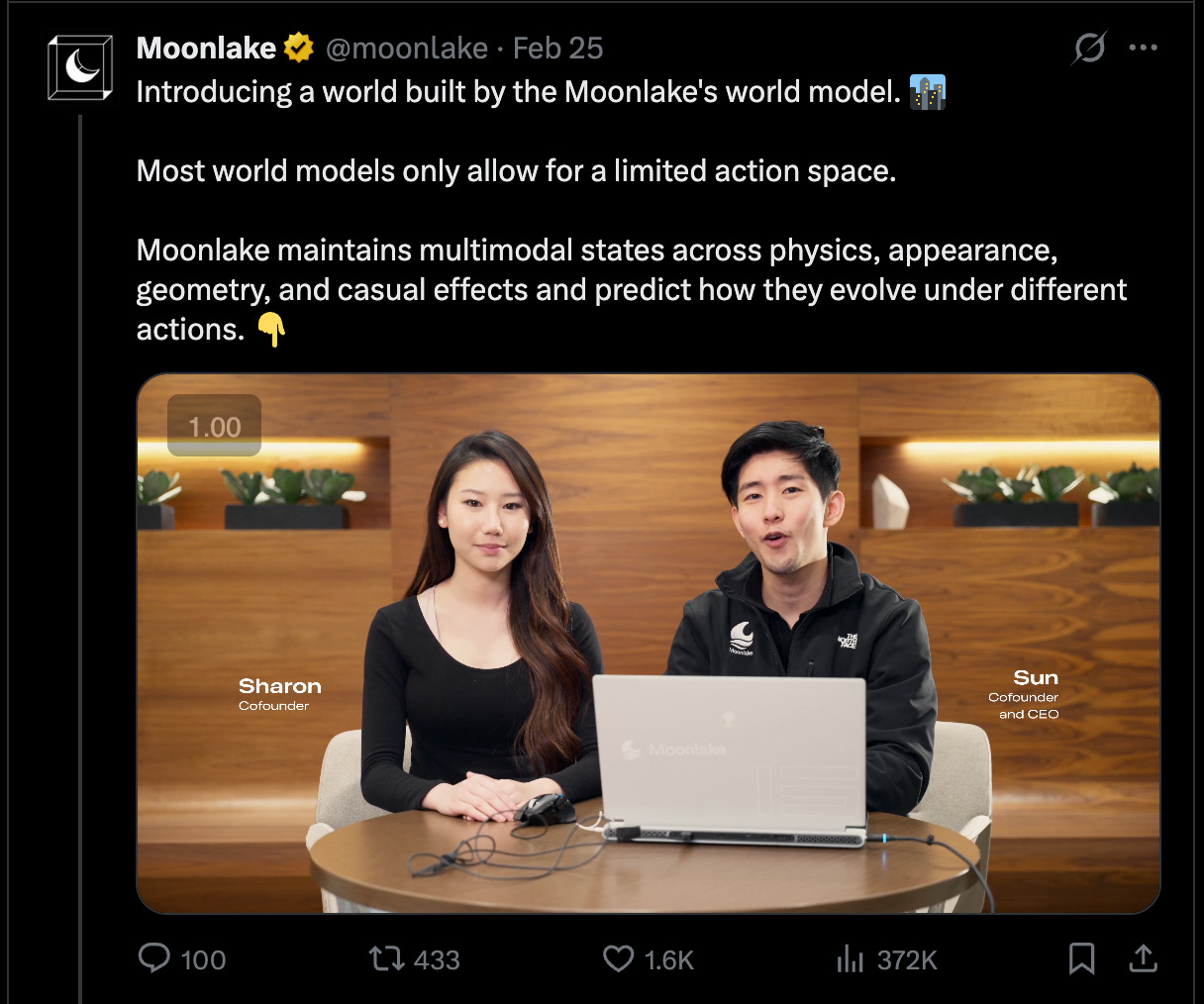
Unlike video generation models that merely predict pixels, Moonlake argues a true world model must understand and predict the consequences of actions over time. This requires an abstracted, semantic understanding of the world, not just visual fidelity.
Unlike video models that generate frame-by-frame, Marble natively outputs Gaussian splats—tiny, semi-transparent particles. This data structure enables real-time rendering, interactive editing, and precise camera control on client devices like mobile phones, a fundamental architectural advantage for interactive 3D experiences.

The future of video isn't just AI-generated clips but a new, interactive media format akin to a video game. Synthesia's CEO envisions personalized, real-time experiences like sales training simulations or conversational movies. This evolution is currently bottlenecked by the high cost and bandwidth of inference, which next-gen infrastructure aims to solve.

Startups and major labs are focusing on "world models," which simulate physical reality, cause, and effect. This is seen as the necessary step beyond text-based LLMs to create agents that can truly understand and interact with the physical world, a key step towards AGI.
Large language models are insufficient for tasks requiring real-world interaction and spatial understanding, like robotics or disaster response. World models provide this missing piece by generating interactive, reason-able 3D environments. They represent a foundational shift from language-based AI to a more holistic, spatially intelligent AI.

To create persistent and interactive AI-generated worlds, Moon Lake uses a hybrid approach. It encodes deterministic rules and interactivity using symbolic representations like code, while leveraging pixel-based models only for the world's visual appearance. This allows for long-horizon memory and complex game mechanics that pixel-only models struggle with.

Traditional video models process an entire clip at once, causing delays. Descartes' Mirage model is autoregressive, predicting only the next frame based on the input stream and previously generated frames. This LLM-like approach is what enables its real-time, low-latency performance.

While compressing video across the temporal dimension offers higher efficiency, it inherently introduces latency. For real-time, interactive applications like "world models," a less efficient frame-by-frame compression approach is necessary to enable immediate responsiveness.
AI video is evolving from passive generation to active engagement. Synthesia's new products focus on the intersection of video and AI agents, allowing users to, for example, watch a training video and then enter a role-playing simulation with an AI to test their comprehension.

Demis Hassabis sees video generation as more than a content tool; it's a step toward building AI with "world models." By learning to generate realistic scenes, these models develop an intuitive understanding of physics and causality, a foundational capability for AGI to perform long-term planning in the real world.
