Get your free personalized podcast brief
We scan new podcasts and send you the top 5 insights daily.
Even if not consistently outperforming models like Fable, Kimi K3 is valuable because its different architecture and training data allow it to find errors or solutions that other models miss. This makes it a powerful complementary tool for 'blending' with other AIs to achieve superior, more robust results.

Related Insights
Kimi K3 achieves performance close to top Western models but breaks the mold of cheap Chinese AI. Its high parameter count and operational costs create a new category of expensive, high-performance open models, closing the traditional cost gap with proprietary competitors like Anthropic and OpenAI.
The researchers' failure case analysis is highlighted as a key contribution. Understanding why the model fails—due to ambiguous data or unusual inputs—provides a realistic scope of application and a clear roadmap for improvement, which is more useful for practitioners than high scores alone.
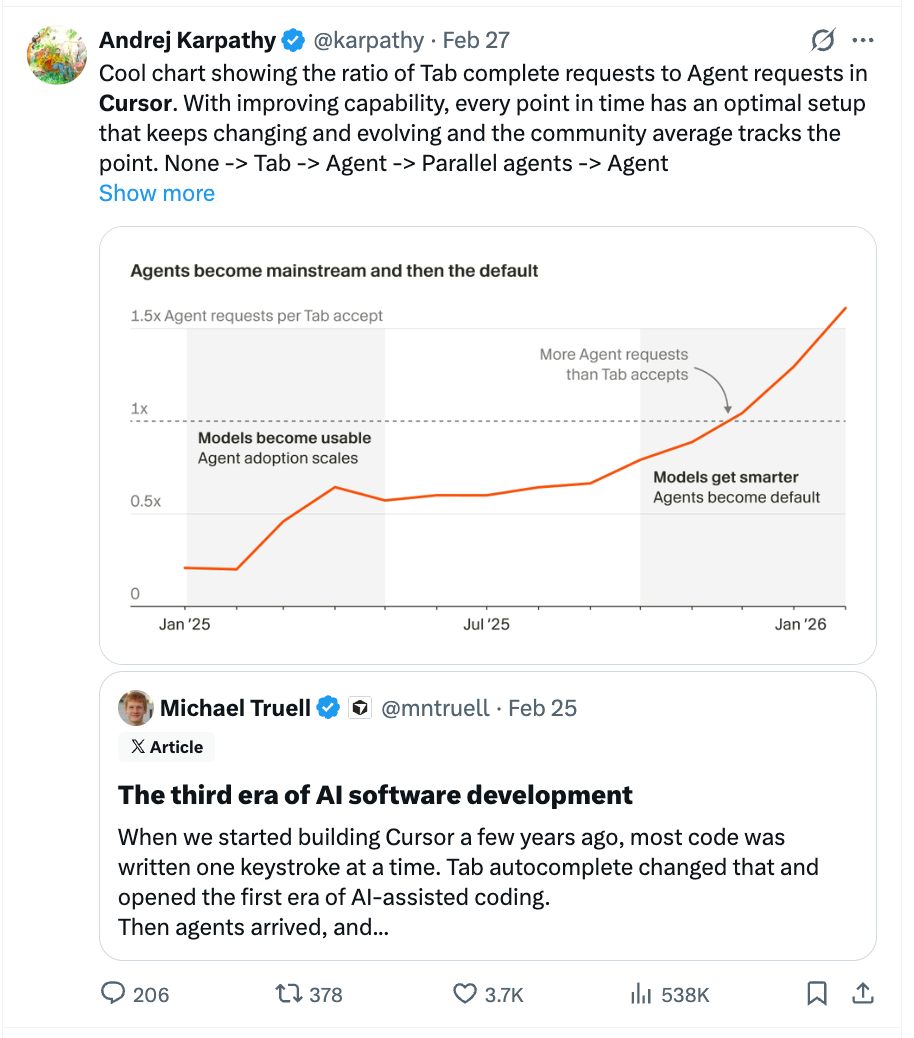
Cursor found an agentic layer combining learnings from models by different providers created a synergistic output, superior to relying on a single, unified model tier. This highlights the value of model diversity in agentic systems, as different models possess unique strengths.
By making different foundation models (like Gemini and Claude) collaborate, developers can achieve superior outcomes. One model's unique knowledge, such as using a free RSS feed instead of costly APIs, can create vastly more efficient and creative solutions than a single model could alone.

The AI model landscape isn't a simple ladder of best to worst. Instead, it's a "spiky" frontier where different models offer unique strengths. For example, one model may excel at complex, niche problems while another is faster, more affordable, and better for collaborative, general-purpose tasks, necessitating a multi-tool approach.

An intelligent AI orchestration layer can achieve a cost-to-accuracy balance superior to any single model. By routing queries to a portfolio of different models (large, small, specialized), it creates a new Pareto frontier, delivering higher success rates at a lower average cost than relying on one "best" model.

Breakthroughs will emerge from 'systems' of AI—chaining together multiple specialized models to perform complex tasks. GPT-4 is rumored to be a 'mixture of experts,' and companies like Wonder Dynamics combine different models for tasks like character rigging and lighting to achieve superior results.

Chinese AI models like Kimi achieve dramatic cost reductions through specific architectural choices, not just scale. Using a "mixture of experts" design, they only utilize a fraction of their total parameters for any given task, making them far more efficient to run than the "dense" models common in the West.

The belief that a single, god-level foundation model would dominate has proven false. Horowitz points to successful AI applications like Cursor, which uses 13 different models. This shows that value lies in the complex orchestration and design at the application layer, not just in having the largest single model.

Instead of relying on a single "best" foundation model, the winning strategy will be creating "harnesses" that combine multiple models. This approach leverages the unique, exponential advantages of each lab—for instance, using Google's Gemini for multimodal tasks and Anthropic's Claude for code generation.
