Get your free personalized podcast brief
We scan new podcasts and send you the top 5 insights daily.
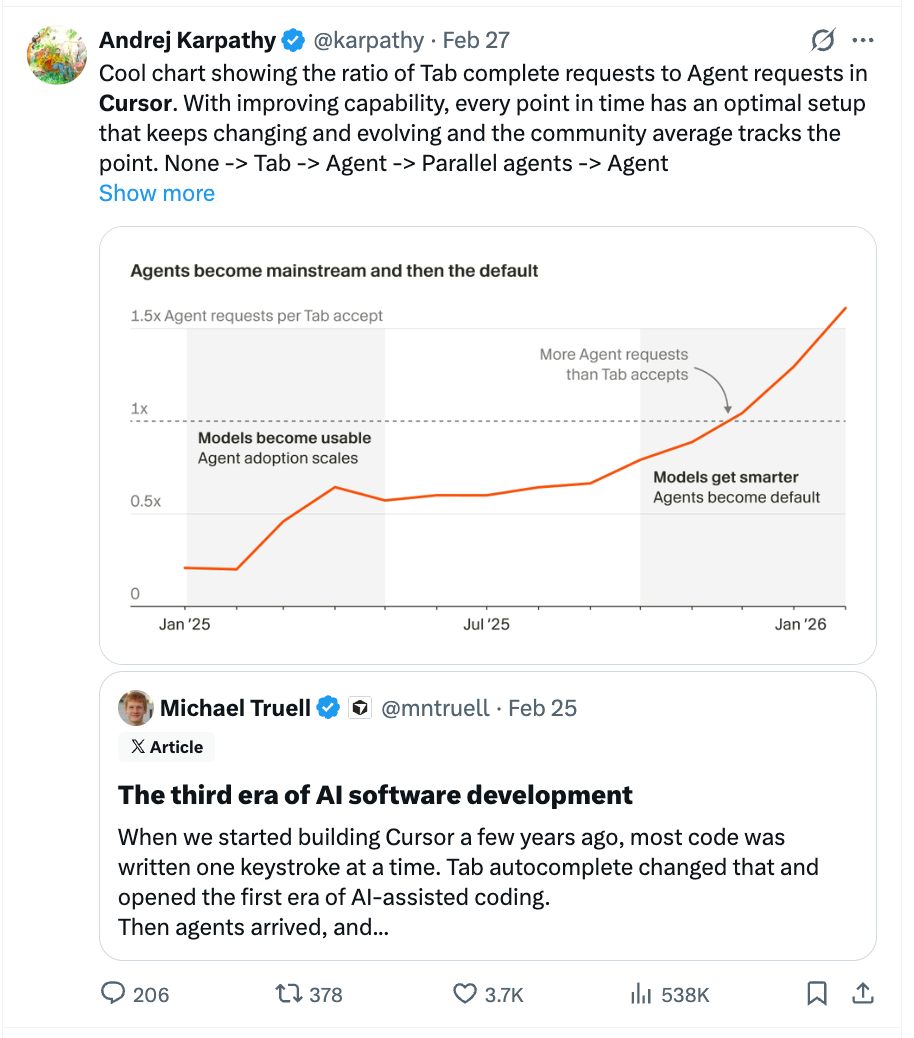
Cursor found an agentic layer combining learnings from models by different providers created a synergistic output, superior to relying on a single, unified model tier. This highlights the value of model diversity in agentic systems, as different models possess unique strengths.
Related Insights
The argument that Moltbook is just one model "talking to itself" is flawed. Even if agents share a base model like Opus 4.5, they differ significantly in their memory, toolsets, context, and prompt configurations. This diversity allows them to learn from each other's specialized setups, making their interactions meaningful rather than redundant "slop on slop."

The true power of the AI application layer lies in orchestrating multiple, specialized foundation models. Users want a single interface (like Cursor for coding) that intelligently routes tasks to the best model (e.g., Gemini for front-end, Codex for back-end), creating value through aggregation and workflow integration.

Instead of relying on a single AI, use different models (e.g., ChatGPT for internal context, Claude for an objective view) for the same problem. This multi-model approach generates diverse perspectives and higher-quality strategic outputs.

Different LLMs have unique strengths and knowledge gaps. Instead of relying on one model, an "LLM Council" approach queries multiple models (e.g., Claude, Gemini) for the same prompt and then uses an agent to aggregate and synthesize the responses into one superior output.
Breakthroughs will emerge from 'systems' of AI—chaining together multiple specialized models to perform complex tasks. GPT-4 is rumored to be a 'mixture of experts,' and companies like Wonder Dynamics combine different models for tasks like character rigging and lighting to achieve superior results.

The belief that a single, god-level foundation model would dominate has proven false. Horowitz points to successful AI applications like Cursor, which uses 13 different models. This shows that value lies in the complex orchestration and design at the application layer, not just in having the largest single model.

Building one centralized AI model is a legacy approach that creates a massive single point of failure. The future requires a multi-layered, agentic system where specialized models are continuously orchestrated, providing checks and balances for a more resilient, antifragile ecosystem.

Replit's leap in AI agent autonomy isn't from a single superior model, but from orchestrating multiple specialized agents using models from various providers. This multi-agent approach creates a different, faster scaling paradigm for task completion compared to single-model evaluations, suggesting a new direction for agent research.
Block's CTO believes the key to building complex applications with AI isn't a single, powerful model. Instead, he predicts a future of "swarm intelligence"—where hundreds of smaller, cheaper, open-source agents work collaboratively, with their collective capability surpassing any individual large model.

Powerful AI tools are becoming aggregators like Manus, which intelligently select the best underlying model for a specific task—research, data visualization, or coding. This multi-model approach enables a seamless workflow within a single thread, outperforming systems reliant on one general-purpose model.
