Get your free personalized podcast brief
We scan new podcasts and send you the top 5 insights daily.
By making different foundation models (like Gemini and Claude) collaborate, developers can achieve superior outcomes. One model's unique knowledge, such as using a free RSS feed instead of costly APIs, can create vastly more efficient and creative solutions than a single model could alone.

Related Insights
The true power of the AI application layer lies in orchestrating multiple, specialized foundation models. Users want a single interface (like Cursor for coding) that intelligently routes tasks to the best model (e.g., Gemini for front-end, Codex for back-end), creating value through aggregation and workflow integration.

An effective AI development workflow involves treating models as a team of specialists. Use Claude as the reliable 'workhorse' for building an application from the ground up, while leveraging models like Gemini or GPT-4 as 'advisory models' for creative input and alternative problem-solving perspectives.

Use a highly intelligent model like Opus for high-level planning and a more diligent, execution-focused model like a GPT-Codex variant for implementation. This 'best of both worlds' approach within a model-agnostic harness leads to superior results compared to relying on a single model for all tasks.

Create a custom Claude Code skill that sends a spec or problem to multiple LLM APIs (e.g., ChatGPT, Gemini, Grok) simultaneously. This "council of AIs" provides diverse feedback, catching errors or omissions that a single model might miss, leading to more robust plans.
Instead of relying on a single AI, use different models (e.g., ChatGPT for internal context, Claude for an objective view) for the same problem. This multi-model approach generates diverse perspectives and higher-quality strategic outputs.

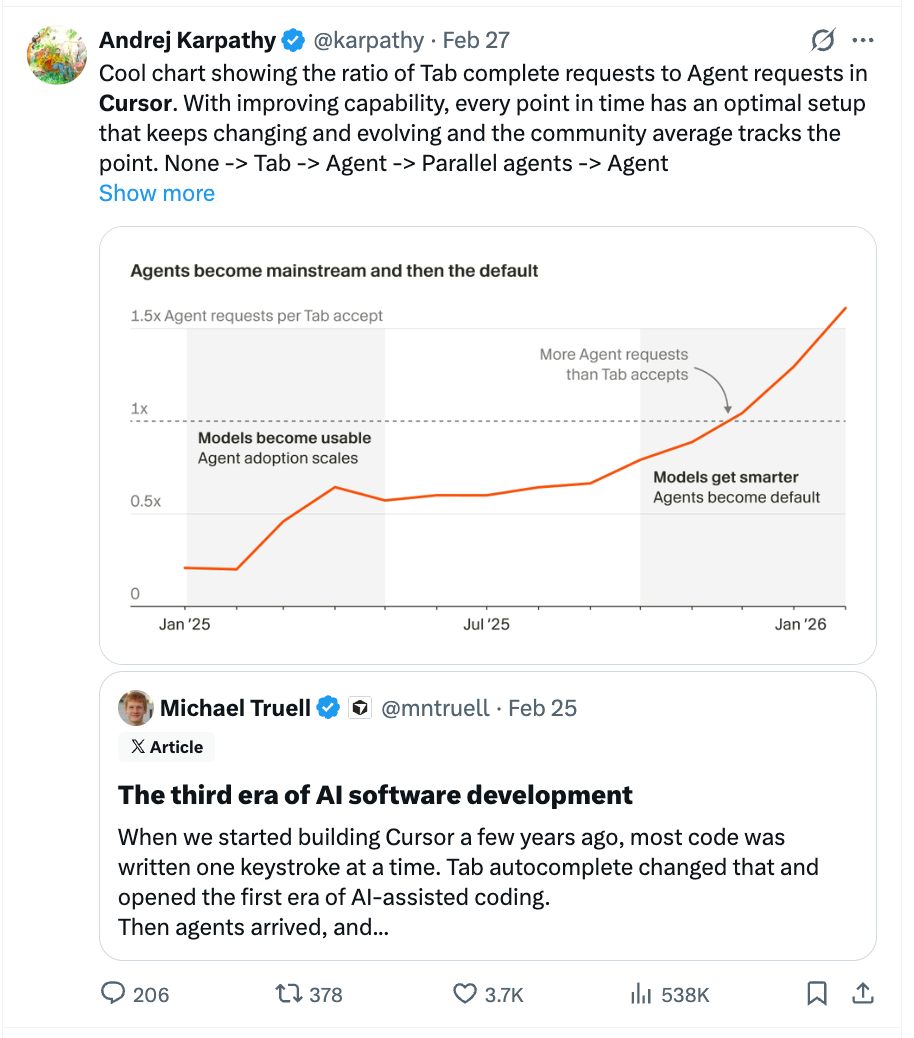
Cursor found an agentic layer combining learnings from models by different providers created a synergistic output, superior to relying on a single, unified model tier. This highlights the value of model diversity in agentic systems, as different models possess unique strengths.
Different LLMs have unique strengths and knowledge gaps. Instead of relying on one model, an "LLM Council" approach queries multiple models (e.g., Claude, Gemini) for the same prompt and then uses an agent to aggregate and synthesize the responses into one superior output.
Breakthroughs will emerge from 'systems' of AI—chaining together multiple specialized models to perform complex tasks. GPT-4 is rumored to be a 'mixture of experts,' and companies like Wonder Dynamics combine different models for tasks like character rigging and lighting to achieve superior results.

Treat different LLMs like colleagues with distinct personalities. Zevi Arnovitz views Claude as a collaborative dev lead, Codex (GPT) as a brilliant but terse bug-fixer, and Gemini as a creative but chaotic designer. This mental model helps in delegating tasks to the most suitable AI, maximizing their strengths and mitigating their weaknesses.
Microsoft's Copilot platform doesn't rely on a single foundation model. It automatically routes user tasks to different models based on what works best for the job—using OpenAI for interactive chat but switching to Claude for long-running, tool-using background tasks.
