Get your free personalized podcast brief
We scan new podcasts and send you the top 5 insights daily.
An intelligent AI orchestration layer can achieve a cost-to-accuracy balance superior to any single model. By routing queries to a portfolio of different models (large, small, specialized), it creates a new Pareto frontier, delivering higher success rates at a lower average cost than relying on one "best" model.

Related Insights
The true power of the AI application layer lies in orchestrating multiple, specialized foundation models. Users want a single interface (like Cursor for coding) that intelligently routes tasks to the best model (e.g., Gemini for front-end, Codex for back-end), creating value through aggregation and workflow integration.

A single AI model is insufficient for running a complex company. An orchestration layer allows you to assign different models (e.g., a powerful frontier model for the CEO, cheaper models for routine tasks) based on their unique "personalities" and cost-effectiveness.

Recognizing there is no single "best" LLM, AlphaSense built a system to test and deploy various models for different tasks. This allows them to optimize for performance and even stylistic preferences, using different models for their buy-side finance clients versus their corporate users.

Advanced AI architectures will use small, fast, and cheap local models to act as intelligent routers. These models will first analyze a complex request, formulate a plan, and then delegate different sub-tasks to a fleet of more powerful or specialized models, optimizing for cost and performance.
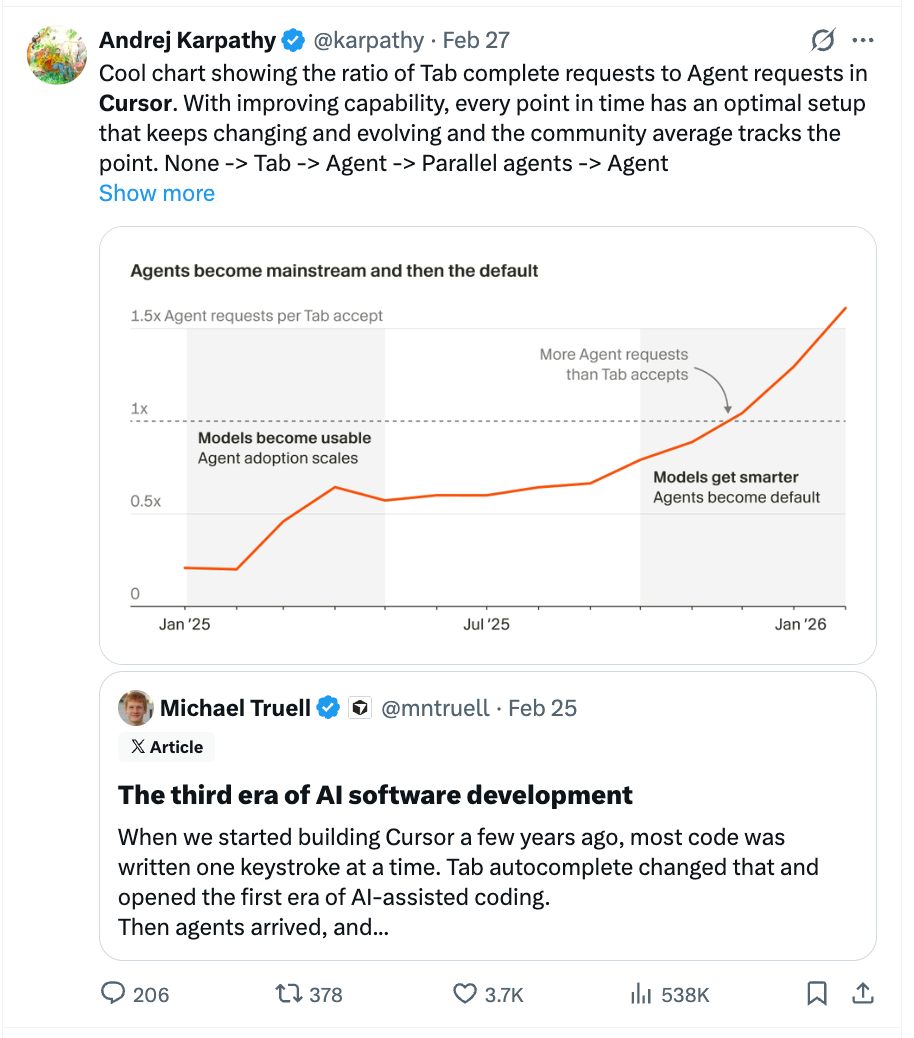
Cursor found an agentic layer combining learnings from models by different providers created a synergistic output, superior to relying on a single, unified model tier. This highlights the value of model diversity in agentic systems, as different models possess unique strengths.
Enterprises will shift from relying on a single large language model to using orchestration platforms. These platforms will allow them to 'hot swap' various models—including smaller, specialized ones—for different tasks within a single system, optimizing for performance, cost, and use case without being locked into one provider.

The belief that a single, god-level foundation model would dominate has proven false. Horowitz points to successful AI applications like Cursor, which uses 13 different models. This shows that value lies in the complex orchestration and design at the application layer, not just in having the largest single model.

Building one centralized AI model is a legacy approach that creates a massive single point of failure. The future requires a multi-layered, agentic system where specialized models are continuously orchestrated, providing checks and balances for a more resilient, antifragile ecosystem.
Perplexity's core advantage is its model-agnostic orchestration. Unlike vertically integrated competitors (Google, OpenAI), it can select the best model for any task—whether from GPT, Claude, or open-source alternatives—to offer a superior, specialized "orchestra" of AI capabilities.

As foundational AI models become commoditized 'intelligence utilities,' the economic value moves up the stack. Orchestrators like OpenClaw, which can intelligently route tasks to the most efficient model based on cost or use case, are positioned to capture the margin that the underlying model providers cannot.
