Get your free personalized podcast brief
We scan new podcasts and send you the top 5 insights daily.
Pichai reveals Google's operational tactic for maintaining speed: teams have "latency budgets" in milliseconds. If a feature saves time, they earn a credit they can "spend" on new capabilities, ensuring the user experience remains fast while the product evolves.

Related Insights
To stay connected with user experience, Sundar Pichai goes beyond typical dogfooding. He now uses an internal AI agent to query and summarize public sentiment about product launches, asking it for the "worst five things" and "best five things" people are saying.
As frontier AI models reach a plateau of perceived intelligence, the key differentiator is shifting to user experience. Low-latency, reliable performance is becoming more critical than marginal gains on benchmarks, making speed the next major competitive vector for AI products like ChatGPT.

In 2001, Google realized its combined server RAM could hold a full copy of its web index. Moving from disk-based to in-memory systems eliminated slow disk seeks, enabling complex queries with synonyms and semantic expansion. This fundamentally improved search quality long before LLMs became mainstream.
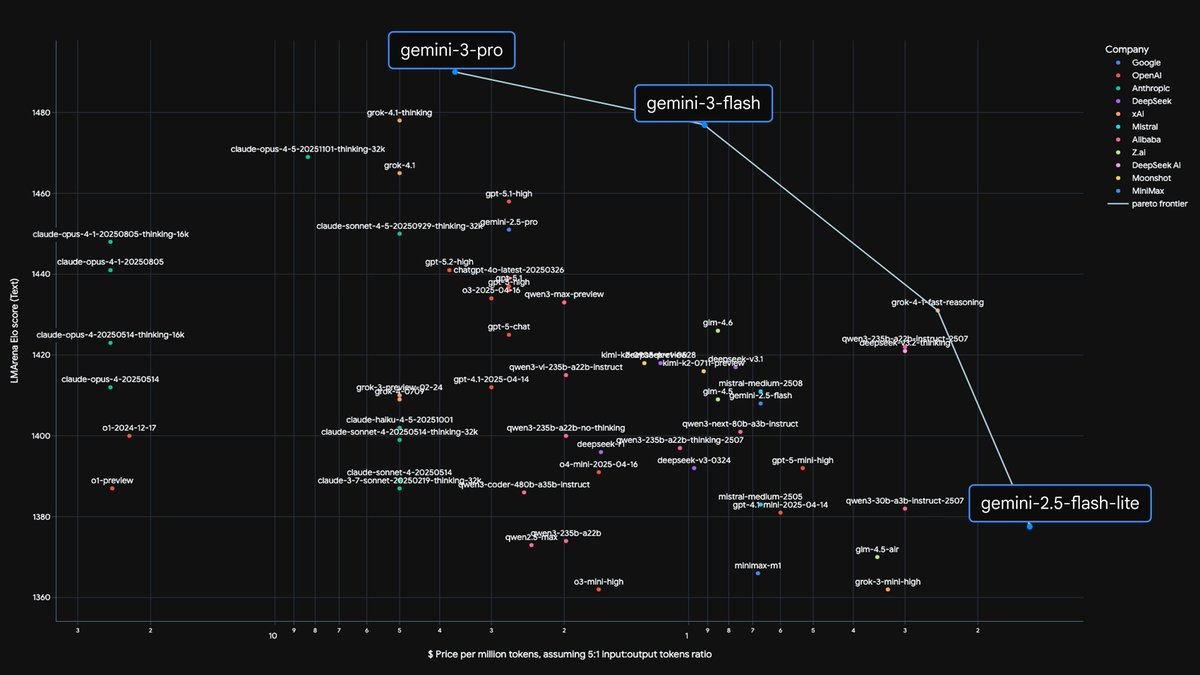
Google's strategy involves creating both cutting-edge models (Pro/Ultra) and efficient ones (Flash). The key is using distillation to transfer capabilities from large models to smaller, faster versions, allowing them to serve a wide range of use cases from complex reasoning to everyday applications.
Unlike feed-based social products where features compete for attention, search products allow for parallel development. Different teams can ship features with little negative impact on each other, simplifying organizational scaling.

Leadership actively evaluates the maturity of core technologies like Gemini to decide when to "double down" on specific applications, such as infusing AI into learning science. This treats timing not as a passive deadline, but as a core management principle for pausing or accelerating projects.

Instead of being replaced by AI chatbots or agents, Pichai believes Search will evolve to manage them. Users will run multiple, long-running tasks, and Search will become the interface to orchestrate these agentic flows, expanding its capabilities rather than becoming obsolete.
When technical performance hits a ceiling, design can solve the user's experience of speed. Perceived performance is a design problem addressed through interactions, optimistic UI, and loading states, making the product feel faster even when the underlying systems are not.

For teams in hyper-competitive spaces like AI, speed is not a goal but a necessity. The team's mindset is that there is no alternative to shipping fast; it's the only way to operate, learn, and stay relevant. This isn't a choice, but a requirement for survival.

Sundar Pichai notes an ironic consequence of the AI boom: the scarcity of TPUs forces a more disciplined capital allocation process. Since all major projects, including Waymo, now compete for the same limited compute resources, the trade-offs are more explicit and front-of-mind than ever before.