Get your free personalized podcast brief
We scan new podcasts and send you the top 5 insights daily.
AppLovin's CTO doesn't see AI as a collaborator but as a foundation. The engineer's role is to sit "on top of" AI, focusing on higher-level problems like long-horizon planning that AI can't yet handle. As AI's capabilities grow, the engineer's role is continuously elevated.

Related Insights
The rise of AI doesn't change your team's fundamental goals. Leaders should demystify AI by positioning it as just another powerful tool, similar to past technological shifts. The core work remains the same; AI just helps you do it better and faster.

The terminology for AI tools (agent, co-pilot, engineer) is not just branding; it shapes user expectations. An "engineer" implies autonomous, asynchronous problem-solving, distinct from a "co-pilot" that assists or an "agent" that performs single-shot tasks. This positioning is critical for user adoption.
An OpenAI engineer advised Cisco's team to stop thinking of their AI coder as a tool. Reframing it as a new teammate fundamentally changed how they interacted with it, improving collaboration and outcomes. This mental model shifts from command-giving to partnership.

The strategic narrative for AI integration is shifting from automation (replacement) to augmentation (collaboration). Augmentation positions AI as an assistant that enhances human skills, enabling teams to achieve outcomes that neither humans nor AI could accomplish independently. This fosters a more inclusive and productive environment.
With AI agents automating raw code generation, an engineer's role is evolving beyond pure implementation. To stay valuable, engineers must now cultivate a deep understanding of business context and product taste to know *what* to build and *why*, not just *how*.

Top-performing engineering teams are evolving from hands-on coding to a managerial role. Their primary job is to define tasks, kick off multiple AI agents in parallel, review plans, and approve the final output, rather than implementing the details themselves.

As AI coding agents become more capable, the primary skill for engineers is evolving. It's less about writing individual lines of code and more about the managerial skills of delegation, context switching, and designing and overseeing systems of agents, mirroring the transition managers go through.

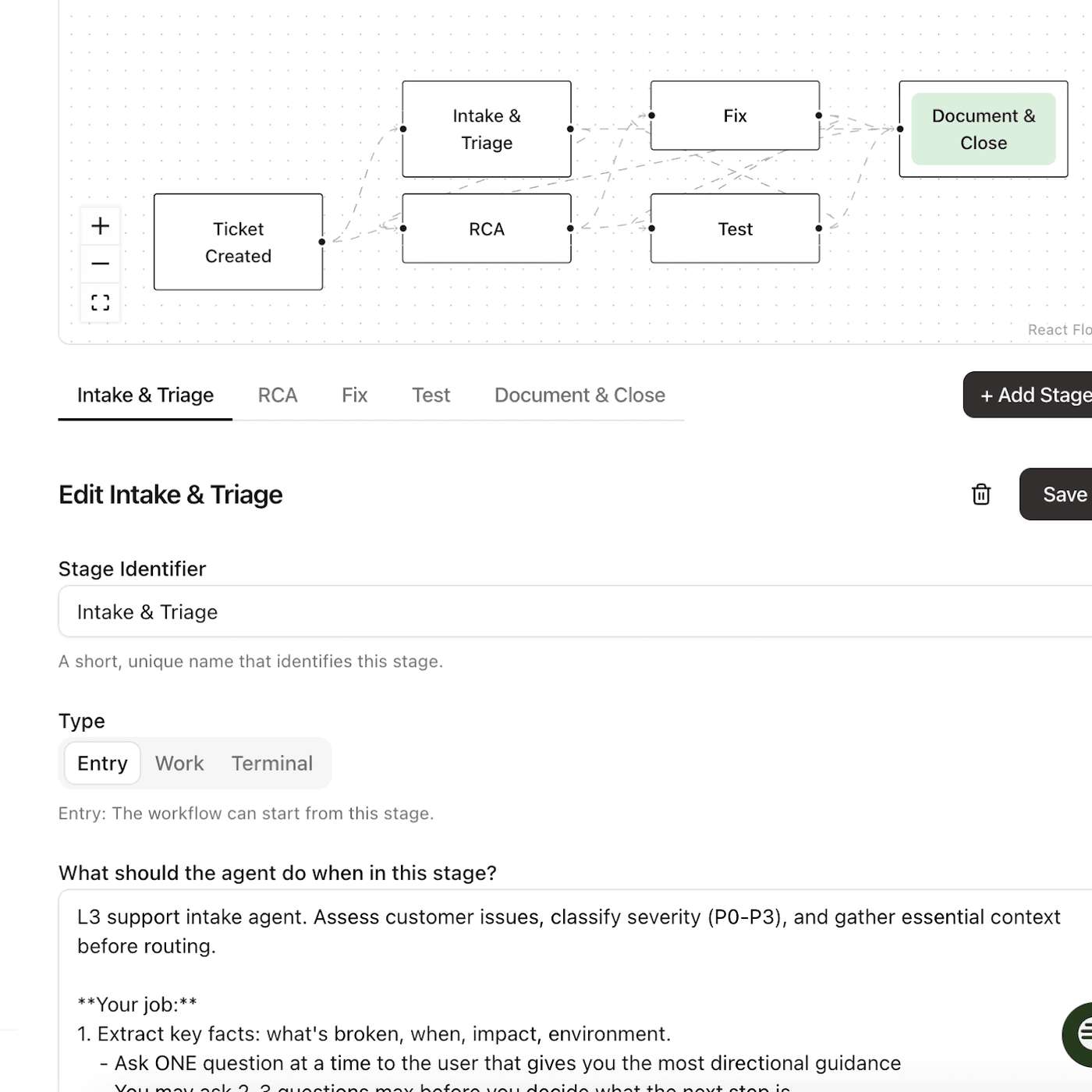
The AI agent's purpose is framed not as a replacement for engineers but as a tool to augment them. Its primary function is to handle the tedious, time-consuming tasks known as 'toil'—initial triage, data gathering, and running basic tests—freeing up senior engineers for high-judgment work that requires human expertise.
AI coding agents are not a replacement for experience but an amplifier. Senior engineers can leverage their deep knowledge and sophisticated vocabulary to direct agents with high precision, making them more effective than ever. This requires 'every inch' of their accumulated experience to manage complex parallel tasks.

With AI's ability to generate working code quickly, an engineer's role is evolving. Value is shifting from speed in finding a solution—which a robot can do faster—to a more strategic role of understanding the full suite of tools and recognizing how human expertise fits into a broader, more complex system.