Get your free personalized podcast brief
We scan new podcasts and send you the top 5 insights daily.
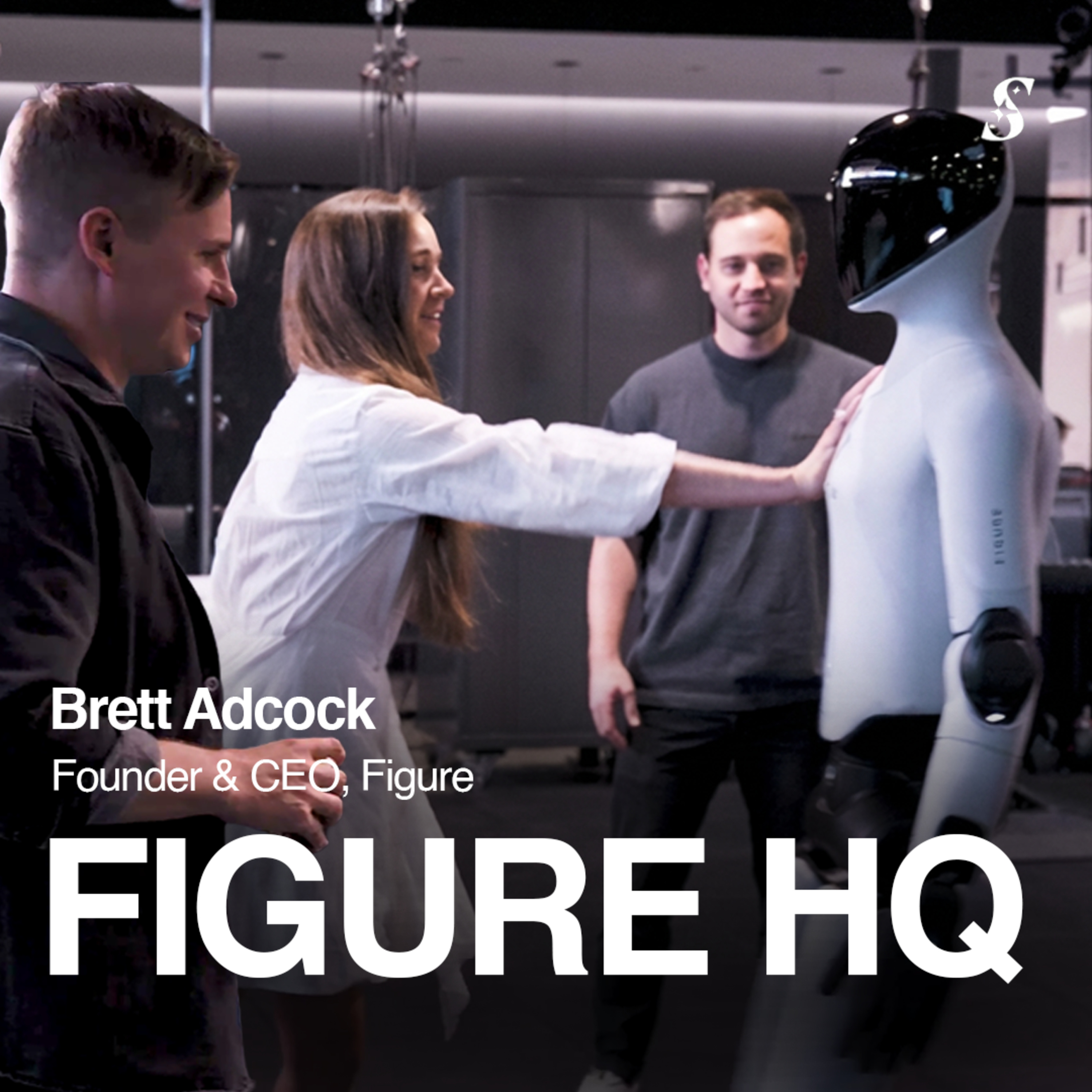
Figure's first robots were optimized for development speed using expensive CNC manufacturing. For its third generation, the company focused on design-for-manufacturing, successfully reducing the cost by nearly an order of magnitude while simultaneously improving the robot's capabilities and slimming its design.
Related Insights
After realizing its initial tendon-driven hand design was an engineering dead end, the team pivoted quickly. Rather than wait months for a full redesign, they repurposed motors from the robot's feet to power the wrist, creating a 'Frankenstein' prototype that allowed AI development to continue without delay.
According to Figure's CEO, the company's biggest challenge is no longer hardware reliability but acquiring enormous amounts of diverse, high-quality data. This data is essential for pre-training their Helix AI model to generalize and handle countless real-world scenarios in homes and commercial settings.
For consumer robotics, the biggest bottleneck is real-world data. By aggressively cutting costs to make robots affordable, companies can deploy more units faster. This generates a massive data advantage, creating a feedback loop that improves the product and widens the competitive moat.

Figure determined that coding robot movements is unscalable due to the infinite possible states (360^40). They pivoted from traditional C++ to Helix, an AI policy that controls the robot's entire body from camera inputs, treating robotics as a neural network problem, not a software engineering one.
Leading robotics companies are taking different paths to market. Boston Dynamics targets industrial use cases (e.g., DHL, BP). In contrast, both Figure AI and 1X are now focused on the home, but 1X is moving more aggressively by accepting consumer pre-orders first.

Zipline's 50% cost reduction for its next-gen aircraft wasn't just from supply chain optimization. The primary driver was a design philosophy focused on eliminating components entirely ("the best part is no part"), which also improves reliability.

While IP protection is a concern, Figure's primary reason for in-house manufacturing is the product's immaturity. The novelty of humanoid robots requires extremely tight control and rapid feedback loops between design, testing, and production that would be impossible to achieve with a contract manufacturer.
Car companies are uniquely positioned to build humanoid robots. They possess deep expertise in mass manufacturing complex systems with chips and batteries, and they are already heavy users of robotics in their own factories, giving them a significant advantage in the emerging market.

Figure designs nearly every component of its robots in-house, from motors to batteries. This extreme vertical integration, though costly upfront, prevents being at the mercy of third-party vendor timelines, code problems, or supply chain issues, enabling faster iteration and deeper system control.
Classical robots required expensive, rigid, and precise hardware because they were blind. Modern AI perception acts as 'eyes', allowing robots to correct for inaccuracies in real-time. This enables the use of cheaper, compliant, and inherently safer mechanical components, fundamentally changing hardware design philosophy.
