Get your free personalized podcast brief
We scan new podcasts and send you the top 5 insights daily.
After realizing its initial tendon-driven hand design was an engineering dead end, the team pivoted quickly. Rather than wait months for a full redesign, they repurposed motors from the robot's feet to power the wrist, creating a 'Frankenstein' prototype that allowed AI development to continue without delay.
Related Insights
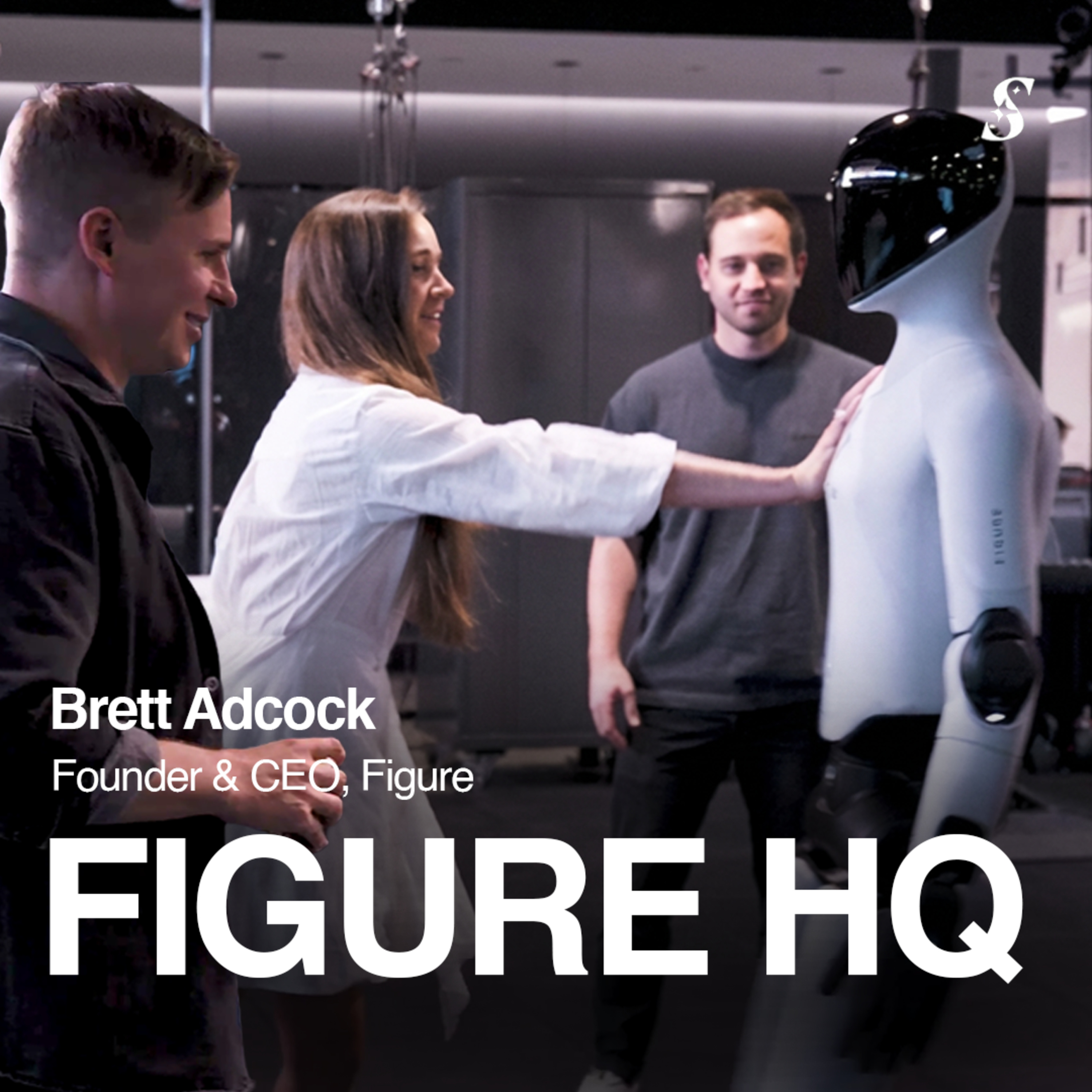
Brett Adcock argues that designing humanoid robots for extreme feats like backflips creates expensive, heavy, and unsafe machines. The optimal design targets the "fat part of the distribution" of human tasks—laundry, dishes, companionship—to build a practical, general-purpose robot for the mass market.

Unlike cloud-reliant AI, Figure's humanoids perform all computations onboard. This is a critical architectural choice to enable high-frequency (200Hz+) control loops for balance and manipulation, ensuring the robot remains fully functional and responsive without depending on Wi-Fi or 5G connectivity.

Figure chose to develop its AI systems in-house rather than rely on its partnership with OpenAI. The reason was that its own team proved superior at the highly specialized task of designing, embedding, and running models on physical robot hardware, a challenge distinct from training purely digital LLMs.
Figure determined that coding robot movements is unscalable due to the infinite possible states (360^40). They pivoted from traditional C++ to Helix, an AI policy that controls the robot's entire body from camera inputs, treating robotics as a neural network problem, not a software engineering one.
Figure's first robots were optimized for development speed using expensive CNC manufacturing. For its third generation, the company focused on design-for-manufacturing, successfully reducing the cost by nearly an order of magnitude while simultaneously improving the robot's capabilities and slimming its design.
While IP protection is a concern, Figure's primary reason for in-house manufacturing is the product's immaturity. The novelty of humanoid robots requires extremely tight control and rapid feedback loops between design, testing, and production that would be impossible to achieve with a contract manufacturer.
Figure designs nearly every component of its robots in-house, from motors to batteries. This extreme vertical integration, though costly upfront, prevents being at the mercy of third-party vendor timelines, code problems, or supply chain issues, enabling faster iteration and deeper system control.
Moving a robot from a lab demo to a commercial system reveals that AI is just one component. Success depends heavily on traditional engineering for sensor calibration, arm accuracy, system speed, and reliability. These unglamorous details are critical for performance in the real world.

Musk identifies three primary challenges for humanoid robots: real-world intelligence, manufacturing at scale, and the hand. He asserts that from an electromechanical standpoint, perfecting the human-like hand is more difficult than all other physical components combined, requiring custom-designed actuators from first principles.

CEO Brett Adcock posits that real-world interaction is the 'last missing piece' for AGI. Because humanoid robots can learn from physically touching the world, trial-and-error, and consequences, he believes they may be the first embodiments to achieve artificial general intelligence, surpassing purely digital models.