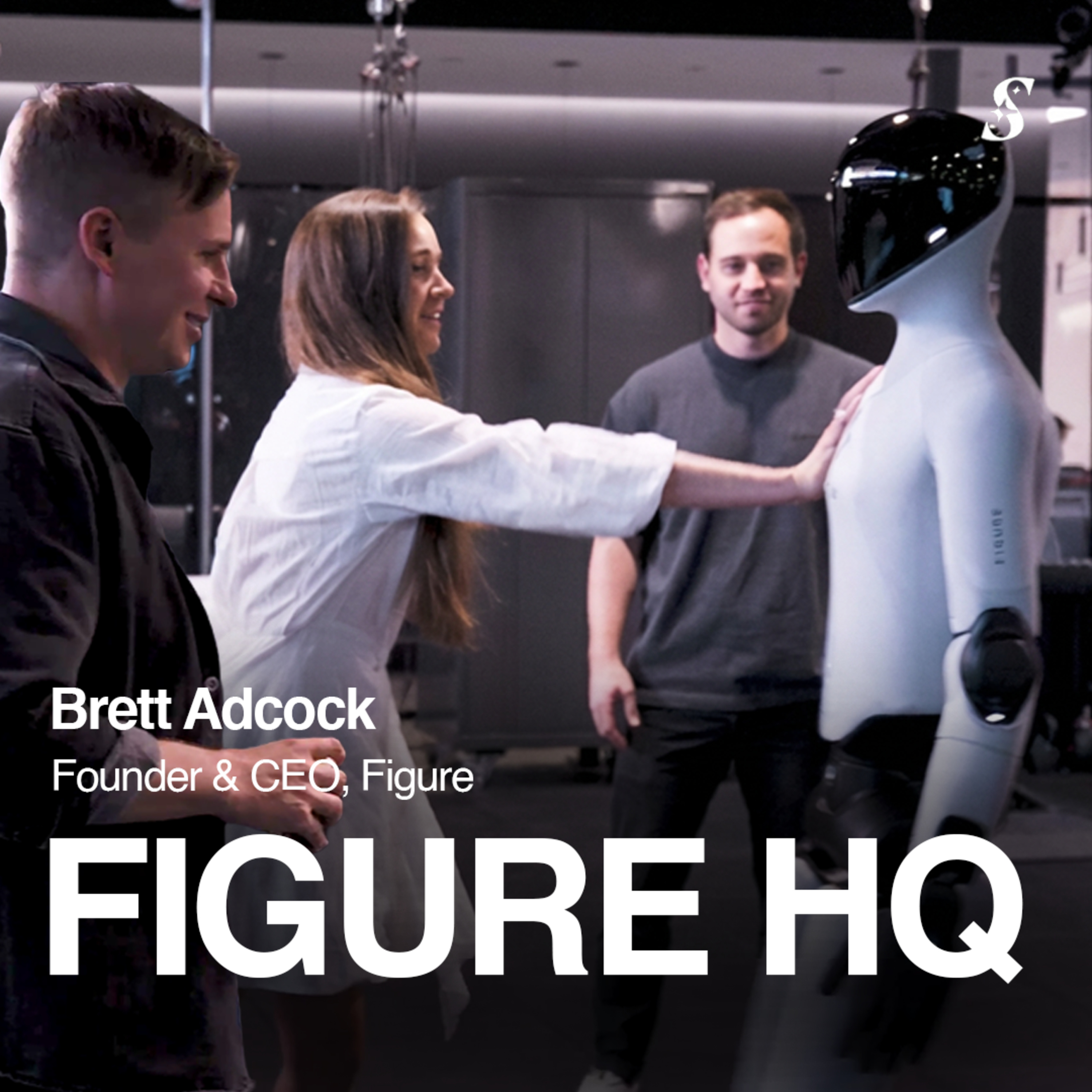
Figure determined that coding robot movements is unscalable due to the infinite possible states (360^40). They pivoted from traditional C++ to Helix, an AI policy that controls the robot's entire body from camera inputs, treating robotics as a neural network problem, not a software engineering one.
Figure trains its robot's stability controller entirely in a physics simulator, akin to a video game. This allows them to test countless scenarios synthetically. The resulting AI model is so effective it can be 'zero-shot' deployed directly onto the physical robot, achieving human-level stability immediately.
To prevent catastrophic failures, Figure's 'Vulcan' project trains its AI to handle hardware failures gracefully. If a robot loses power to a knee joint, it automatically locks the joint and begins hobbling on the remaining leg, allowing it to move to safety or await replacement without falling.
Figure's first robots were optimized for development speed using expensive CNC manufacturing. For its third generation, the company focused on design-for-manufacturing, successfully reducing the cost by nearly an order of magnitude while simultaneously improving the robot's capabilities and slimming its design.
CEO Brett Adcock posits that real-world interaction is the 'last missing piece' for AGI. Because humanoid robots can learn from physically touching the world, trial-and-error, and consequences, he believes they may be the first embodiments to achieve artificial general intelligence, surpassing purely digital models.
According to Figure's CEO, the company's biggest challenge is no longer hardware reliability but acquiring enormous amounts of diverse, high-quality data. This data is essential for pre-training their Helix AI model to generalize and handle countless real-world scenarios in homes and commercial settings.
After realizing its initial tendon-driven hand design was an engineering dead end, the team pivoted quickly. Rather than wait months for a full redesign, they repurposed motors from the robot's feet to power the wrist, creating a 'Frankenstein' prototype that allowed AI development to continue without delay.
Figure's robots do not rely on a cloud connection for their core functions. The Helix AI model runs inference on GPUs located inside the robot's torso. This allows them to perform complex tasks like logistics or tidying a house even if they lose network connectivity, ensuring high operational reliability.
While IP protection is a concern, Figure's primary reason for in-house manufacturing is the product's immaturity. The novelty of humanoid robots requires extremely tight control and rapid feedback loops between design, testing, and production that would be impossible to achieve with a contract manufacturer.
The fabric clothing on Figure's robots serves a practical purpose. It can be easily unzipped and replaced if dirty or damaged, avoiding the need for a technician. This also allows for simple customization with client logos and colors, effectively turning the robot into branded, functional workwear.
To achieve continuous, autonomous operation, Figure's robots recharge by standing on a 2kW wireless inductive charging pad. This design, similar to a phone charger, allows a robot to recharge for an hour to gain 4-5 hours of operational time, enabling seamless 24/7 work cycles without manual intervention.