Get your free personalized podcast brief
We scan new podcasts and send you the top 5 insights daily.
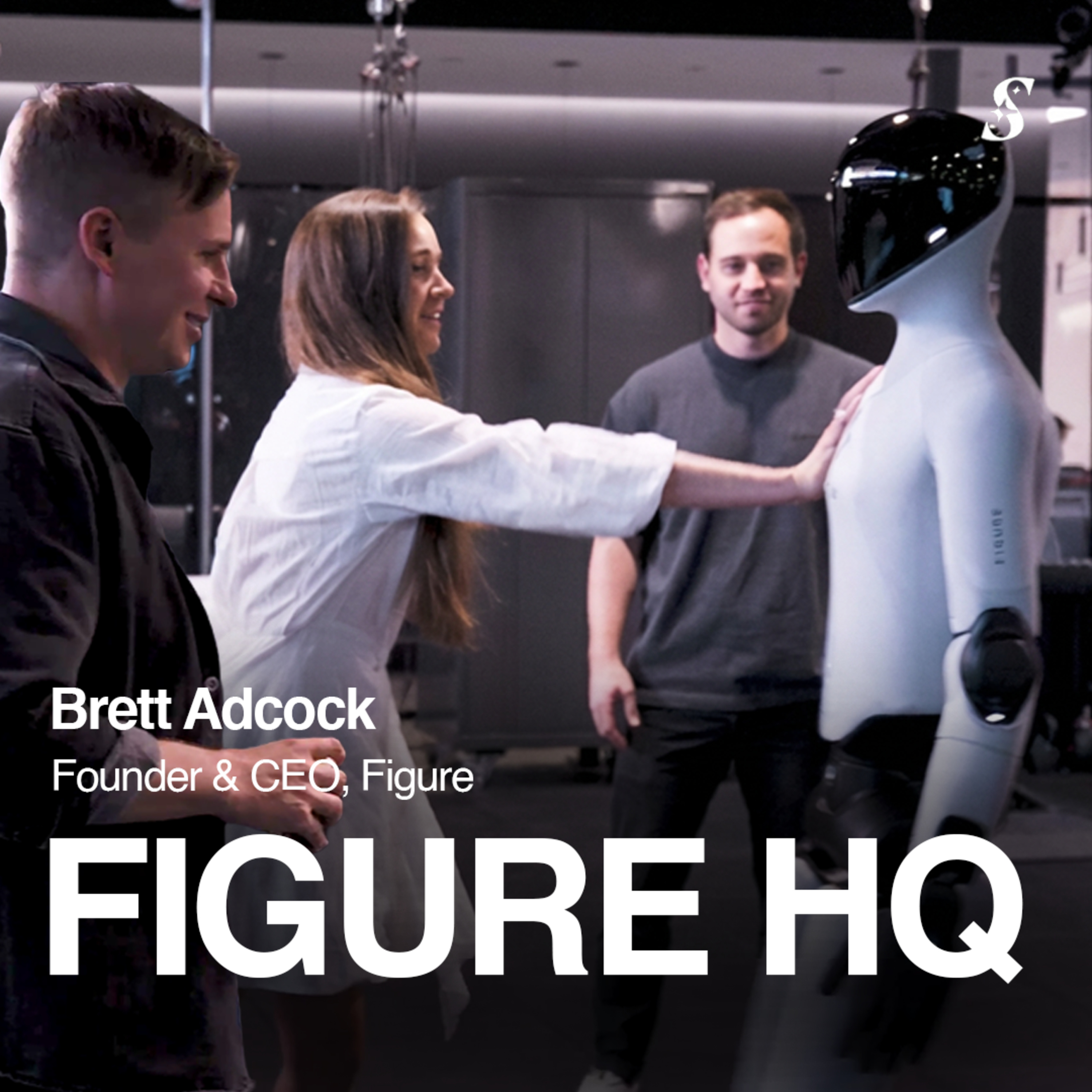
Figure determined that coding robot movements is unscalable due to the infinite possible states (360^40). They pivoted from traditional C++ to Helix, an AI policy that controls the robot's entire body from camera inputs, treating robotics as a neural network problem, not a software engineering one.
Related Insights
A core controversy in robotics is whether to follow AI's "bitter lesson"—that general methods using massive data outperform systems with hand-coded knowledge. Many roboticists still argue for programming in physics for reliability, resisting a purely end-to-end learning approach that relies solely on data.
![Sergey Levine - Building LLMs for the Physical World - [Invest Like the Best, EP.465] thumbnail](https://megaphone.imgix.net/podcasts/fdcd4328-2c77-11f1-a72b-977309fd08f1/image/b1bb4368d6e13a4a804924681ffe3ab1.jpg?ixlib=rails-4.3.1&max-w=3000&max-h=3000&fit=crop&auto=format,compress)
Figure trains its robot's stability controller entirely in a physics simulator, akin to a video game. This allows them to test countless scenarios synthetically. The resulting AI model is so effective it can be 'zero-shot' deployed directly onto the physical robot, achieving human-level stability immediately.
Instead of loading robots with costly sensors for touch or force, powerful learning models can infer physical properties from simple cameras. A wrist camera can act as a "touch sensor in disguise" by observing local deformations, dramatically lowering hardware costs and complexity for scalable robotics.
Unlike cloud-reliant AI, Figure's humanoids perform all computations onboard. This is a critical architectural choice to enable high-frequency (200Hz+) control loops for balance and manipulation, ensuring the robot remains fully functional and responsive without depending on Wi-Fi or 5G connectivity.

Physical Intelligence demonstrated an emergent capability where its robotics model, after reaching a certain performance threshold, significantly improved by training on egocentric human video. This solves a major bottleneck by leveraging vast, existing video datasets instead of expensive, limited teleoperated data.

According to Comma AI's CTO, the next frontier in robotics isn't just bigger models, but solving three fundamental challenges: 1) using ML for low-level controls, 2) making reinforcement learning (RL) practical for noisy environments, and 3) enabling continual, on-device learning to adapt to changing conditions.

Brett Adcock states that Figure AI's "Helix 2" neural net provides the right technical stack for general robotics. The biggest remaining obstacle is not hardware but the immense data required to train the robot for a wide distribution of tasks. The company plans to spend nine figures on data acquisition in 2026 to solve this.

Figure's robots do not rely on a cloud connection for their core functions. The Helix AI model runs inference on GPUs located inside the robot's torso. This allows them to perform complex tasks like logistics or tidying a house even if they lose network connectivity, ensuring high operational reliability.
A humanoid robot with 40 joints has more potential positions than atoms in the universe (360^40). This combinatorial explosion makes it impossible to solve movement and interaction with traditional, hard-coded rules. Consequently, advanced AI like neural networks are not just an optimization but a fundamental necessity.
Unlike older robots requiring precise maps and trajectory calculations, new robots use internet-scale common sense and learn motion by mimicking humans or simulations. This combination has “wiped the slate clean” for what is possible in the field.
