Get your free personalized podcast brief
We scan new podcasts and send you the top 5 insights daily.
Walmart builds "orchestrator" AIs that act as project managers for other task-based agents (e.g., writing user stories). This system automates the product development lifecycle, from discovery to developer handoff, only alerting the human PM for key decisions or anomalies, dramatically boosting efficiency.

Related Insights
AI agents will automate PM tasks like competitive analysis, user feedback synthesis, and PRD writing. This efficiency gain could shift the standard PM-to-developer ratio from 1:6-10 to 1:20-30, allowing PMs to cover a much broader product surface area and focus on higher-level strategy.
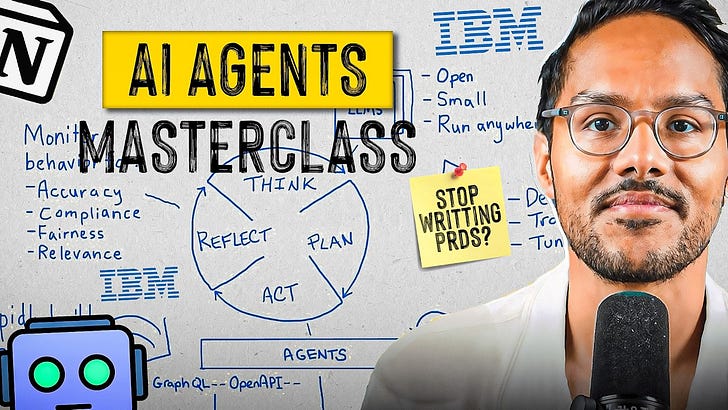
The most significant productivity gains come from applying AI to every stage of development, including research, planning, product marketing, and status updates. Limiting AI to just code generation misses the larger opportunity to automate the entire engineering process.

AI automates tactical tasks, shifting the PM's role from process management to de-risking delivery by developing deep customer insights. This allows PMs to spend more time confirming their instincts about customer needs, which engineering teams now demand.

AI tools are blurring the lines between product, design, and engineering. The future PM will leverage AI to not only spec features but also create mockups and even write and check in code for smaller tasks, owning the entire lifecycle from idea to delivery.

The next frontier for AI in product is automating time-consuming but cognitively simple tasks. An AI agent can connect CRM data, customer feedback, and product specs to instantly generate a qualified list of beta testers, compressing a multi-week process into days.

The traditional product management workflow (spec -> engineer build) is obsolete. The modern AI PM uses agentic tools to build, test, and iterate on the initial product, handing a working, validated prototype to engineering for productionalization.
![Building a Personal AI Model Map [AI Operators Bonus Episode] thumbnail](https://d3t3ozftmdmh3i.cloudfront.net/staging/podcast_uploaded_nologo/41472609/41472609-1752234663609-8665756a468e5.jpg)
AI's rapid capability growth makes top-down product specs obsolete. Product Managers now work bottoms-up with engineers, prototyping and even checking in code using AI tools. This blurs traditional roles, shifting the PM's focus to defining high-level customer needs and evaluating outcomes rather than prescribing features.
![Gokul Rajaram - Lessons from Investing in 700 Companies - [Invest Like the Best, EP.456] thumbnail](https://megaphone.imgix.net/podcasts/a35cb364-fc94-11f0-a24d-836fa963ece3/image/f64963c59af651cbb2d022f3a0dd7199.jpg?ixlib=rails-4.3.1&max-w=3000&max-h=3000&fit=crop&auto=format,compress)
AI coding agents compress product development by turning specs directly into code. This transforms the PM's role from a translator between customers and engineers into a "shaper of intent." The key skill becomes defining a problem so clearly that an agent can execute it, making the spec itself the prototype.
AI's value for PMs is augmentation, not replacement. By automating tactical tasks that consume most of a PM's day (e.g., "six out of eight hours"), AI frees up critical capacity for higher-level strategic, creative, and innovative work—the core functions of a product leader.

Instead of holding context for multiple projects in their heads, PMs create separate, fully-loaded AI agents (in Claude or ChatGPT) for each initiative. These "brains" are fed with all relevant files and instructions, allowing the PM to instantly get up to speed and work more efficiently.