Get your free personalized podcast brief
We scan new podcasts and send you the top 5 insights daily.
AI's value for PMs is augmentation, not replacement. By automating tactical tasks that consume most of a PM's day (e.g., "six out of eight hours"), AI frees up critical capacity for higher-level strategic, creative, and innovative work—the core functions of a product leader.

Related Insights
As AI automates time-consuming tasks like data analysis, requirement writing, and prototyping, the product manager's focus will shift. More time will be spent on upstream activities like customer discovery and market strategy, transforming the role from operational execution to strategic thinking.

AI agents will automate PM tasks like competitive analysis, user feedback synthesis, and PRD writing. This efficiency gain could shift the standard PM-to-developer ratio from 1:6-10 to 1:20-30, allowing PMs to cover a much broader product surface area and focus on higher-level strategy.
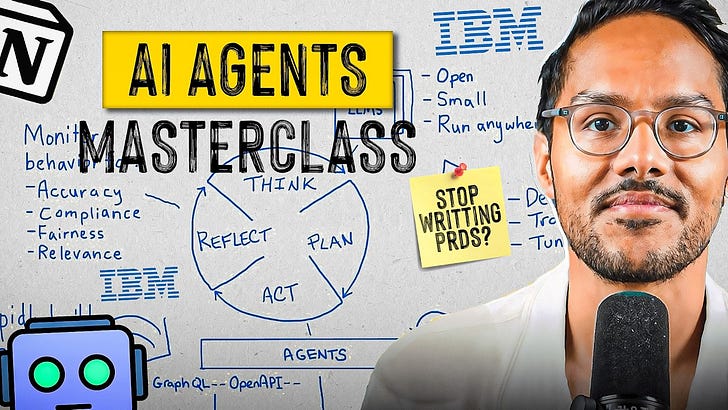
Generative AI's most immediate impact for product managers isn't just writing user stories. It's consolidating disparate information sources into a single interface, freeing up the cognitive load wasted on context switching and allowing for deeper strategic thinking.

AI automates tactical tasks, shifting the PM's role from process management to de-risking delivery by developing deep customer insights. This allows PMs to spend more time confirming their instincts about customer needs, which engineering teams now demand.

AI won't replace product managers but will elevate their role. PMs will shift from executing tasks like financial forecasting to managing a team of specialized AI agents, forcing them to focus on high-level strategy and assumption-checking.
Beyond just using AI tools, the fundamental process of product management is evolving. For every new initiative, PMs must now consider the appropriate level of AI, automation, or customization. This question is now as critical as "what problem are we solving?" and addresses rising customer expectations for adaptive products.

The rise of AI tools isn't replacing the PM role, but transforming it. PMs who embrace an "AI-enhanced" workflow for research, docs, and prototyping will gain a massive productivity advantage, ultimately displacing those who stick to traditional methods.
Product managers often hit cognitive fatigue from constantly re-formatting the same core information for different audiences (e.g., customer notes to PRD, PRD to Jira tickets, tickets to executive summaries). Automating this "translation" work with AI frees up mental energy for higher-value strategic tasks and prevents lazy, context-poor handoffs.

As AI automates 'hard' product management tasks like data synthesis and spec writing, the role’s value will shift. PMs who thrive will be those who master uniquely human skills like stakeholder influence, creative problem-solving, and critical thinking, which AI cannot yet replicate.

As AI automates synthesis and creation, the product manager's core value shifts from managing the development process to deeply contextualizing all available information (market, customer, strategy) to define the *right* product direction.