Get your free personalized podcast brief
We scan new podcasts and send you the top 5 insights daily.
The team reports significant velocity gains from AI but dismisses "3x" claims. While AI compresses research, coding, and testing, it doesn't solve the inherently human and time-consuming aspects of software development like debate, discovery, re-evaluation, and coordination.

Related Insights
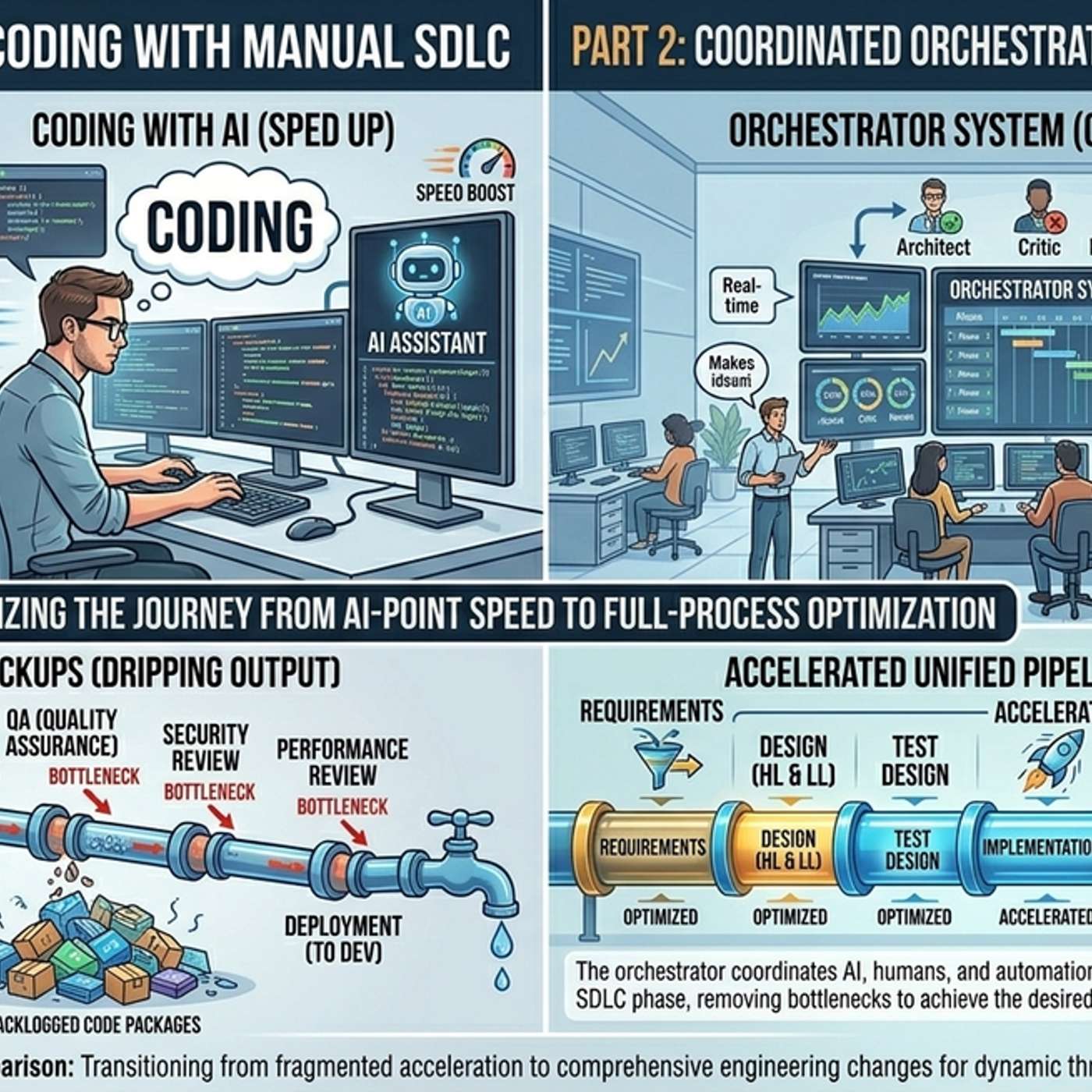
Speeding up just the coding phase with AI doesn't increase overall project delivery speed. It merely shifts the bottleneck to other parts of the Software Development Life Cycle (SDLC) like design, review, or deployment. To achieve real throughput gains, the entire end-to-end workflow must be optimized.
While AI tools can get you from zero to a functioning prototype in a weekend, the "second 80%" of the work—navigating dependencies, rewriting for different environments, and dealing with production complexities—is still a grueling, multi-week process. The path to shipping remains as difficult as ever.

AI has compressed development cycles from weeks to days, but it hasn't equally accelerated human coordination. The new bottleneck is getting stakeholders aligned on strategy, planning user communication, and managing the "fuzzy" aspects of a launch. While coding saw a 100x speed-up, these coordination problems remain.

It's a common misconception that advancing AI reduces the need for human input. In reality, the probabilistic nature of AI demands increased human interaction and tighter collaboration among product, design, and engineering teams to align goals and navigate uncertainty.

Even if AI perfects software engineering, automating AI R&D will be limited by non-coding tasks, as AI companies aren't just software engineers. Furthermore, AI assistance might only be enough to maintain the current rate of progress as 'low-hanging fruit' disappears, rather than accelerate it.

Braintrust's CEO argues that developer productivity is already 'tapped out.' Even if AI models become 5% better at writing code, it won't dramatically increase output because the true bottleneck is the human capacity to manage, test, deploy, and respond to user feedback—not the speed of code generation itself.

AI coding tools provide massive acceleration, turning projects that once took weeks or a dev shop into a weekend sprint. However, they are not a one-click solution. These tools still require significant, focused human expertise and effort to guide the process and deliver a final, functional product.

Despite AI's promise to reduce menial work, developers still spend 23-25% of their week on repetitive tasks. The nature of this "toil" has simply changed from writing boilerplate code to the more complex and time-consuming task of validating and debugging plausible-looking AI-generated code.
The focus on AI writing code is narrow, as coding represents only 10-20% of the total software development effort. The most significant productivity gains will come from AI automating other critical, time-consuming stages like testing, security, and deployment, fundamentally reshaping the entire lifecycle.

AI agents can generate code far faster than humans can meaningfully review it. The primary challenge is no longer creation but comprehension. Developers spend most of their time trying to understand and validate AI output, a task for which current tools like standard PR interfaces are inadequate.
