Get your free personalized podcast brief
We scan new podcasts and send you the top 5 insights daily.
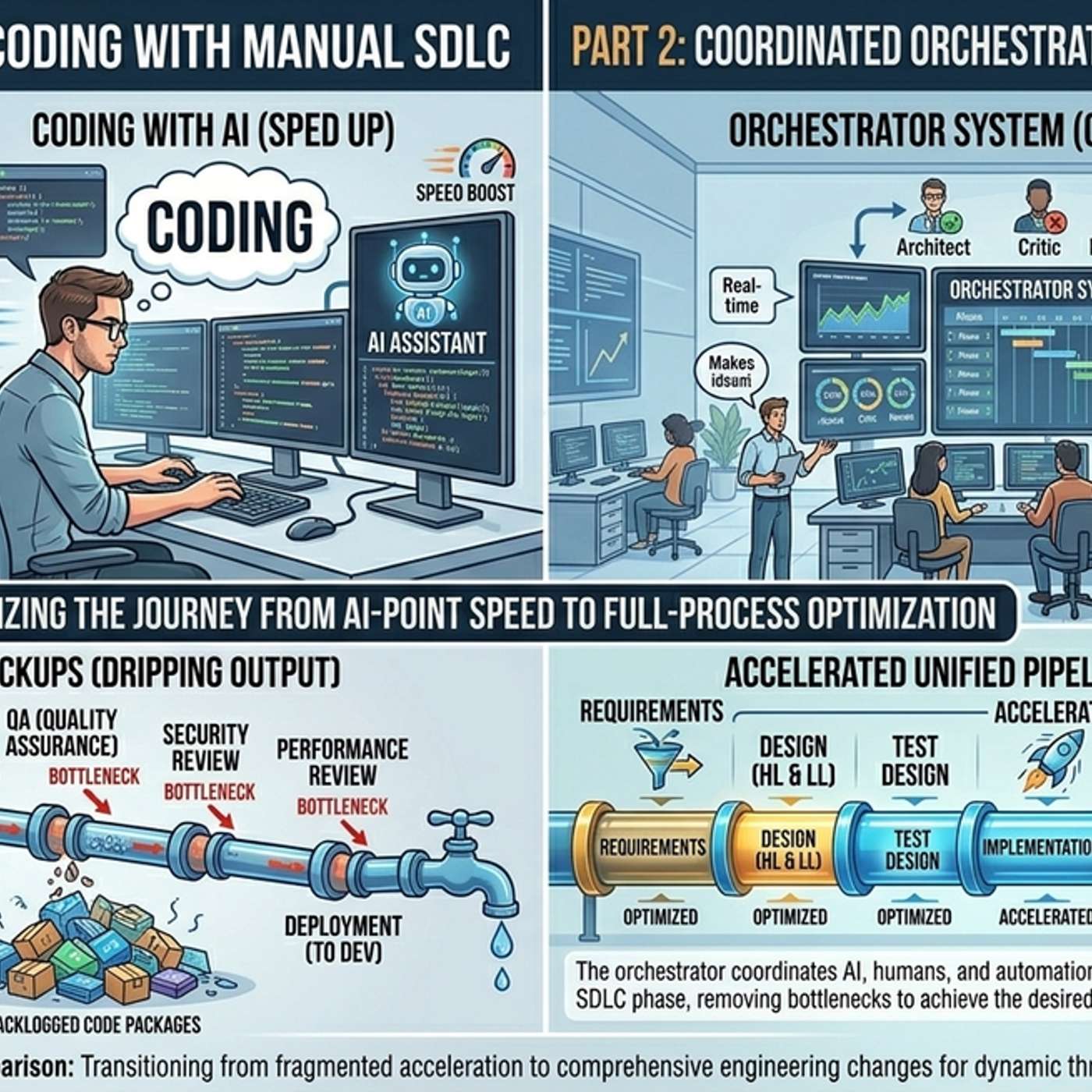
Speeding up just the coding phase with AI doesn't increase overall project delivery speed. It merely shifts the bottleneck to other parts of the Software Development Life Cycle (SDLC) like design, review, or deployment. To achieve real throughput gains, the entire end-to-end workflow must be optimized.
Related Insights
While AI accelerates code generation, it creates significant new chokepoints. The high volume of AI-generated code leads to "pull request fatigue," requiring more human reviewers per change. It also overwhelms automated testing systems, which must run full cycles for every minor AI-driven adjustment, offsetting initial productivity gains.

As AI agents handle the mechanics of code generation, the primary role of a developer is elevated. The new bottlenecks are not typing speed or syntax, but higher-level cognitive tasks: deciding what to build, designing system architecture, and curating the AI's work.

Simply deploying AI to write code faster doesn't increase end-to-end velocity. It creates a new bottleneck where human engineers are overwhelmed with reviewing a flood of AI-generated code. To truly benefit, companies must also automate verification and validation processes.

AI has compressed development cycles from weeks to days, but it hasn't equally accelerated human coordination. The new bottleneck is getting stakeholders aligned on strategy, planning user communication, and managing the "fuzzy" aspects of a launch. While coding saw a 100x speed-up, these coordination problems remain.

AI tools dramatically speed up code implementation, making engineering velocity less of a constraint. The new challenge becomes the slower, more considered process of deciding *what* to build, placing a premium on strategic design thinking and choosing when to be deliberate.

With AI accelerating development, the key challenge is no longer building faster; it's getting completed features through legal, marketing, and other operational hurdles. Organizations must now re-engineer these internal processes to match the new pace of creation.

Braintrust's CEO argues that developer productivity is already 'tapped out.' Even if AI models become 5% better at writing code, it won't dramatically increase output because the true bottleneck is the human capacity to manage, test, deploy, and respond to user feedback—not the speed of code generation itself.

Prompting AI agents without a strict framework increases an individual's code output but leads to inconsistent standards. This makes code reviews a nightmare for teams, creating a collaborative bottleneck that cancels out the initial speed advantage.

The focus on AI writing code is narrow, as coding represents only 10-20% of the total software development effort. The most significant productivity gains will come from AI automating other critical, time-consuming stages like testing, security, and deployment, fundamentally reshaping the entire lifecycle.
While AI tools have massively accelerated developer velocity by up to 10x, design tool acceleration has lagged at only 1.5-2x. This imbalance makes the design phase a new critical bottleneck in the product development lifecycle.
