Get your free personalized podcast brief
We scan new podcasts and send you the top 5 insights daily.
While AI tools can get you from zero to a functioning prototype in a weekend, the "second 80%" of the work—navigating dependencies, rewriting for different environments, and dealing with production complexities—is still a grueling, multi-week process. The path to shipping remains as difficult as ever.

Related Insights
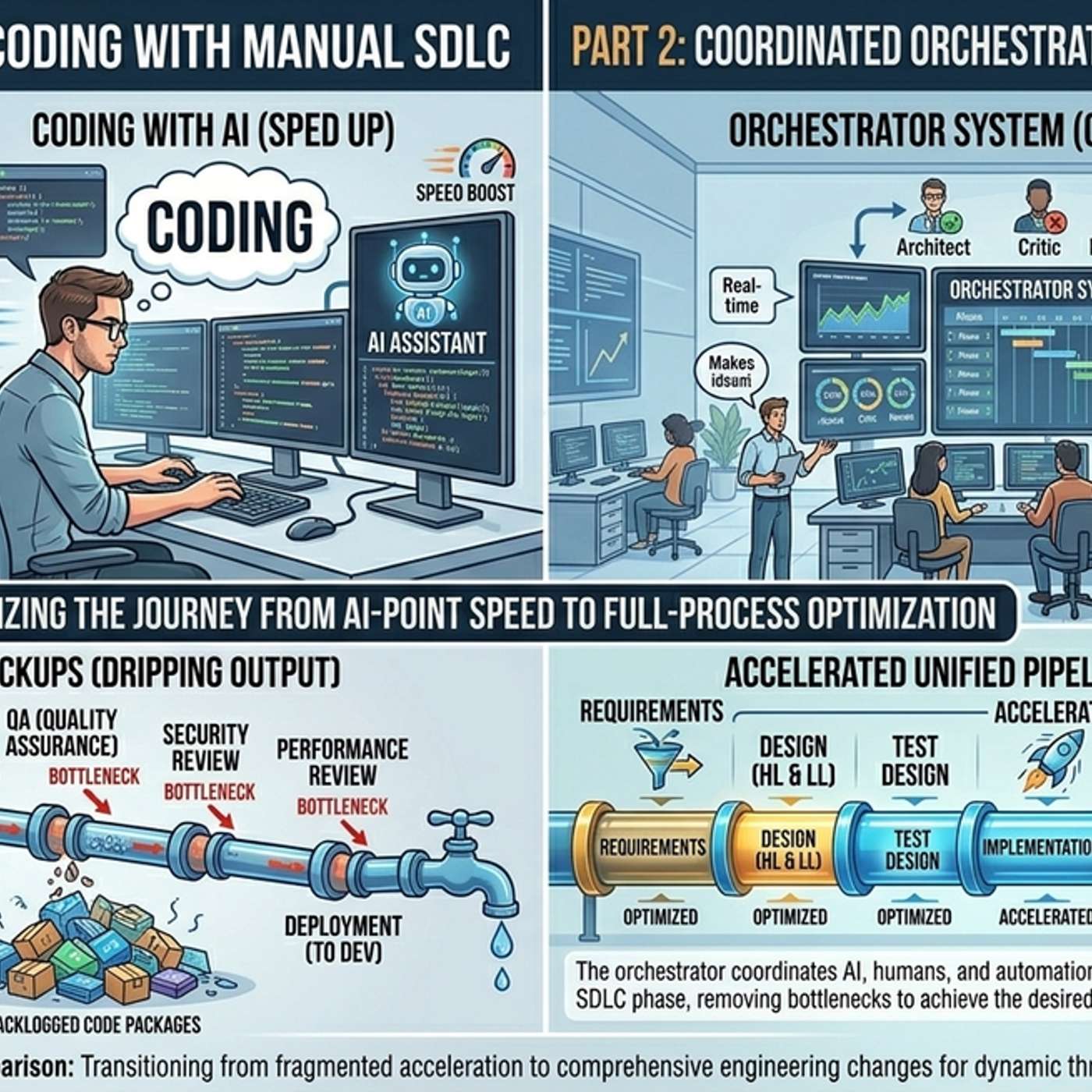
Speeding up just the coding phase with AI doesn't increase overall project delivery speed. It merely shifts the bottleneck to other parts of the Software Development Life Cycle (SDLC) like design, review, or deployment. To achieve real throughput gains, the entire end-to-end workflow must be optimized.
With AI, the initial effort to explore an idea—like writing the first draft of a spec or building a janky prototype—is now effectively free. This drastically lowers the cost of exploration, but the last 10% of refinement and quality assurance remains the hardest and most critical part.

While AI can rapidly scaffold a functional application, the most time-consuming phase is the final 20% of work. This involves refining UI details, handling numerous edge cases, and achieving a high level of polish, which requires meticulous back-and-forth and debugging.

AI tools are making code development 10-20x faster. However, the 'why we should build' (customer research) and 'getting it to customers' (adoption) phases remain bottlenecked by human interaction speed. This creates an imbalance that modern product teams must manage.

AI coding tools can rapidly build the first 70% of an application, but the final 30%—the complex, unique features that define your vision—will consume the vast majority of your development time. This is a critical reality check for anyone starting with these tools.

AI has compressed development cycles from weeks to days, but it hasn't equally accelerated human coordination. The new bottleneck is getting stakeholders aligned on strategy, planning user communication, and managing the "fuzzy" aspects of a launch. While coding saw a 100x speed-up, these coordination problems remain.

Braintrust's CEO argues that developer productivity is already 'tapped out.' Even if AI models become 5% better at writing code, it won't dramatically increase output because the true bottleneck is the human capacity to manage, test, deploy, and respond to user feedback—not the speed of code generation itself.

AI coding tools provide massive acceleration, turning projects that once took weeks or a dev shop into a weekend sprint. However, they are not a one-click solution. These tools still require significant, focused human expertise and effort to guide the process and deliver a final, functional product.
Glean's founder reveals that even with AI generating almost all initial code, their product shipping velocity hasn't significantly increased. The bottleneck has shifted from writing code to the human review process. Manual oversight remains critical for maintaining quality and managing long-term complexity.

AI tools provide the most value at the start of the product development funnel. They can reduce the time for creating prototypes and proofs-of-concept from weeks to mere hours, dramatically accelerating the ideation and validation phases.
