Get your free personalized podcast brief
We scan new podcasts and send you the top 5 insights daily.
Centralized experimentation causes corporate AI budgets to deplete rapidly when no single department is held accountable. Treasure AI exhausted its annual AI budget early because usage lacked clear departmental owners. Pushing all token and AI costs directly onto departmental P&Ls enforces fiscal discipline across teams.

Related Insights
The optimal strategy for managing AI costs is neither total restriction nor a free-for-all. It's providing engineers with dedicated "learning budgets" and experimentation pools, coupled with clear visibility into costs. This fosters innovation responsibly without incurring surprise invoices and turns cost into a first-class constraint.
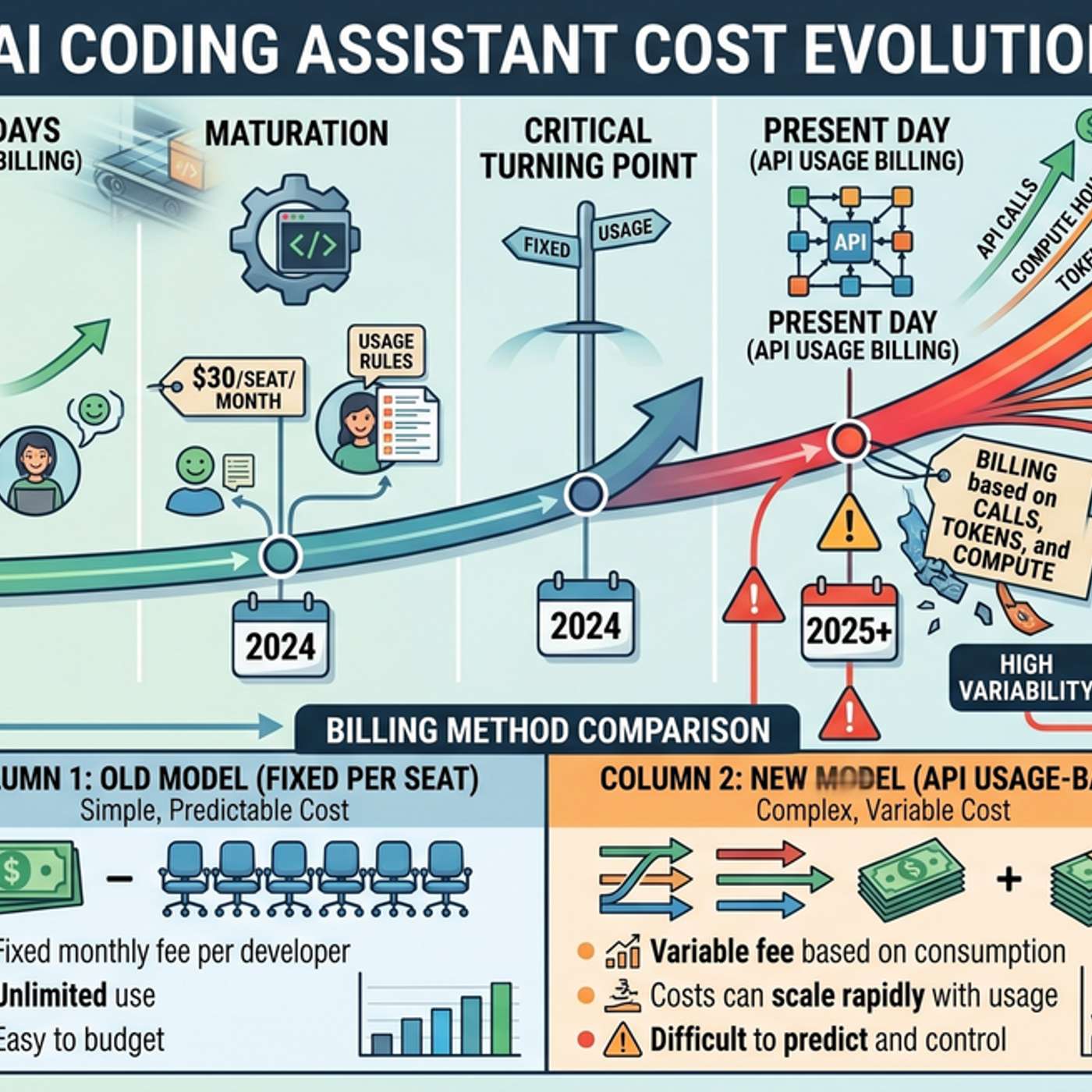
FP&A teams must develop a new muscle for managing AI costs, which behave like consumption-based cloud spend, not predictable recurring software fees. Uncapped token usage can lead to massive budget blowouts, requiring more dynamic tracking and forecasting than traditional expenses.

An anecdote about an engineer spending $100M in a month on AI tokens reveals a core enterprise issue. For Lenovo's CFO, the problem isn't the amount but its lack of planning and clear ROI. This signals a shift from predictable software subscriptions to volatile, usage-based AI compute costs.

Unlike predictable seat-based SaaS, consumption-based AI is a fungible resource. Companies must treat 'intelligence' like capital, creating budgets and allocating it to the most productive people and projects. This requires a new financial discipline beyond simple software procurement.

Thinking about token budgets per person is a flawed, input-focused metric. The correct model is to allocate a budget (potentially seven figures) to a project or desired outcome, like beating a benchmark. This reframes AI spend as a capital allocation towards business goals, not an employee perk.
The era of unmonitored enterprise AI experimentation is closing. While companies previously celebrated employees with the highest token consumption, Apter now audits heavy token users to demand demonstrable return on investment. CFOs must enforce governance and training around AI tooling to ensure spend drives measurable commercial returns rather than wasteful costs.
The move from pre-agentic to agentic AI workloads consumes massive resources. This has ended the 'AI subsidy era,' forcing companies like Walmart and Uber to implement usage-based models and strict caps on AI spending to control runaway costs and enforce discipline.

To combat budget chaos from AI usage, enterprises are moving the cost of technology from the central CIO's budget to the P&L of the specific business unit using it. This decentralizes accountability, forcing department managers to make ROI-driven decisions about their team's AI consumption.

Christian Klein described reaching a tipping point where runaway AI usage forced SAP to institute formal token limits for employees based on their roles. This signals a new phase of enterprise AI where cost governance is becoming a standard operational control.

Giving teams a 'token budget' is flawed because it incentivizes generating low-value output to hit a quota, similar to bad hiring quotas. Instead, companies must tie token consumption directly to business KPIs. This reframes AI spend as a value-creating investment, not a cost to be managed.
