Get your free personalized podcast brief
We scan new podcasts and send you the top 5 insights daily.
The era of unmonitored enterprise AI experimentation is closing. While companies previously celebrated employees with the highest token consumption, Apter now audits heavy token users to demand demonstrable return on investment. CFOs must enforce governance and training around AI tooling to ensure spend drives measurable commercial returns rather than wasteful costs.

Related Insights
After initial unrestricted spending led to budget overruns at companies like Uber, major enterprises are shifting focus. They are moving away from measuring raw AI usage (tokens) and toward implementing AI only for proven use cases with clear ROI, which may benefit cheaper, open-source models over expensive frontier ones.
As companies adopt AI, token costs become a significant, opaque expense. This creates a need for new financial tools that provide granular analytics to track, understand, and optimize AI spend across models, use cases, employees, and even per customer.

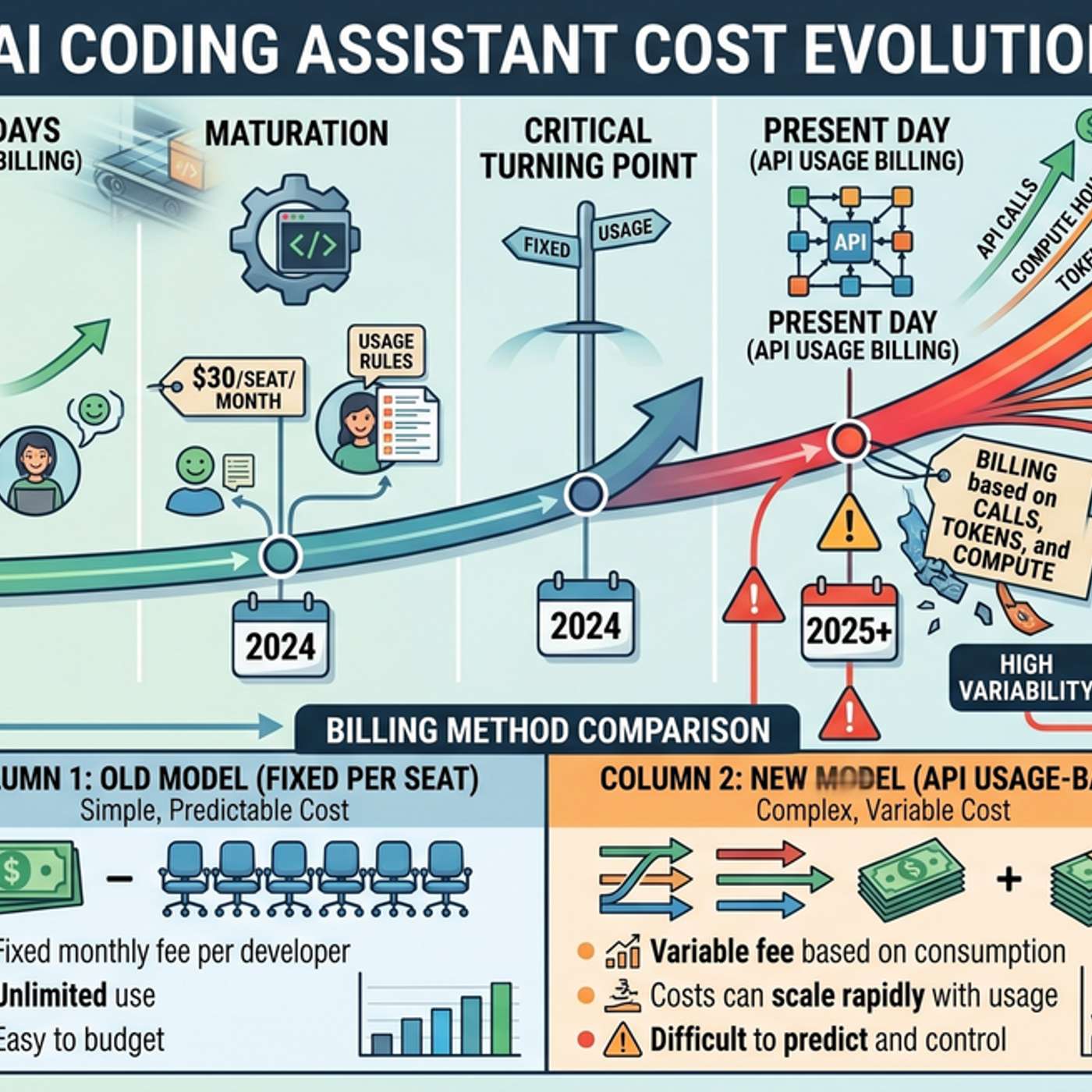
An anecdote about an engineer spending $100M in a month on AI tokens reveals a core enterprise issue. For Lenovo's CFO, the problem isn't the amount but its lack of planning and clear ROI. This signals a shift from predictable software subscriptions to volatile, usage-based AI compute costs.

Unlike predictable seat-based SaaS, consumption-based AI is a fungible resource. Companies must treat 'intelligence' like capital, creating budgets and allocating it to the most productive people and projects. This requires a new financial discipline beyond simple software procurement.

According to Mike Cannon-Brookes, advanced enterprises are not tracking AI success by counting tokens. Instead, they are asking harder questions about overall output, such as engineering productivity and quality. They understand that high token usage doesn't always correlate with high productivity, shifting focus from raw usage to tangible business outcomes.

Categorize all AI token spend into three buckets: 'Tokens that Teach' (valuable experimentation), 'Tokens that Produce' (work output), and 'Tokens that Spin' (wasteful, idle processes). The optimal strategy is to aggressively eliminate 'spin' tokens, optimize 'produce' tokens, and fiercely protect the budget for 'teach' tokens to foster innovation.
Just as uncontrolled cloud spending in the 2010s spawned the FinOps field, the shift to consumption-based AI pricing will necessitate a similar discipline. This involves attributing costs to specific workloads, setting granular budgets, and providing real-time visibility to prevent budget overruns and measure ROI accurately.
Christian Klein described reaching a tipping point where runaway AI usage forced SAP to institute formal token limits for employees based on their roles. This signals a new phase of enterprise AI where cost governance is becoming a standard operational control.

Giving teams a 'token budget' is flawed because it incentivizes generating low-value output to hit a quota, similar to bad hiring quotas. Instead, companies must tie token consumption directly to business KPIs. This reframes AI spend as a value-creating investment, not a cost to be managed.

The significant cost of advanced AI models ($20-$50 per million tokens) is no longer a trivial expense for internal development. Companies are now implementing observability, permissioning systems, and other controls to manage "token burn" and ensure a positive ROI on AI-assisted work.
