Get your free personalized podcast brief
We scan new podcasts and send you the top 5 insights daily.
Nadella advocates for AI standards allowing enterprises to switch between models. He compares this to Windows' early interoperability with Unix, which, counterintuitively, increased Windows' enterprise adoption by making it a flexible part of the existing ecosystem, rather than a threat to it.

Related Insights
Nadella argues there's a "massive model capability overhang," where AI power exceeds its application. The bottleneck isn't a better model but product innovation—like creating the right "harness" (e.g., an agent loop with a file system)—that unlocks existing power for broad adoption.
Nadella posits a future where the winner isn't the company with the best model. Instead, value accrues to the platform that provides the data, context, and tools (the 'scaffolding') that make any model useful, especially as capable open-source alternatives proliferate.
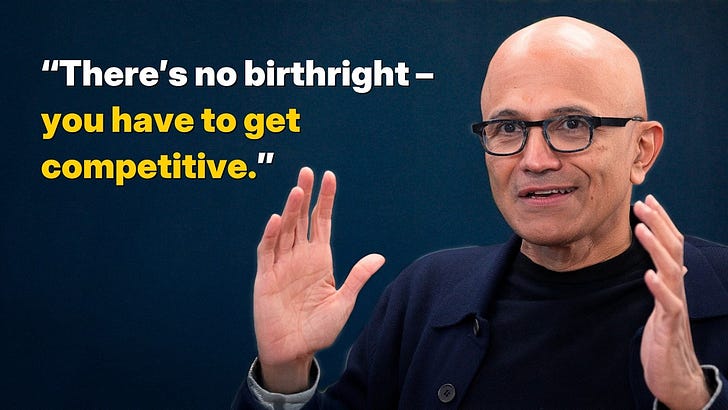
Nadella frames open-source AI not as a threat but as a crucial market corrective. Drawing parallels to Linux vs. Windows, he argues that open models prevent closed-source providers from capturing all economic value, thus enabling a healthier, more profitable application and middleware ecosystem to flourish.
Like IBM in the 90s, Microsoft is positioning itself as the dependable, integrated provider for enterprises wary of new tech. It offers a middleware layer that connects legacy systems to new AI models, selling stability and integration over cutting-edge performance.
![Ben Thompson on Big Tech, China, and the AI Boom Running Out of Money - [Invest Like the Best, EP.487] thumbnail](https://megaphone.imgix.net/podcasts/b0356202-9aa0-11f1-b3c3-6bc8a0cf3d6f/image/772d31a372a483035b6fc678729cae0b.jpg?ixlib=rails-4.3.1&max-w=3000&max-h=3000&fit=crop&auto=format,compress)
Nadella warns enterprises against becoming dependent on a single AI provider. He proposes an "acid test": can you remove one model from your stack and retain core capabilities? This architectural principle ensures long-term control, avoids vendor lock-in, and promotes resilience.
Microsoft is bundling AI tools into a "super app" and offering a broad model catalog. This positions them as a neutral platform, aiming to win enterprise clients who prioritize control, cost, and choice over loyalty to a specific AI lab like OpenAI or Anthropic.

Microsoft's decision to promote Anthropic models on Azure as aggressively as OpenAI's reflects a core belief from CEO Satya Nadella. He anticipates AI models will become commoditized, making the underlying intelligence interchangeable and the cloud platform the primary point of differentiation and value capture.

Tech giants like Microsoft and Nvidia are leading the charge for open-weight models. This isn't just about innovation; it prevents a few proprietary labs from becoming monopolies. A competitive model ecosystem drives broader AI adoption, which in turn fuels massive demand for their core products: cloud compute and GPUs.

Satya Nadella’s critique of frontier models learning from customer data is a strategic move to sell Microsoft's infrastructure. It promotes a vision where enterprises control their own AI destiny, thereby making Microsoft the essential platform provider.
Counter to the idea of a few dominant frontier models, Satya Nadella believes the AI model market will mirror the database market's evolution. He expects a proliferation of specialized models, including open-source and proprietary ones, with firms eventually embedding their unique tacit knowledge into custom models they control.