Get your free personalized podcast brief
We scan new podcasts and send you the top 5 insights daily.
Microsoft is bundling AI tools into a "super app" and offering a broad model catalog. This positions them as a neutral platform, aiming to win enterprise clients who prioritize control, cost, and choice over loyalty to a specific AI lab like OpenAI or Anthropic.

Related Insights
Like IBM Global Services helped firms adopt PCs, Microsoft is now building a massive services arm to implement OpenAI and Anthropic models. This signals a strategic shift: when unable to lead with your own product, you use your enterprise relationships to become the trusted adoption partner for new innovators.

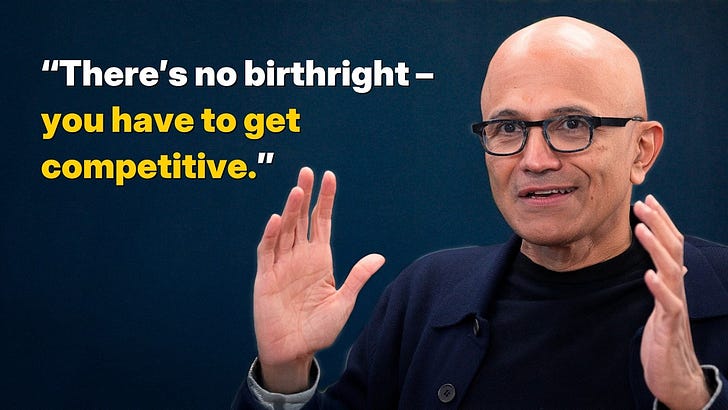
Nadella posits a future where the winner isn't the company with the best model. Instead, value accrues to the platform that provides the data, context, and tools (the 'scaffolding') that make any model useful, especially as capable open-source alternatives proliferate.
Microsoft is not solely reliant on its OpenAI partnership. It actively integrates competitor models, such as Anthropic's, into its Copilot products to handle specific workloads where they perform better, like complex Excel tasks. This pragmatic "best tool for the job" approach diversifies its AI capabilities.
Microsoft's decision to promote Anthropic models on Azure as aggressively as OpenAI's reflects a core belief from CEO Satya Nadella. He anticipates AI models will become commoditized, making the underlying intelligence interchangeable and the cloud platform the primary point of differentiation and value capture.

Microsoft's cybersecurity AI doesn't rely on a single superior model. Instead, it acts as a smart router, selecting the most cost-effective model for each sub-task—whether from Microsoft, OpenAI, or Anthropic. This hybrid approach is designed to deliver comparable results to expensive frontier models at a lower price point.
Microsoft is making Anthropic's Claude and Co-Work available through its Co-pilot service. This suggests an acknowledgment that their own models aren't always superior and that the future of enterprise AI lies in providing a suite of best-in-class models, not a single-provider ecosystem.

Satya Nadella’s critique of frontier models learning from customer data is a strategic move to sell Microsoft's infrastructure. It promotes a vision where enterprises control their own AI destiny, thereby making Microsoft the essential platform provider.
At its Build conference, Microsoft is strategically pitching its own suite of homegrown AI models for coding, reasoning, and more. The play is to leverage its massive, existing developer community to create a viable third option in the AI model market, competing on cost, performance, and integration against the perceived OpenAI/Anthropic duopoly.
Microsoft is developing its own AI models from scratch, pitching them as cheaper and more effective for customized enterprise needs than leading models from its partner OpenAI or competitor Anthropic. This signals a strategy to control the full AI stack and compete directly on price.
Microsoft's Copilot platform doesn't rely on a single foundation model. It automatically routes user tasks to different models based on what works best for the job—using OpenAI for interactive chat but switching to Claude for long-running, tool-using background tasks.
