Get your free personalized podcast brief
We scan new podcasts and send you the top 5 insights daily.
Satya Nadella’s critique of frontier models learning from customer data is a strategic move to sell Microsoft's infrastructure. It promotes a vision where enterprises control their own AI destiny, thereby making Microsoft the essential platform provider.

Related Insights
Like IBM Global Services helped firms adopt PCs, Microsoft is now building a massive services arm to implement OpenAI and Anthropic models. This signals a strategic shift: when unable to lead with your own product, you use your enterprise relationships to become the trusted adoption partner for new innovators.

Nadella posits a future where the winner isn't the company with the best model. Instead, value accrues to the platform that provides the data, context, and tools (the 'scaffolding') that make any model useful, especially as capable open-source alternatives proliferate.
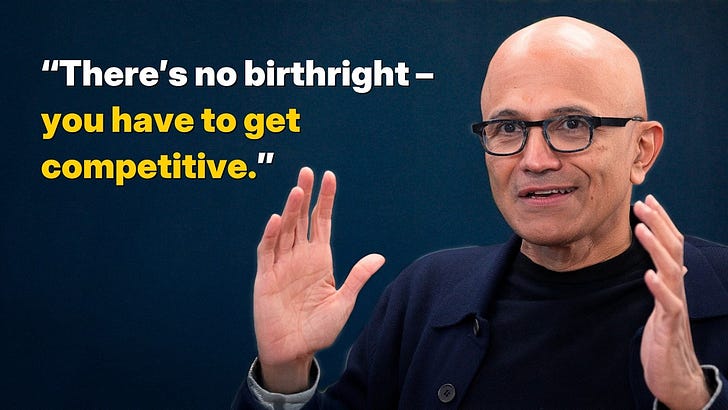
Satya Nadella posits the key enterprise AI strategy is building a proprietary "learning loop." This system transforms a company's unique human knowledge into "token capital," a defensible asset that compounds over time, independent of any single underlying AI model. This creates a durable competitive advantage against competitors and model providers alike.
As noted by Chamath Palihapitiya, businesses fear deploying major AI models directly, seeing it as letting the 'fox into the henhouse' where their usage data could train a future competitor. This creates a strategic opening for 'harness-first' companies that offer enterprises control and choice over underlying models.
Microsoft's decision to promote Anthropic models on Azure as aggressively as OpenAI's reflects a core belief from CEO Satya Nadella. He anticipates AI models will become commoditized, making the underlying intelligence interchangeable and the cloud platform the primary point of differentiation and value capture.

A Microsoft memo states, "Treat AI like a tool and you build a tool that serves people." This is a strategic sales pitch positioning Microsoft's AI as business-focused and value-driven, contrasting it with the grand, AGI-centric missions of labs like Anthropic and OpenAI.
Microsoft AI CEO Mustafa Suleiman explains that while the OpenAI partnership is strong, Microsoft must develop its own superintelligence capabilities to avoid long-term structural dependency on a third party, referencing Satya Nadella's fear of becoming the commoditized 'Intel' to OpenAI's 'Microsoft'.

Microsoft is marketing its new MAI models by emphasizing their "clean pre-training data set" and lack of distillation from other models. This strategy directly targets enterprise customers' legal and compliance fears around IP infringement from AI, offering them a legally safer foundation model to build upon.

At its Build conference, Microsoft is strategically pitching its own suite of homegrown AI models for coding, reasoning, and more. The play is to leverage its massive, existing developer community to create a viable third option in the AI model market, competing on cost, performance, and integration against the perceived OpenAI/Anthropic duopoly.
Counter to the idea of a few dominant frontier models, Satya Nadella believes the AI model market will mirror the database market's evolution. He expects a proliferation of specialized models, including open-source and proprietary ones, with firms eventually embedding their unique tacit knowledge into custom models they control.