Get your free personalized podcast brief
We scan new podcasts and send you the top 5 insights daily.
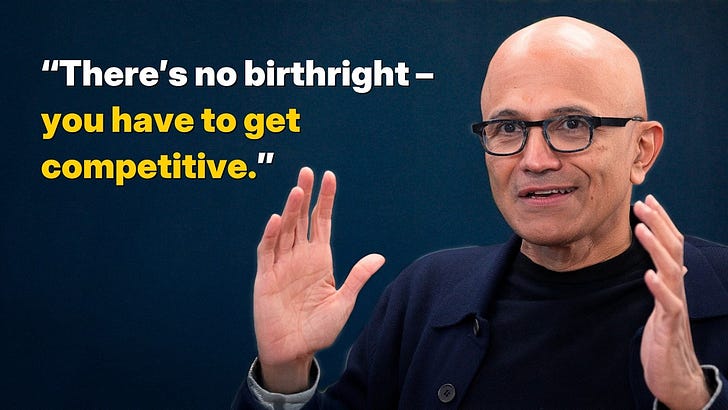
Nadella posits a future where the winner isn't the company with the best model. Instead, value accrues to the platform that provides the data, context, and tools (the 'scaffolding') that make any model useful, especially as capable open-source alternatives proliferate.
Related Insights
While some competitors prioritize winning over ROI, Nadella cautions that "at some point that party ends." In major platform shifts like AI, a long-term orientation is crucial. He cites Microsoft's massive OpenAI investment, committed *before* ChatGPT's success, as proof of a long-term strategy paying off.
Unlike competitors focused on vertical integration, Microsoft's "hyperscaler" strategy prioritizes supporting a long tail of diverse customers and models. This makes a hyper-optimized in-house chip less urgent. Furthermore, their IP rights to OpenAI's hardware efforts provide them with access to cutting-edge designs without bearing all the development risk.

OpenAI CEO Sam Altman now publicly hedges that winning requires the best models, product, *and* infrastructure. This marks a significant industry-wide shift away from the earlier belief that a sufficiently advanced model would make product differentiation irrelevant. The focus is now on the complete, cohesive user experience.

Satya Nadella predicts that SaaS disruption from AI will hit "high ARPU, low usage" companies hardest. He argues that products like Microsoft 365, with their high usage and low average revenue per user (ARPU), create a constant stream of data. This data graph is crucial for grounding AI agents, creating a defensive moat.

OpenAI's long-term value lies in the ChatGPT app and ecosystem, not just its model. The platform can thrive even with competitor models like Gemini because user loyalty is to the app. This follows the strategy of 'commoditizing your complements'.
Satya Nadella states that Microsoft's core philosophy for platforms like Azure and GitHub is that they are only successful if the ecosystem partners building on top of them capture more economic value than Microsoft does. This partner-first approach is central to their strategy.
Microsoft's early OpenAI investment was a calculated, risk-adjusted decision. They saw that generalizable AI platforms were a 'must happen' future and asked, 'Can we remain a top cloud provider without it?' The clear 'no' made the investment a defensive necessity, not just an offensive gamble.
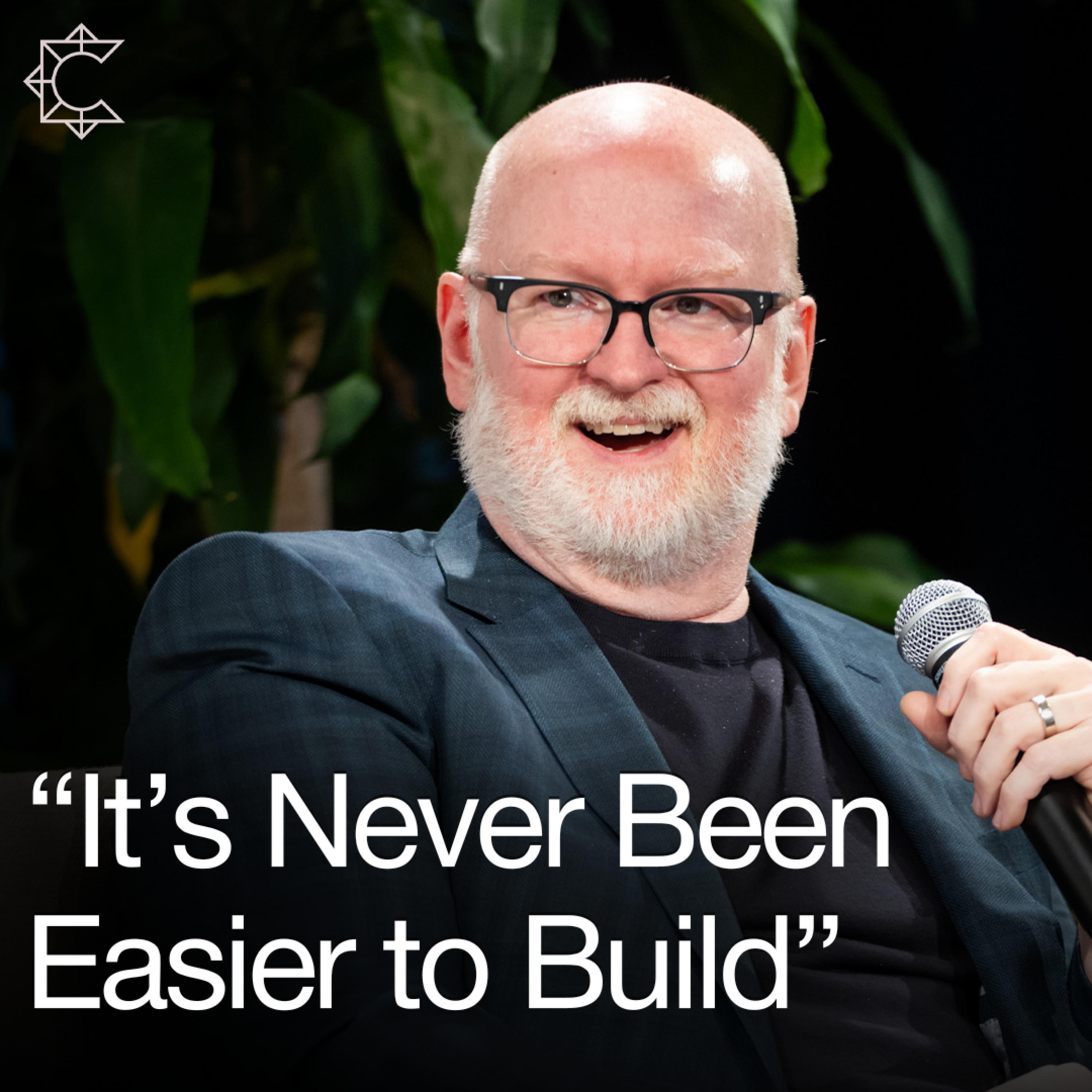
AI models are becoming commodities; the real, defensible value lies in proprietary data and user context. The correct strategy is for companies to use LLMs to enhance their existing business and data, rather than selling their valuable context to model providers for pennies on the dollar.

Beyond the equity stake and Azure revenue, Satya Nadella highlights a core strategic benefit: royalty-free access to OpenAI's IP. For Microsoft, this is equivalent to having a "frontier model for free" to deeply integrate across its entire product suite, providing a massive competitive advantage without incremental licensing costs.
As algorithms become more widespread, the key differentiator for leading AI labs is their exclusive access to vast, private data sets. XAI has Twitter, Google has YouTube, and OpenAI has user conversations, creating unique training advantages that are nearly impossible for others to replicate.
