Get your free personalized podcast brief
We scan new podcasts and send you the top 5 insights daily.
Microsoft's decision to promote Anthropic models on Azure as aggressively as OpenAI's reflects a core belief from CEO Satya Nadella. He anticipates AI models will become commoditized, making the underlying intelligence interchangeable and the cloud platform the primary point of differentiation and value capture.

Related Insights
While some competitors prioritize winning over ROI, Nadella cautions that "at some point that party ends." In major platform shifts like AI, a long-term orientation is crucial. He cites Microsoft's massive OpenAI investment, committed *before* ChatGPT's success, as proof of a long-term strategy paying off.
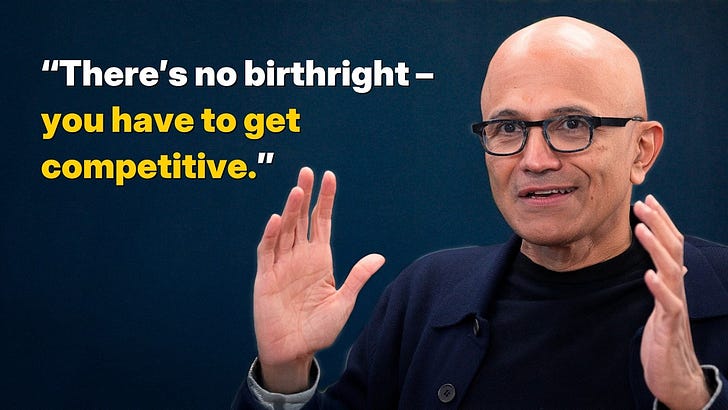
Nadella posits a future where the winner isn't the company with the best model. Instead, value accrues to the platform that provides the data, context, and tools (the 'scaffolding') that make any model useful, especially as capable open-source alternatives proliferate.
The assumption that enterprise API spending on AI models creates a strong moat is flawed. In reality, businesses can and will easily switch between providers like OpenAI, Google, and Anthropic. This makes the market a commodity battleground where cost and on-par performance, not loyalty, will determine the winners.

Satya Nadella reveals that Microsoft prioritizes building a flexible, "fungible" cloud infrastructure over catering to every demand of its largest AI customer, OpenAI. This involves strategically denying requests for massive, dedicated data centers to ensure capacity remains balanced for other customers and Microsoft's own high-margin products.

Contrary to typical corporate fears, Microsoft's AI lead views the rapid commoditization of AI models and resulting price wars as a positive outcome for humanity. The ultimate goal is to make intelligence abundant and near-zero cost, with Microsoft's business model focused on value-added software integrations.
Satya Nadella states that Microsoft's core philosophy for platforms like Azure and GitHub is that they are only successful if the ecosystem partners building on top of them capture more economic value than Microsoft does. This partner-first approach is central to their strategy.

Microsoft's early OpenAI investment was a calculated, risk-adjusted decision. They saw that generalizable AI platforms were a 'must happen' future and asked, 'Can we remain a top cloud provider without it?' The clear 'no' made the investment a defensive necessity, not just an offensive gamble.
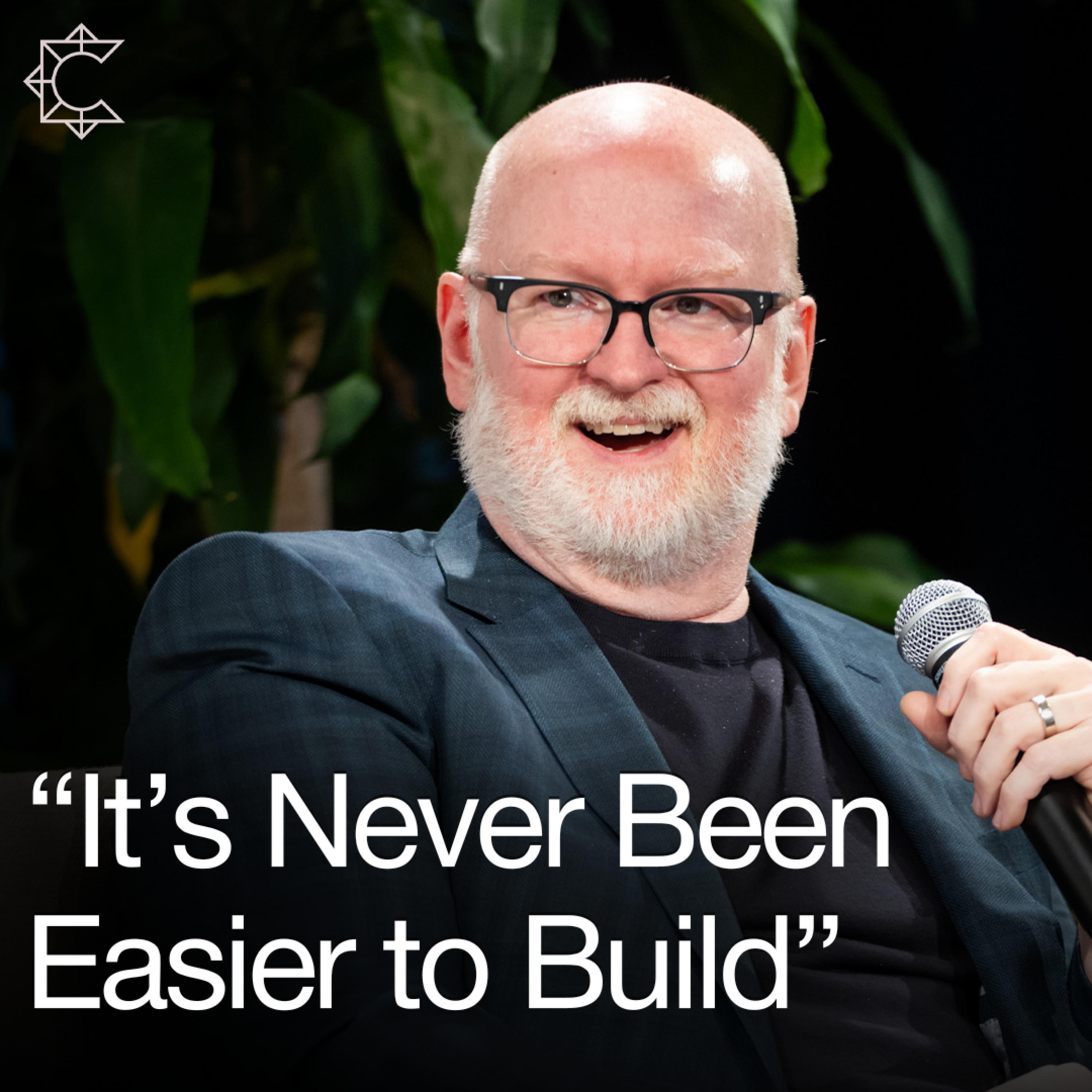
Beyond the equity stake and Azure revenue, Satya Nadella highlights a core strategic benefit: royalty-free access to OpenAI's IP. For Microsoft, this is equivalent to having a "frontier model for free" to deeply integrate across its entire product suite, providing a massive competitive advantage without incremental licensing costs.
Anthropic is making its models available on AWS, Azure, and Google Cloud. This multi-cloud approach is a deliberate business strategy to position itself as a neutral infrastructure provider. Unlike competitors who might build competing apps, this signals to customers that Anthropic aims to be a partner, not a competitor.
OpenAI’s pivotal partnership with Microsoft was driven more by the need for massive-scale cloud computing than just cash. To train its ambitious GPT models, OpenAI required infrastructure it could not build itself. Microsoft Azure provided this essential, non-commoditized resource, making them a perfect strategic partner beyond their balance sheet.