Get your free personalized podcast brief
We scan new podcasts and send you the top 5 insights daily.
Like IBM in the 90s, Microsoft is positioning itself as the dependable, integrated provider for enterprises wary of new tech. It offers a middleware layer that connects legacy systems to new AI models, selling stability and integration over cutting-edge performance.
![Ben Thompson on Big Tech, China, and the AI Boom Running Out of Money - [Invest Like the Best, EP.487] thumbnail](https://megaphone.imgix.net/podcasts/b0356202-9aa0-11f1-b3c3-6bc8a0cf3d6f/image/772d31a372a483035b6fc678729cae0b.jpg?ixlib=rails-4.3.1&max-w=3000&max-h=3000&fit=crop&auto=format,compress)
Related Insights
Like IBM Global Services helped firms adopt PCs, Microsoft is now building a massive services arm to implement OpenAI and Anthropic models. This signals a strategic shift: when unable to lead with your own product, you use your enterprise relationships to become the trusted adoption partner for new innovators.

Nadella posits a future where the winner isn't the company with the best model. Instead, value accrues to the platform that provides the data, context, and tools (the 'scaffolding') that make any model useful, especially as capable open-source alternatives proliferate.
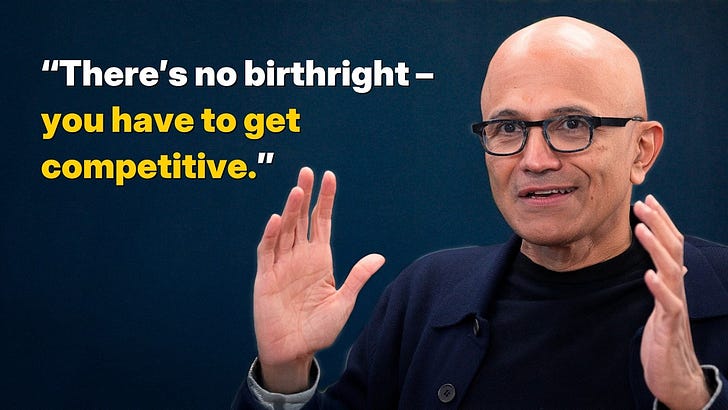
Microsoft's Copilot, while not considered the best AI model, achieves massive adoption by being integrated into existing enterprise workflows. The company leverages its vast recurring revenue relationships and sales force to make its AI the path of least resistance for large organizations concerned with security and integration.

Microsoft is bundling AI tools into a "super app" and offering a broad model catalog. This positions them as a neutral platform, aiming to win enterprise clients who prioritize control, cost, and choice over loyalty to a specific AI lab like OpenAI or Anthropic.

A Microsoft memo states, "Treat AI like a tool and you build a tool that serves people." This is a strategic sales pitch positioning Microsoft's AI as business-focused and value-driven, contrasting it with the grand, AGI-centric missions of labs like Anthropic and OpenAI.

Microsoft CEO Satya Nadella has structured a brilliant hedge. If frontier models from labs like OpenAI dominate, Microsoft wins via its significant equity stake. If models commoditize, Microsoft wins by leveraging its unparalleled enterprise distribution channels. The company is positioned to profit from either outcome.

Microsoft is training its sales teams to directly pitch its in-house MAI models over partners' by emphasizing cost, efficiency, and superior security integration within its ecosystem. This strategy leverages Microsoft's distribution power, shifting the sales narrative away from raw model performance to enterprise-specific value propositions like security and cost.
Nadella introduces the 'harness'—the integrated system of data, tools, and context preparation surrounding a model. He posits this harness, which enables multi-model strategies and efficient execution, is where companies create unique value, rather than in the base model alone.

Satya Nadella’s critique of frontier models learning from customer data is a strategic move to sell Microsoft's infrastructure. It promotes a vision where enterprises control their own AI destiny, thereby making Microsoft the essential platform provider.
Microsoft's forthcoming homegrown AI models are not designed to be state-of-the-art. Instead, their strategy is to offer 'good enough' performance at a significantly lower price point. This classic value-based approach targets developers feeling the pinch from the rising costs of frontier models from competitors like Anthropic and OpenAI.