Get your free personalized podcast brief
We scan new podcasts and send you the top 5 insights daily.
Nadella warns enterprises against becoming dependent on a single AI provider. He proposes an "acid test": can you remove one model from your stack and retain core capabilities? This architectural principle ensures long-term control, avoids vendor lock-in, and promotes resilience.

Related Insights
The most valuable intellectual property for companies will be their unique, private evaluation benchmarks. These evals allow them to "hill climb" any model, ensuring they retain control and are not locked into a single AI provider. The ability to switch models and improve performance is the key asset.
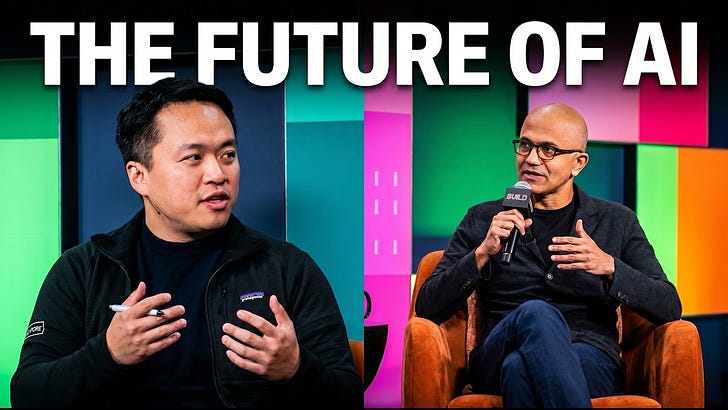
Satya Nadella posits the key enterprise AI strategy is building a proprietary "learning loop." This system transforms a company's unique human knowledge into "token capital," a defensible asset that compounds over time, independent of any single underlying AI model. This creates a durable competitive advantage against competitors and model providers alike.

As noted by Chamath Palihapitiya, businesses fear deploying major AI models directly, seeing it as letting the 'fox into the henhouse' where their usage data could train a future competitor. This creates a strategic opening for 'harness-first' companies that offer enterprises control and choice over underlying models.
Nadella advocates for AI standards allowing enterprises to switch between models. He compares this to Windows' early interoperability with Unix, which, counterintuitively, increased Windows' enterprise adoption by making it a flexible part of the existing ecosystem, rather than a threat to it.
Large enterprises are avoiding commitment to a single AI provider like OpenAI or Anthropic. Instead, they're building control planes and abstraction layers that allow them to hot-swap the underlying models, mitigating technology risk and preventing dependence on one provider's terms of service.

Microsoft AI CEO Mustafa Suleiman explains that while the OpenAI partnership is strong, Microsoft must develop its own superintelligence capabilities to avoid long-term structural dependency on a third party, referencing Satya Nadella's fear of becoming the commoditized 'Intel' to OpenAI's 'Microsoft'.

The rapid pace of model releases is a distraction. A sustainable enterprise strategy focuses on a robust AI architecture that allows models to be swapped based on cost, performance, or geopolitical factors. This ensures long-term stability and control, preventing vendor lock-in and constant rebuilding.
For many companies, 'AI sovereignty' is less about building their own models and more about strategic resilience. It means having multiple model providers to benchmark, avoid vendor lock-in, and ensure continuous access if one service is cut off or becomes too expensive.

Satya Nadella’s critique of frontier models learning from customer data is a strategic move to sell Microsoft's infrastructure. It promotes a vision where enterprises control their own AI destiny, thereby making Microsoft the essential platform provider.
Cognition intentionally remains independent from major AI labs (like OpenAI, Google, Anthropic) to offer a model-neutral platform. This strategy reassures enterprise customers who want long-term partnerships without being locked into a single, potentially superseded, AI model ecosystem, providing flexibility and future-proofing.