Get your free personalized podcast brief
We scan new podcasts and send you the top 5 insights daily.
Counter to the idea of a few dominant frontier models, Satya Nadella believes the AI model market will mirror the database market's evolution. He expects a proliferation of specialized models, including open-source and proprietary ones, with firms eventually embedding their unique tacit knowledge into custom models they control.
Related Insights
The AI market is becoming "polytheistic," with numerous specialized models excelling at niche tasks, rather than "monotheistic," where a single super-model dominates. This fragmentation creates opportunities for differentiated startups to thrive by building effective models for specific use cases, as no single model has mastered everything.

Nadella posits a future where the winner isn't the company with the best model. Instead, value accrues to the platform that provides the data, context, and tools (the 'scaffolding') that make any model useful, especially as capable open-source alternatives proliferate.
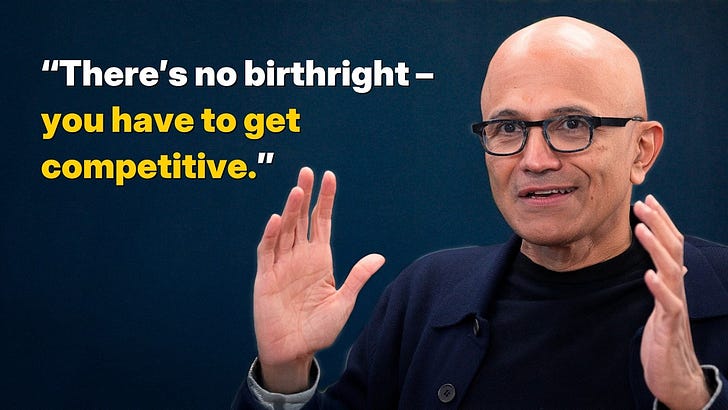
Microsoft's decision to promote Anthropic models on Azure as aggressively as OpenAI's reflects a core belief from CEO Satya Nadella. He anticipates AI models will become commoditized, making the underlying intelligence interchangeable and the cloud platform the primary point of differentiation and value capture.

The AI industry is not a winner-take-all market. Instead, it's a dynamic "leapfrogging" race where competitors like OpenAI, Google, and Anthropic constantly surpass each other with new models. This prevents a single monopoly and encourages specialization, with different models excelling in areas like coding or current events.

Fears of a single AI company achieving runaway dominance are proving unfounded, as the number of frontier models has tripled in a year. Newcomers can use techniques like synthetic data generation to effectively "drink the milkshake" of incumbents, reverse-engineering their intelligence at lower costs.

Contrary to typical corporate fears, Microsoft's AI lead views the rapid commoditization of AI models and resulting price wars as a positive outcome for humanity. The ultimate goal is to make intelligence abundant and near-zero cost, with Microsoft's business model focused on value-added software integrations.
Initially, even OpenAI believed a single, ultimate 'model to rule them all' would emerge. This thinking has completely changed to favor a proliferation of specialized models, creating a healthier, less winner-take-all ecosystem where different models serve different needs.
Beyond the equity stake and Azure revenue, Satya Nadella highlights a core strategic benefit: royalty-free access to OpenAI's IP. For Microsoft, this is equivalent to having a "frontier model for free" to deeply integrate across its entire product suite, providing a massive competitive advantage without incremental licensing costs.

While the most powerful AI will reside in large "god models" (like supercomputers), the majority of the market volume will come from smaller, specialized models. These will cascade down in size and cost, eventually being embedded in every device, much like microchips proliferated from mainframes.

The idea that one company will achieve AGI and dominate is challenged by current trends. The proliferation of powerful, specialized open-source models from global players suggests a future where AI technology is diverse and dispersed, not hoarded by a single entity.
