Get your free personalized podcast brief
We scan new podcasts and send you the top 5 insights daily.
For AI to manage the software development process from idea to completion, the entire SDLC cannot be an unspoken or abstract set of habits. It must be explicitly documented with defined inputs, tasks, outputs, and quality gates that an AI agent can interpret and execute against.
Related Insights
To maximize leverage, reframe every SDLC component—docs, tests, review agents—as a way to 'prompt inject' non-functional requirements into the agent. This approach teases out expert knowledge from engineers' heads and makes it part of the automated system, guided by the agent's mistakes.
Exploratory AI coding, or 'vibe coding,' proved catastrophic for production environments. The most effective developers adapted by treating AI like a junior engineer, providing lightweight specifications, tests, and guardrails to ensure the output was viable and reliable.

To achieve a state where AI agents handle nearly all coding, a solo founder must implement a surprisingly formal Software Development Lifecycle (SDLC), like one for a large team. This includes rigorous processes like mandatory Pull Requests (PRs), providing a structured system for agent-driven development.

Snyk founder's new venture, TESOL, posits that AI will make code disposable. Instead of code being the source of truth, a durable, versioned 'spec' document defining requirements will become the core asset. AI agents will generate the implementation, fundamentally changing software development.

Breaking down the software development lifecycle into small, well-defined subtasks is not just for improving AI success rates. It creates a significant cost-saving opportunity by allowing teams to use cheaper, specialized AI models for most steps, reserving expensive frontier models only for high-complexity tasks like architectural design.
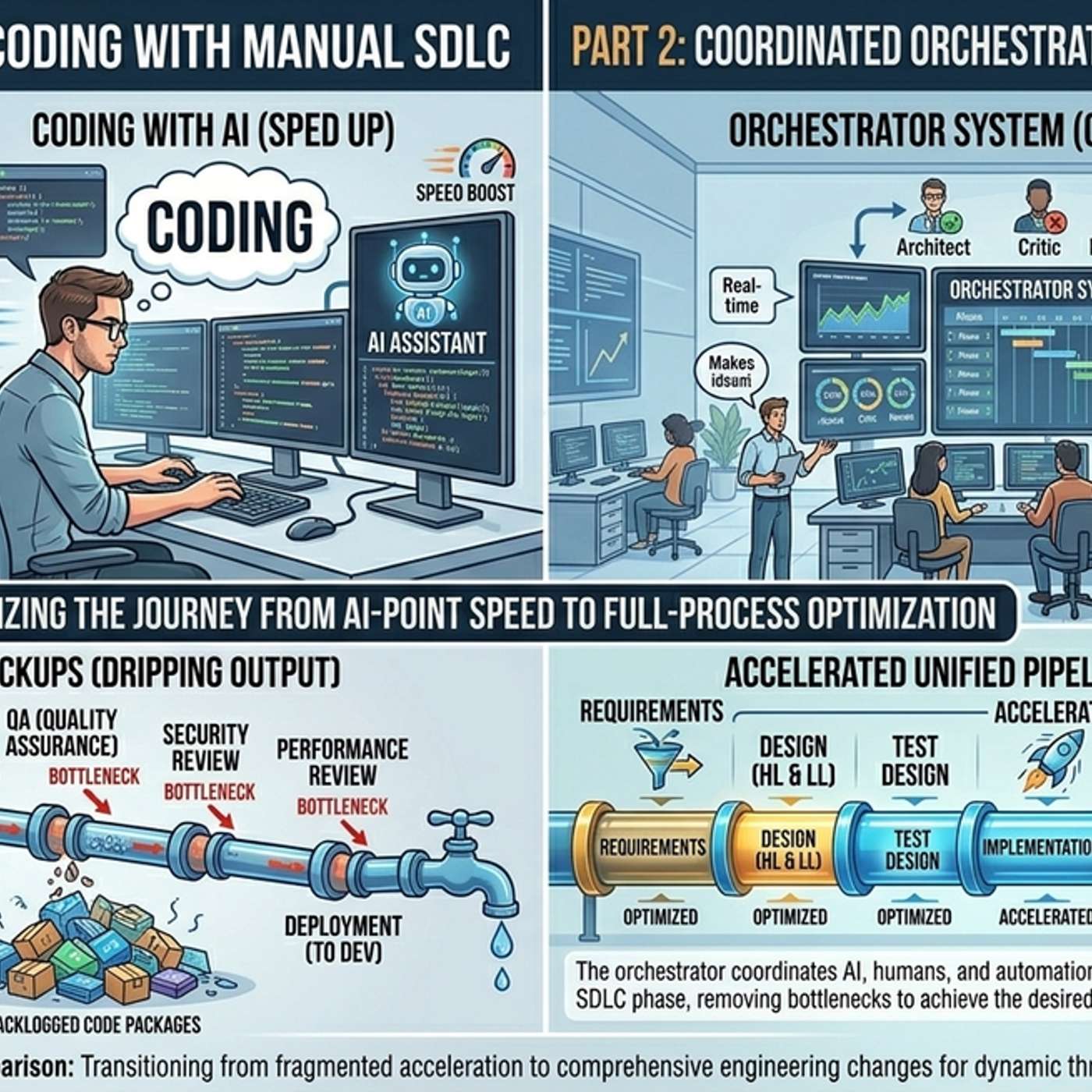
The endgame for software development isn't just code completion, but an "AI factory." A chain of specialized agents will handle design, coding, review, and security. This requires an interoperable platform where different models can check each other's work, with humans as "agent managers."

Inspired by fully automated manufacturing, this approach mandates that no human ever writes or reviews code. AI agents handle the entire development lifecycle from spec to deployment, driven by the declining cost of tokens and increasingly capable models.

The current model of a developer using an AI assistant is like a craftsman with a power tool. The next evolution is "factory farming" code, where orchestrated multi-agent systems manage the entire development lifecycle—planning, implementation, review, and testing—moving it from a craft to an industrial process.

Successfully building with AI, even using no-code tools, demands a new level of detail from product managers. One must go deeper than a standard PRD and translate a high-level vision into extremely literal, step-by-step instructions, as the AI system cannot infer intent or fill in logical gaps.

Simply adding AI "nodes" to a deterministic workflow builder is a limited view of AI's potential. This approach fails to capture the human judgment and edge cases that define complex processes. A better architecture empowers AI agents to run standard operating procedures from end to end.
